
SPIL Acquires AUO Plant to Expand AI Packaging Capacity


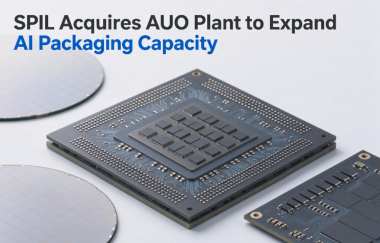
According to ASE Technology Holding, its semiconductor packaging and testing subsidiary, Siliconware Precision Industries (SPIL), has approved a plan to acquire AUO's Hwaya plant in Taoyuan, Taiwan, for NT$19.7 billion (approximately RMB 3.98 billion). The acquisition is intended to address growing operational requirements and support the company's expansion of semiconductor packaging capacity.
According to an announcement made on behalf of SPIL by ASE Technology Holding, the transaction covers two parcels of land in the Hwaya section of Guishan District, Taoyuan City, with a combined area of approximately 19,741 ping (65,259 square meters), along with eight buildings totaling approximately 49,254 ping (162,823 square meters).
AUO stated that the sale is part of its strategy to focus on an asset-light operating model, unlock the value of existing assets, and improve its financial structure. The company will sell the Hwaya plant's real estate and related facility infrastructure to SPIL for NT$19.7 billion. After deducting transaction expenses and estimated taxes, AUO expects to recognize a disposal gain of approximately NT$10.4 billion.
The Hwaya plant had previously been involved in another proposed sale. In October 2026, AUO announced a planned NT$19.7 billion transaction involving the same facility. However, the deal was terminated after the two parties failed to reach an agreement on factory specifications and the delivery schedule. At that time, AUO estimated a disposal gain of approximately NT$13.39 billion. The newly announced transaction with SPIL retains the same overall sale price.
The acquisition comes as SPIL accelerates investments in advanced packaging to support growing demand for artificial intelligence (AI) chips. SPIL recently disclosed that it is working with NVIDIA to expand advanced packaging capacity for next-generation AI platforms. The companies aim to increase SPIL's advanced packaging capacity to three times its current level by mid-2029, supporting the expansion of global AI infrastructure and higher production volumes across NVIDIA's platforms.
Under a reported multi-year agreement, NVIDIA will provide billions of dollars in financial support, primarily allocated to factory space and manufacturing equipment. The expansion will introduce new production lines covering bumping, interposer wafer fabrication, assembly, and testing. These processes are among the critical stages currently facing capacity constraints in AI accelerator packaging. SPIL Chairman Chih-Wen Tsai said the agreement would strengthen the company's ability to support next-generation advanced packaging technologies.
Industry analysts point out that continued investment in AI infrastructure is shifting production bottlenecks further downstream in the semiconductor supply chain. As demand for computing power increases, advanced packaging capacity has become increasingly constrained, making it a critical factor affecting AI chip production and delivery.
The transaction also highlights a growing trend of display manufacturing facilities being repurposed for semiconductor production. In October 2026, AUO announced the sale of its Taichung Second Plant and associated facility infrastructure to TSMC for NT$38.8 billion, with an estimated disposal gain of approximately NT$18.5 billion. Earlier, in April 2026, SPIL acquired manufacturing facilities in the Southern Taiwan Science Park from HannStar Display and Jinn Fong, with the two transactions totaling approximately RMB 2.19 billion.
For AUO, the Hwaya plant sale continues its asset optimization strategy. The company has previously disposed of several properties, including its Lujhu color filter plant in Kaohsiung, which was sold to ASE, and its Singapore manufacturing facility, which was acquired by Western Digital.
AUO reported consolidated revenue of NT$66.88 billion in the third quarter of 2026, alongside a net loss attributable to its parent company of NT$2.5 billion. Against the backdrop of prolonged oversupply in the display panel industry, the sale of high-specification cleanroom facilities and supporting infrastructure provides AUO with an opportunity to unlock asset value. Meanwhile, these existing industrial facilities are becoming attractive options for semiconductor manufacturers seeking to expand advanced packaging operations and meet rising demand for AI-related chips.


