
Kioxia and NVIDIA Validate SSD-Based GPU Memory Expansion


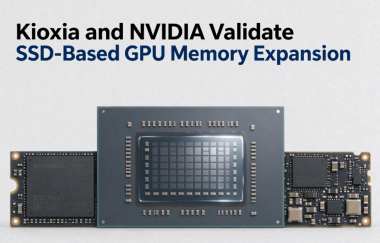
According to Kioxia, the company has completed a proof of concept (PoC) with NVIDIA to demonstrate how flash storage can serve as an extended memory tier for GPUs. By combining NVIDIA's SCADA (Scaled Accelerated Data Access) software, Storage-Next technology, and Kioxia NVMe SSDs, the collaboration demonstrated the potential to process up to 2 trillion vectors on NVIDIA's GB200 NVL72 rack-scale system.
The PoC was conducted using an NVIDIA GB200 NVL72 system consisting of 18 server nodes equipped with 144 Kioxia XD8 Series 7.68TB E1.S NVMe SSDs. The configuration provided approximately 1.1PB of raw flash storage capacity. Each server node contained eight SSDs, delivering nearly 60TB of flash-based extended memory capacity. With support for 512-byte granular data access, the architecture demonstrated the potential to process up to 2 trillion 512-byte vectors across the entire system.
A key component of the collaboration is NVIDIA's SCADA software library, which is designed to extend effective GPU memory capacity through NVMe SSDs while enabling fine-grained data access at granularities as small as 512 bytes. Combined with the Storage-Next architecture, the solution allows GPUs to access large datasets stored on SSDs. This approach could help reduce the need to repeatedly divide computational workloads and transfer data between memory and storage when high-bandwidth memory (HBM) capacity becomes a limiting factor.
The technology could benefit data-intensive AI applications, including large-scale vector databases and graph neural networks (GNNs), which require efficient access to massive datasets. Conventional GPU platforms primarily rely on HBM for high-speed data access, but HBM capacity is limited and relatively expensive. Integrating SSDs as an additional storage tier could significantly expand the amount of data accessible to GPUs without requiring proportional increases in HBM or DRAM capacity.
However, SSDs are not direct replacements for HBM in terms of bandwidth and latency. Instead, the collaboration explores a tiered memory architecture in which HBM continues to handle performance-critical data access, while SSDs provide a higher-capacity flash storage layer for large-scale datasets. This approach aims to balance memory performance, capacity, and system costs for demanding AI workloads.
Kioxia said it will continue working with NVIDIA to evaluate the technical feasibility and performance of the SCADA and Storage-Next architecture. The companies will explore ways to improve the efficiency of processing large-scale AI datasets. The announced results remain at the proof-of-concept stage and do not indicate that petabyte-scale GPU memory expansion is already commercially available at scale.
Separately, Kioxia introduced its GP2 Series of ultra-high-IOPS SSDs on the same day, targeting GPU-direct-access applications. Based on its third-generation XL-FLASH technology, the GP2 Series delivers more than 18 million random read IOPS, nearly twice the performance of its predecessor, the GP1. Its sequential read throughput is expected to reach 28GB/s, potentially saturating a PCIe 6.0 x4 interface. Kioxia expects to provide evaluation samples to selected customers before the end of 2027. The company also disclosed that its next-generation GP Series aims to achieve 100 million random read IOPS. Notably, the NVIDIA proof of concept used Kioxia XD8 Series SSDs rather than the newly announced GP2 Series.
The collaboration reflects a broader shift in the semiconductor and AI industries toward improving system-level data processing efficiency alongside GPU computing performance. As AI workloads continue to expand, coordination among HBM, DRAM, and high-capacity SSD storage is becoming increasingly important. Kioxia and NVIDIA's latest proof of concept highlights the potential of integrating advanced flash storage more closely into GPU computing architectures to support increasingly data-intensive AI applications.


