
IR Diodes vs LEDs: What's the Difference?


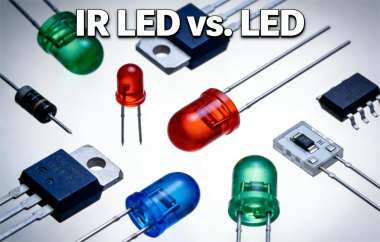
In the global electronic components industry, infrared diodes and light-emitting diodes (LEDs) are two important types of semiconductor optoelectronic devices that have a broad impact in design, manufacturing, and applications. Although they may appear similar in form, they differ significantly in emission principles, spectral characteristics, and engineering applications. This article will clearly explain the basic concepts of these two diodes and provide a detailed comparison of their differences in wavelength, applications, and luminous efficiency.
Catalog
II. What is a Light-Emitting Diode?
I. What is an Infrared Diode?
An infrared diode typically refers to a light-emitting diode capable of emitting infrared light, also known as an Infrared LED (IR LED). This device is based on a semiconductor PN junction structure. When a forward current is applied to the PN junction, electrons and holes recombine to release infrared photons. The emitted light falls within the infrared spectrum, usually with a central wavelength of around 830 nm to 950 nm, which lies in the near-infrared region invisible to the human eye.
Infrared diodes play a key role in areas such as infrared illumination for security surveillance systems, remote control signal transmission, photoelectric sensing, and wireless communication. Their main advantages include high infrared radiation efficiency, long lifespan, and compact structure, but the emitted light requires dedicated sensors or receiving systems to be detected.
The packaging of an infrared LED is similar to that of a standard LED, but the materials often use gallium arsenide (GaAs) or gallium aluminum arsenide (GaAlAs) with high infrared radiation efficiency. Its operating voltage and driving method also differ slightly from those of visible-light LEDs.
II. What is a Light-Emitting Diode?
A light-emitting diode (LED) is a semiconductor light source that converts electrical energy into light through the electroluminescence effect of a PN junction. LEDs emit light across both visible and some invisible ranges, with the specific wavelength determined by the semiconductor material and doping design. LEDs within the visible spectrum are widely used in lighting, indicators, and displays.
Compared to traditional incandescent and fluorescent lamps, LEDs offer significant advantages, including high energy efficiency, long lifespan, fast response, and compact size. As a result, they dominate modern lighting industries and consumer electronic devices.
The color and spectral characteristics of an LED are mainly determined by the core material. For example, gallium nitride (GaN) is used for blue and white LEDs, while gallium phosphide (GaP) is suitable for green or red LEDs.
III. Infrared Diode vs. LED
The main differences between infrared diodes and LEDs lie in several core technical specifications and application areas.
1. Wavelength
Infrared diodes and LEDs differ significantly in wavelength. Infrared diodes emit light with wavelengths typically above 700 nm, falling in the invisible infrared range. LEDs, on the other hand, emit light roughly between 400 and 700 nm, within the visible spectrum. This difference in wavelength directly affects their optical properties: infrared light penetrates better but is invisible, whereas visible light can be perceived by the human eye, making it suitable for illumination and display.
2. Applications
In terms of applications, infrared diodes and LEDs have different focuses due to their wavelengths. Infrared diodes are often used in situations that require covert or non-visual sensing, such as infrared remote controls, temperature measuring devices, night-vision cameras, and infrared data transmission. In contrast, LEDs are primarily used in visible-light environments, such as home lighting, automotive lighting, electronic displays, and advertising signs. While the two may be used complementarily in electronic systems, their core functions are distinct.
3. Luminous Efficiency
Infrared diodes have high electro-optical conversion efficiency in the infrared range, but most of the energy is released as invisible heat radiation, making them unsuitable for illumination purposes. LEDs, however, achieve high luminous efficiency in the visible range. Modern LED technologies optimize materials and design to balance high brightness with low energy consumption. When selecting a device, it is important to evaluate light output and energy use according to the specific application.
IV. Conclusion
In summary, infrared diodes and LEDs are important optoelectronic components in electronics, with key differences in wavelength, applications, and luminous efficiency. Understanding these distinctions not only helps in choosing the right component but also enhances the performance and reliability of electronic designs. With the continuous advancement of semiconductor technology, both types of diodes will continue to drive innovation in the electronics industry and meet diverse market demands.


