
Schottky & Standard Diode: What's the Difference?


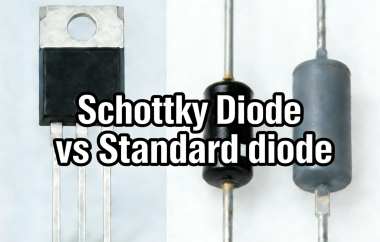
In electronic circuit design, the choice of diode often determines power efficiency, signal integrity, and overall system reliability. When engineers aim for faster switching speeds and lower energy loss, Schottky diodes naturally come into focus. What, exactly, makes them fundamentally different from the standard diodes we are all familiar with? Why are they indispensable in high-speed digital circuits and high-efficiency power designs, yet unable to completely replace conventional diodes? This article takes a deep dive into how Schottky diodes work, compares their strengths and weaknesses in a structured way, and clearly explains their core differences from standard diodes.
Catalog
V. Schottky Diodes vs. Standard Diodes
I. What is a Schottky Diode?
A Schottky diode is a type of diode formed by direct contact between a metal and a semiconductor material. It achieves rectification through a Schottky barrier created at the interface between the metal and an N-type semiconductor. Unlike traditional PN junction diodes, Schottky diodes do not rely on a junction formed between P-type and N-type semiconductors. In a typical Schottky device, metals such as aluminum or tungsten are brought into direct contact with doped N-type silicon. The barrier formed at this metal–semiconductor interface is known as the Schottky barrier. Because the resulting current is mainly carried by majority carriers, namely electrons, Schottky diodes exhibit electrical characteristics that are distinctly different from those of standard diodes.
II. Work Principle
The operating principle of a Schottky diode is based on the barrier behavior created by the metal–semiconductor contact. When no external voltage is applied, electron diffusion and drift between the metal and the semiconductor reach equilibrium, forming a barrier layer that prevents free electron flow. When a forward voltage is applied to the Schottky diode, the external electric field lowers the barrier height, making it easier for electrons in the N-type semiconductor to cross the metal–semiconductor interface. These electrons enter the metal region and form a conduction current. When reverse voltage is applied, the barrier height increases, and most electrons cannot cross the barrier, so the current through the diode is nearly zero. Because Schottky diodes do not involve minority carrier injection or recombination, they feature a lower forward voltage drop and very fast switching speed, which gives them a clear advantage in high-frequency rectification and fast-switching applications.
III. Advantages
The advantages of Schottky diodes mainly stem from their unipolar conduction mechanism and metal–semiconductor junction structure, and they are reflected in several key aspects.
The first and most notable advantage is fast switching performance with extremely short reverse recovery time. Because Schottky diodes are majority-carrier devices, their turn-on and turn-off processes only involve the movement of electrons, without any minority carrier storage or recombination as seen in PN junction diodes. As a result, their reverse recovery time is extremely short, often negligible and typically on the order of nanoseconds. This makes them especially suitable for high-frequency switching circuits and pulse-based digital systems, where switching losses can be greatly reduced.
The second advantage is a very low forward conduction voltage drop. Typical values range from about 0.15 V to 0.45 V, which is much lower than the roughly 0.6 V to 0.7 V of standard silicon diodes. In low-voltage, high-current rectification applications, such as output rectification in switching power supplies, a lower voltage drop translates directly into reduced conduction losses and heat generation, significantly improving overall power conversion efficiency.
The third advantage is relatively low operating noise. The junction capacitance of a metal–semiconductor junction is generally small, and there is no shot noise caused by random minority carrier recombination. This gives Schottky diodes better noise performance when used as mixers or detectors in RF and microwave circuits.
In addition, Schottky diodes typically offer good temperature behavior. Their forward voltage drop has a negative temperature coefficient, meaning the voltage drop decreases slightly as temperature rises, which can provide a degree of self-regulation in certain applications. At the same time, their unipolar operation helps maintain relatively stable performance at elevated temperatures.
IV. Disadvantages
Despite their strong advantages, Schottky diodes also have inherent limitations determined by their structure, and these must be carefully considered during circuit design.
The most significant drawback is relatively high reverse leakage current. Because the Schottky barrier is thin, electrons can more easily cross it through thermionic emission under reverse bias, especially as ambient temperature increases. This causes the reverse saturation current to rise noticeably. Not only does this increase static power consumption, but in high-temperature environments it can also raise the risk of thermal runaway, which limits the use of Schottky diodes in precision circuits that require extremely high reverse blocking capability.
Another limitation is their low reverse breakdown voltage. Due to the structural constraints of the metal–semiconductor junction and its thin depletion layer, Schottky diodes cannot withstand high reverse voltages. Common silicon Schottky diodes are typically rated between 20 V and 100 V, with very few exceeding 200 V. This is far lower than standard rectifier diodes, which can easily handle hundreds or even thousands of volts, making Schottky diodes unsuitable for high-voltage applications.
Finally, there are considerations around cost and electrostatic sensitivity. The use of precious metals and more complex manufacturing processes generally makes Schottky diodes more expensive than standard diodes with similar ratings. In addition, the metal–semiconductor junction is relatively fragile and more sensitive to electrostatic discharge, requiring stricter ESD protection during manufacturing and handling.
V. Schottky Diodes vs. Standard Diodes
The differences between Schottky diodes and standard diodes all stem from their fundamentally different structures.
· Structural difference: Standard diodes are based on a PN junction formed between P-type and N-type semiconductors, while Schottky diodes are based on a metal–semiconductor junction formed between a metal and N-type semiconductor.
· Switching speed: Standard diodes suffer from minority carrier storage effects, which result in longer reverse recovery times and slower switching. Schottky diodes do not have this issue, enabling extremely fast switching that is well suited for high-frequency circuits.
· Forward voltage drop: Standard silicon diodes typically have a forward voltage drop of about 0.6 to 0.7 volts, whereas Schottky diodes usually fall in the range of 0.15 to 0.45 volts, leading to lower conduction losses.
· Reverse leakage current: Standard diodes have very small reverse leakage currents, while Schottky diodes exhibit higher leakage currents that are also more sensitive to temperature.
· Application areas: Based on these characteristics, standard diodes are widely used in general-purpose rectification, clamping, and signal processing where speed is not critical. Schottky diodes dominate applications that demand high efficiency and high speed, such as high-frequency rectification and freewheeling in switching power supplies, RF circuits, and protection in low-dropout regulator designs.
VI. Conclusion
In summary, Schottky diodes and standard diodes are designed to serve different design goals rather than representing a simple upgrade path. With their extremely fast switching speed and low forward voltage drop, Schottky diodes play a key role in improving the efficiency and performance of modern electronic systems. At the same time, their higher leakage current and limited voltage ratings clearly define their application boundaries. By contrast, traditional PN junction diodes, with their mature structure, high voltage capability, and low leakage current, continue to hold an important place in many conventional circuits. In practical circuit design, engineers should evaluate factors such as voltage level, switching frequency, efficiency requirements, and cost to decide whether a Schottky diode or a standard diode is the better fit for a given application.


