
Semiconductor vs Resistive Strain Gauges: What's the Difference?


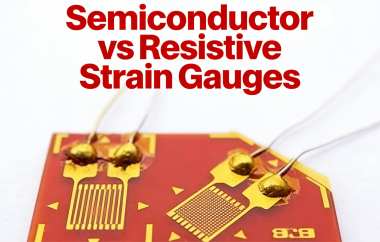
In modern electronic components and sensor technology, strain gauges serve as key sensitive elements and are widely used for detecting and converting mechanical quantities such as stress, strain, pressure, and load. Depending on the material and working mechanism, strain gauges are mainly divided into two types: semiconductor strain gauges and metal resistive strain gauges, also known as metal foil strain gauges. This article will start with basic definitions and gradually analyze the differences between these two types of strain gauges.
Catalog
I. What is a Semiconductor Strain Gauge?
II. What is a Resistive Strain Gauge?
I. What is a Semiconductor Strain Gauge?
A semiconductor strain gauge is a sensitive element that uses the piezoresistive effect of semiconductor materials, such as doped silicon, to detect strain. When the semiconductor material is subjected to mechanical stress, its crystal lattice undergoes microscopic deformation, causing a significant change in resistivity. This effect, known as the piezoresistive effect, has a much higher coefficient than the geometric effect of metals under strain. Semiconductor strain gauges are typically made of silicon-based materials and can be manufactured using integrated circuit processes or thin-film deposition techniques. They can be directly integrated onto elastic substrates or sensitive membranes, forming the core sensing unit of high-sensitivity sensors. Because the piezoresistive effect arises from changes in the material’s conduction mechanism, the sensitivity of semiconductor strain gauges, defined as the rate of resistance change caused by strain (gauge factor), is tens of times or even more higher than that of traditional metal resistive gauges, making them suitable for high-precision measurements that require detecting very small displacements or low loads.
II. What is a Resistive Strain Gauge?
A resistive strain gauge generally refers to a strain-sensitive element based on metal resistive wires or metal foils, and its working principle relies on the traditional resistive strain effect. When the substrate experiences an external force, the geometric dimensions of the metal wire or foil, including its length and cross-sectional area, change, which in turn alters its resistance. Resistive strain gauges are usually made from fine metal wires or metal foils etched into a grid pattern and attached to a flexible substrate. By measuring the small changes in resistance, mechanical strain can be reflected. Traditional metal strain gauges have the advantages of a simple structure, low production cost, good temperature characteristics, and relatively linear response, and they are commonly used in general measurement systems and industrial sensors, such as load cells and pressure sensors.
III. Differences
Semiconductor strain gauges and metal resistive strain gauges differ in their principles, structures, and performance.
1. Principle
The resistance change of a semiconductor strain gauge is not only caused by changes in the material’s dimensions but also, more importantly, by the significant variation of the material’s intrinsic resistivity due to the piezoresistive effect. This effect makes semiconductor strain gauges extremely sensitive to strain. In contrast, resistive strain gauges mainly rely on resistance changes caused by geometric deformation, and the piezoresistive change of the metal itself is very small, which results in a fundamental difference in sensitivity between the two types.
2. Structure
Structurally, semiconductor strain gauges are usually small in size, easy to miniaturize, and suitable for integrated designs, making them ideal for micro-sensor fabrication. Metal resistive strain gauges, on the other hand, are made of metal grids attached to flexible substrates, with a relatively simple structure that is easy to mass-produce and install in the field.
3. Accuracy
In terms of accuracy, semiconductor strain gauges have a large resistance response to strain, and their gauge factor often reaches tens to hundreds, meaning their output signal is much greater than that of metal resistive gauges under the same strain, allowing for higher measurement precision. Metal resistive gauges typically have a gauge factor of around 2; although their response is more linear, the signal is weaker when detecting very small strains.
4. Response Speed
Regarding response speed, the resistance changes in the microstructure of semiconductor materials can generally reflect stress changes more quickly, making them suitable for dynamic, high-speed measurements. Metal resistive gauges, due to material and structural limitations, respond slightly slower in some high-speed applications.
5. Interference Resistance
In terms of interference resistance, semiconductor strain gauges, with high sensitivity and higher resistance values, often provide clearer signal output in electrically noisy environments. However, they are also more sensitive to temperature changes and require complex temperature compensation designs. Metal resistive strain gauges have smaller temperature-induced drift and better environmental adaptability, performing more stably under wide temperature ranges and industrial field conditions.
IV. Conclusion
In summary, semiconductor strain gauges and metal resistive strain gauges differ significantly in principle, structure, accuracy, response characteristics, and interference resistance. Their respective advantages make them suitable for different application scenarios. For high-precision measurements, fast dynamic response, and detection of very small strains, semiconductor strain gauges offer advantages due to their high sensitivity, small size, and good integration. For general industrial measurements, cost control, and applications requiring stable performance under temperature variations, metal resistive strain gauges remain the preferred choice because of their maturity, stability, and economic benefits.


