
What Are the Four Relay Control States?


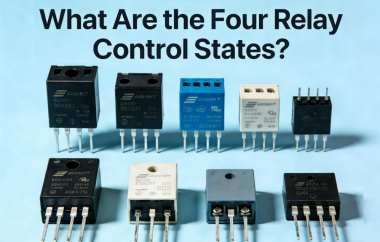
In modern electronic control and automation systems, relays are indispensable fundamental components, and they manage the operation of devices or electrical equipment by controlling the opening and closing of circuits through electrical current. Relays are widely used not only in industrial production lines, household appliances, transportation equipment, and commercial automation systems but also play a critical role in safety protection and remote control. Understanding the four basic relay control states—normally open, normally closed, self-latching, and interlocking—is essential for electronic engineers and automation system designers when creating reliable and safe control systems. This article will provide a detailed introduction to relays and their working principles, as well as an in-depth explanation of these four control states.
Catalog
III. The Four Relay Control States
I. What Is a Relay?
A relay is an electronic component that uses electromagnetic or other physical effects to control the switching of a circuit, and it achieves control of a high-power circuit through a low-power control circuit. Relays mainly consist of a coil, magnetic core, movable contacts, and stationary contacts. When the coil is energized, it generates a magnetic field that drives the armature to move, causing the movable contacts to change position relative to the stationary contacts, thereby opening or closing the circuit. Relays can convert small control signals into actions that control larger currents, enabling remote or automated control of equipment while providing electrical isolation and logic implementation within circuits. They are essential components in industrial control, communication systems, and household appliances.
II. Work Principles
The working principle of a relay is primarily based on electromagnetic induction. When a control voltage is applied to the coil, the coil generates a magnetic field, which allows the armature to overcome the spring force and move, causing the movable and stationary contacts to close or open the circuit. When the coil is de-energized, the magnetic field disappears, and the armature returns to its original position under the spring force, restoring the contacts to their default state and completing one full switching cycle. The contacts of a relay have a default state when the coil is not energized, which forms the basis of normally open and normally closed contacts. Normally open contacts remain open when not energized and close when energized, while normally closed contacts remain closed when not energized and open when energized. These actions control the circuit load and provide safety protection.
III. The Four Relay Control States
1. Normally Open
Normally open contacts (NO) refer to relay contacts that are open when the coil is not energized, meaning the circuit is not conducting. When the coil is energized, the contacts close and the circuit conducts electricity. Normally open relays are widely used in situations where equipment should only start when energized, such as motor startup, lighting of automated production line equipment, or operation of refrigeration systems. Normally open contacts ensure that the load remains off when there is no power or control signal, improving circuit safety and providing flexible control.
2. Normally Closed
Normally closed contacts (NC) refer to relay contacts that are closed when the coil is not energized, meaning the circuit conducts electricity by default. When the coil is energized, the contacts open, and the circuit stops conducting. Normally closed relays are commonly used in scenarios where equipment must stop when the current is interrupted, such as access control systems, safety systems, or emergency power cutoff protection. The design of normally closed contacts ensures that circuits can automatically disconnect in the event of a power failure or fault, enhancing system safety and reducing risks.
3. Self-Latching
Self-latching relays are a special type of control where the relay maintains its energized state through its own normally open auxiliary contacts. Once the relay is triggered, the coil remains energized even if the control button is released, keeping the relay continuously activated. Self-latching is often used in applications that require equipment to remain operational for extended periods, such as starting high-power motors, maintaining signal lights, or running automated production lines continuously. By performing a single operation, the relay maintains the equipment state, improving control convenience and system stability.
4. Interlocking
Interlocking relays are a type of control where multiple relays are mutually constrained to achieve exclusive operation. In an interlocking design, the normally closed contact of one relay is connected in series with the coil circuit of another relay. When one relay is energized, its normally closed contact opens, preventing the other relay from energizing. Interlocking relays are widely used in scenarios where equipment conflicts must be avoided, such as elevator door control, electric door systems, and multi-motor control systems. Through interlocking logic, only one device operates at a time, preventing conflicts and safety incidents.
IV. Conclusion
The four relay control states—normally open, normally closed, self-latching, and interlocking—play an irreplaceable role in electronic components and industrial control systems. Each corresponds to different control logic and application needs, and choosing and configuring relay control states correctly not only ensures normal equipment operation but also enhances system safety and reliability.


