
How Is an SCR Controlled?


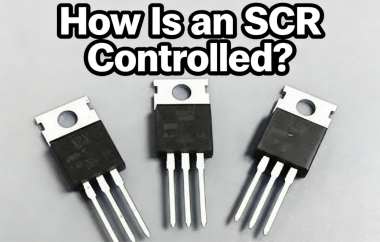
Silicon-controlled rectifier (SCR) is widely used as a high-power semiconductor switching device in systems such as rectification, voltage regulation, and speed control. Many engineers, technical buyers, or designers often focus on two core questions when searching for information: What controls an SCR? Is it suitable for DC or AC? This article will provide a systematic analysis from four aspects: definition, working principle, control methods, and typical applications.
Catalog
I. What is a Silicon-Controlled Rectifier?
I. What is a Silicon-Controlled Rectifier?
Silicon Controlled Rectifier (SCR) belongs to the thyristor family and is a semiconductor power device with a four-layer structure and three PN junctions. It has three terminals: anode, cathode, and gate. This structure allows the SCR to have the rectifying characteristics of a diode while also enabling conduction control through an external signal. As a result, it features a "small controlling large" capability in high-voltage, high-current scenarios. Essentially, an SCR conducts in only one direction. Even if a high voltage is applied in the forward blocking state, it will not conduct. It only enters the conduction state when the triggering conditions are met.
II. Working Principle
The operation of an SCR is based on its PNPN four-layer structure, which is equivalent to two interconnected bipolar transistors forming a self-latching circuit. Under normal conditions, when a positive voltage is applied to the anode relative to the cathode without a gate trigger signal, the SCR remains in a high-resistance blocking state, preventing current flow. When an external trigger signal with the appropriate polarity is applied to the gate, a small number of carriers are injected internally, which triggers positive feedback in the internal transistors, bringing the device into a low-resistance conduction state. Once conducting, it remains on until external conditions change, such as the anode current falling below the holding current or a reverse voltage being applied.
This latching mechanism is one of the key characteristics of an SCR. After being triggered, the SCR continues to conduct even if the gate signal is removed, until the main current drops below the holding current or the main voltage reverses.
III. Control Methods
SCR control is mainly achieved through the trigger signal applied to the gate. This signal can be DC or AC, though in practice, DC pulse signals are the most common. The main triggering methods include DC triggering, AC triggering, optical triggering, and pulse triggering:
· DC triggering is achieved by applying a positive voltage or current to the gate, typically generated by control circuits such as transistors, microcontrollers, or pulse transformers.
· AC triggering applies an AC voltage to the gate in specific applications, such as AC voltage regulator systems.
· Optical triggering converts a light signal into an electrical signal using the photoelectric effect, providing electrical isolation and improving system safety.
· Pulse triggering uses a short current or voltage pulse to trigger the SCR. Pulses can be generated by electronic circuits like a 555 timer or a microcontroller.
These control methods allow the SCR to achieve precise conduction control in different applications.
IV. Applications
SCRs have a wide range of applications, including:
· Phase-controlled rectification: Here, SCRs control the power delivered from an AC source to a load by adjusting the triggering angle, regulating voltage and current on the load.
· AC voltage regulation: SCRs are used to adjust the AC voltage applied to a load, enabling functions such as dimming or speed control.
· Contactless electronic switches: SCRs can act as contactless switches to control the on/off operation of high-power devices.
· Overvoltage protection: SCRs can work with varistors or Zener diodes to provide overvoltage protection.
· Power regulation: In power systems, SCRs regulate power flow, improving grid stability and efficiency.
V. Conclusion
The SCR is a semiconductor device that controls high-power current through a gate trigger signal. Its control signal can be DC or AC, but DC pulses are more commonly used in practice. Its core characteristics—including unidirectional conduction, trigger latching, and high-power handling—make it critical in applications such as AC voltage regulation, phase-controlled rectification, contactless switching, overvoltage protection, and power regulation.


