
Relays vs Contactors: What's the Difference?


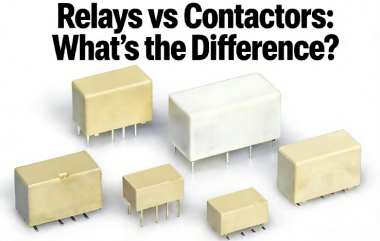
In the electronics and electrical control industry, relays and contactors are two commonly used types of electromagnetic switching devices. They may look similar in appearance, but they have clear differences in functional roles, application scenarios, load capacity, and structural design. Understanding the fundamental differences between them is crucial for circuit design, industrial automation, equipment selection, and maintenance. This article systematically analyzes the definitions, functions, and differences of relays and contactors.
Catalog
III. Differences Between Relays and Contactors
I. What Is a Relay?
A relay is an electromagnetic switching device mainly used for signal detection, transmission, conversion, or processing in control circuits. The basic structure of a relay includes a coil and one or more contacts. When the coil is energized, it generates a magnetic field that drives the contacts to open or close. Relays typically operate in low-current, low-voltage control circuits, where they isolate and amplify signals. They can also be used to control the on/off state of multiple circuits.
Relays can be categorized based on their function and size, including miniature relays, sub-miniature relays, and small-sized relays, to meet the different requirements of automation control systems and electronic devices.
II. What Is a Contactor?
A contactor is also an electromagnetic switching device, but it is primarily designed to control the switching of main circuits and handle high currents and large power loads. Contactors are commonly used to control industrial motors, power systems, heating equipment, and large lighting systems. Compared to relays, contactors have a sturdier structure, more durable contacts, and are equipped with dedicated arc-extinguishing devices to handle the arcs generated when switching high currents, ensuring system safety and reliability.
Contactors can be classified as DC contactors or AC contactors based on the type of control power. They are widely used in primary circuits and high-power industrial control applications.
III. Differences Between Relays and Contactors
1. Different Functions:
The function of a relay is to detect, transmit, convert, or process signals, and it is used in control circuits mainly for weak signal control. The function of a contactor is to connect or disconnect the main circuit, and it is used in main circuits primarily to control high-power equipment. There is a clear distinction in functional roles: relays belong to control circuit switches, while contactors belong to main circuit switches.
2. Different Designations:
In electrical schematics or component labeling, relays are usually represented by the single letter "K," whereas contactors are represented by "KM." The letter K represents a relay or control switch device, and M indicates that a contactor is typically used for motor or high-power load control.
3. Different Arc-Extinguishing Devices:
Relays are generally used for low-power signal control, and the arcs generated when their contacts open or close are minimal, so they usually do not have dedicated arc-extinguishing devices. Contactors, when switching high-power main circuits, generate significant arcs when opening or closing contacts. Therefore, they are designed with arc-extinguishing devices, such as arc chutes or arc splitting structures, to extend contact life and ensure safe operation.
4. Different Types:
Relays come in various types, including miniature relays, sub-miniature relays, and small-sized relays, to meet different control needs. Contactors are mainly categorized as DC contactors or AC contactors according to control power type and application scenario, making them suitable for high-current industrial automation and power control systems.
5. Different Load Capacities:
Relays are primarily used in secondary circuits and can only handle small currents, typically ranging from a few amps to around ten amps. Contactors are primarily used in primary circuits and can handle large currents, often ranging from tens to over a thousand amps. Relays are suitable for signal control and low-power load management, while contactors are suitable for switching high-power equipment.
IV. Conclusion
Both relays and contactors are electromagnetic switching devices, but their fundamental differences lie in functional roles, load capacity, and application circuits. Relays, as signal switches in control circuits, emphasize logic control and signal processing, while contactors, as switches in main circuits, emphasize safe and stable switching of high currents and high-power loads. Understanding these differences allows accurate selection and application in circuit design, industrial automation systems, and equipment maintenance, ultimately improving system reliability and safety.


