
SMD Inductors vs Capacitors: What's the Difference?


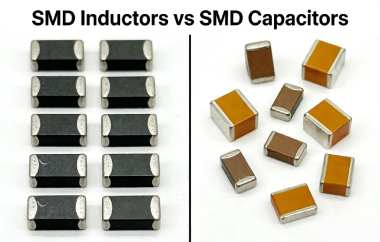
In modern electronic devices and circuit design, SMD inductors and SMD capacitors are among the most commonly used passive components. They not only perform different functions in circuits but also differ significantly in structure, operating principles, and the types of currents they are suitable for. Understanding the characteristics of these two components helps engineers optimize circuit performance and improve the stability and reliability of electronic products. This article will provide a detailed explanation of the differences between SMD inductors and SMD capacitors and analyze how they behave under different current conditions.
Catalog
II. Differences Between SMD Inductors and SMD Capacitors
I. Definition
1. SMD Inductor
An SMD inductor is an electronic component that stores energy through a magnetic field. It is primarily used for energy storage, filtering, impedance matching, and electromagnetic interference (EMI) suppression in circuits. It typically consists of wire windings and a magnetic core, making it compact and lightweight, which is highly suitable for surface-mount technology (SMT). SMD inductors are essential components in switching power supplies, high-frequency signal filtering, and radio-frequency circuits.
2. SMD Capacitor
An SMD capacitor is an electronic component that stores energy through an electric field. It is used for voltage smoothing, filtering, coupling, and decoupling. Common types include multilayer ceramic capacitors (MLCCs), tantalum capacitors, and aluminum electrolytic capacitors. SMD capacitors are compact in structure, compatible with surface-mount technology, and are widely used in both high-frequency and low-frequency circuits.
II. Differences Between SMD Inductors and SMD Capacitors
1. Structure and Appearance
SMD inductors are usually made by winding wire around a magnetic core. They often have a cylindrical or block-like shape and feature pads or pins for connecting to the circuit board. In contrast, SMD capacitors are made by stacking multiple layers of dielectric material and electrodes. They are usually rectangular or square, with two electrode terminals at the ends for circuit connection.
2. Function and Application
SMD inductors are mainly used for energy storage, filtering, current limiting, and high-frequency noise suppression. They help stabilize current in power management and RF circuits. SMD capacitors, on the other hand, are used for energy storage, filtering, decoupling, and signal coupling. They can smooth voltage fluctuations, improve signal integrity, and are widely applied in oscillators, filters, and coupling circuits.
3. Operating Frequency Range
SMD inductors typically operate in a frequency range from tens of kilohertz to several hundred megahertz and exhibit good impedance characteristics for high-frequency currents. SMD capacitors are suitable for low- to mid-frequency circuits ranging from a few hertz to several hundred kilohertz. In high-frequency applications, their parasitic inductance and losses need to be considered.
4. Size and Power Handling
Due to their structure and magnetic cores, SMD inductors are generally larger than SMD capacitors. They can handle higher currents and power levels, and they typically have stronger voltage withstand capabilities. SMD capacitors are smaller in size and have limited power handling. Their selection must consider rated voltage and capacitance to meet the specific requirements of different circuits.
5. Cost
SMD inductors have relatively simple manufacturing processes and are usually less expensive than SMD capacitors. SMD capacitors involve more complex manufacturing, especially high-capacitance, multilayer ceramic, or tantalum types. Although they are more costly, they offer significant advantages in high-frequency filtering and voltage smoothing performance.
III. Common Types of Current
1. Direct Current (DC)
Direct current flows in a single direction, maintaining a constant current intensity. SMD inductors allow direct current to pass through but produce a slight voltage drop due to their resistance. SMD capacitors, after charging in a DC circuit, behave as open circuits and block continuous direct current.
2. Alternating Current (AC)
Alternating current periodically changes direction, with its frequency typically measured in hertz (Hz), indicating how many times the direction changes per second. SMD inductors present impedance to alternating current and can filter high-frequency noise. SMD capacitors allow alternating current to pass, and their impedance changes with frequency, making them widely used for coupling and filtering.
3. Pulsed Current
Pulsed current consists of transient current signals with short-duration cycles, usually generated by switching actions or sudden voltage changes. Both SMD inductors and SMD capacitors can handle pulsed currents. However, attention must be paid to core saturation in inductors and the voltage rating limits of capacitors.
4. High-Frequency Current
High-frequency current refers to signals with frequencies exceeding several hundred kilohertz. SMD inductors are used in high-frequency circuits to suppress noise and control current fluctuations. SMD capacitors perform exceptionally well in high-frequency filtering and signal coupling. MLCCs, in particular, offer low equivalent series resistance (ESR) advantages in high-frequency applications.
5. Low-Frequency Current
Low-frequency current refers to signals with frequencies below several hundred kilohertz. SMD inductors are used in low-frequency circuits for filtering, current limiting, and signal coupling. SMD capacitors can allow low-frequency currents to pass, storing and releasing charge to smooth voltage fluctuations.
IV. Conclusion
SMD inductors and SMD capacitors each play critical roles in electronic circuits, with distinct structures, operating principles, and application scenarios. Inductors primarily store energy through magnetic fields and suppress high-frequency interference, while capacitors store energy through electric fields, providing filtering, voltage smoothing, and signal coupling. Understanding the differences between the two components and their responses to DC, AC, pulsed, high-frequency, and low-frequency currents is essential for circuit design, component selection, and performance optimization. Properly combining SMD inductors and SMD capacitors can significantly enhance the stability and reliability of electronic devices.


