
FFC vs FPC: What's the Difference?


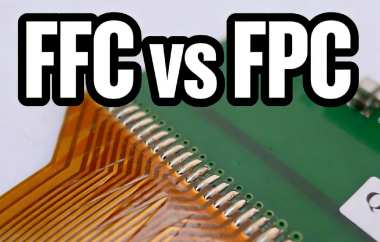
In modern electronic product design and manufacturing, flat flex cables (FFC) and flexible printed circuits (FPC) serve as critical interconnection solutions. They are widely used across multiple industries, including consumer electronics, communication devices, automotive electronics, medical instruments, and industrial automation. As products continue to become thinner, faster, and more functionally complex, the technical performance, reliability, and manufacturing processes of FFC and FPC have become core concerns for design engineers, procurement specialists, and industry analysts. This article provides a systematic introduction to the definitions, working principles, main features, advantages, and typical applications of FFC and FPC.
Catalog
I. What is FFC?
A flat flex cable (FFC) is a type of flat, flexible cable made by arranging multiple parallel metal conductors and sandwiching them between insulating materials, followed by thermal pressing or adhesive bonding. FFCs typically use polyimide (PI) or polyester (PET) film as the insulation layer and copper as the conductor. The cross-section is flat, and the conductor pitch can range from 0.3 mm to 2.54 mm or other specifications, making it suitable for point-to-point connections.
FFC is mainly used for electrical connections between two fixed or moving components. It is particularly suitable for design scenarios where internal space is limited but some bending and insertion/removal are required, such as the connection between a display screen and a motherboard or between a keyboard and a control board.
II. What is FPC?
A flexible printed circuit (FPC) is a flexible circuit board formed on a flexible substrate, such as a polyimide film, using printing, etching, and copper plating processes. Unlike traditional rigid printed circuit boards (PCBs), FPCs can bend, fold, or roll in three-dimensional space and support single-layer, multi-layer, or even rigid-flex (Rigid-Flex) designs.
FPCs are not limited to simple wire connections; they can also implement complex circuit functions. For example, they can embed resistors, capacitors, impedance-controlled traces, and signal integrity optimization structures. As a result, they are widely used in high-density wiring, complex interconnection structures, and high-frequency signal transmission designs.
III. Working Principle
The basic working mechanism of FFC is to achieve electrical conduction through its flat-arranged metal conductors. When current or signals enter from one end of the connector, they are transmitted along the parallel conductors to the other end. Because the conductor spacing is consistent and the structure is regular, FFC provides stable resistance and impedance characteristics. FFC connections typically rely on corresponding zero-insertion-force (ZIF) or low-insertion-force (LIF) connectors for insertion and removal.
FPCs, based on a flexible insulating substrate, generate circuit patterns through photolithography, etching, and other processes. Their working principle is similar to that of rigid PCBs, but because of the flexible material, the circuit can bend or fold as needed within the device. When current flows through an FPC, it transmits signals and power along the designed circuit paths. FPCs can integrate power lines, signal lines, and control lines, and their design can achieve impedance matching and high-frequency signal optimization.
IV. Features and Advantages
· High space efficiency: FFC and FPC are much thinner than conventional round cables or PCBs, significantly saving internal device space and supporting thinner product designs.
· Good mechanical flexibility: Both FFC and FPC can bend. FFC is more suitable for simple bending or insertion/removal scenarios, while FPC can support more complex bending, folding, or even dynamic movement applications.
· High signal integrity: Especially for FPCs, impedance control and differential trace optimization can maintain high signal quality in high-speed transmission scenarios, such as USB, LVDS, or HDMI.
· Compatibility with automated assembly: Both FFC and FPC are compatible with automated assembly equipment, which helps improve production efficiency and reduce defects caused by manual soldering.
· Cost and reliability: Although FPC design and manufacturing costs are generally higher than simple FFCs, FPCs provide higher integration and long-term reliability in high-density and complex circuit scenarios. FFCs are lower cost and suitable for standard connection solutions.
V. Applications
FFC and FPC are widely used for internal connections in various electronic devices, including:
· Consumer electronics: Connections in smartphones, laptops, tablets, displays, and camera modules.
· Automotive electronics: Wiring within instrument panels, infotainment systems, and sensor modules.
· Medical devices: Internal flexible connections in high-precision instruments, such as ultrasound machines and monitors.
· Industrial automation and communications: Internal wiring for robots, high-speed communication modules, and 5G base station equipment.
VI. Conclusion
In the global electronic components industry, FFC and FPC are fundamental interconnection components that enable compact, intelligent, and high-performance electronic products. The flat, flexible structure of FFC suits standard connection line requirements, while the flexible circuit design of FPC supports higher-density and multifunctional embedded wiring. As technology advances and end-user applications evolve, their use in smart terminals, automotive systems, industrial equipment, and high-end devices will continue to expand.


