
What is a Damping Resistor?


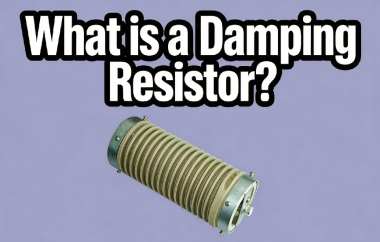
In modern electronic and power systems, as high-frequency switching circuits, power electronic devices, and complex systems become more widespread, various oscillation, resonance, and transient interference issues have become increasingly prominent. The damping resistor (Damping Resistor), as a key component specifically used to control circuit dynamic response and suppress oscillation, has evolved from a traditional circuit protection element into an indispensable part of high-performance designs. Whether in power modules, filters, driver circuits, or complex grids and automation systems, damping resistors play a critical role. This article will systematically introduce damping resistors from their definition, working principle, characteristics, and applications.
Catalog
I. What is a Damping Resistor?
III. Characteristics and Advantages
I. What is a Damping Resistor?
A damping resistor (Damping Resistor) is a type of resistor specifically used in circuits to control oscillations, reduce transient fluctuations in current or voltage, and absorb unwanted energy. It is usually connected in series or parallel with energy storage elements such as capacitors or inductors, converting excess energy in the system into heat. This helps suppress oscillations, reduce resonance effects, and improve system stability. Compared to ordinary current-limiting resistors, damping resistors are designed with a focus on dynamic behavior rather than just controlling static resistance values.
II. Working Principle
The core working principle of a damping resistor lies in energy dissipation and oscillation attenuation. In circuits containing energy storage elements like inductors (L) and capacitors (C), rapid changes in voltage or current can cause these components to release and exchange energy in the form of oscillations. If the circuit lacks an effective damping mechanism, self-excited oscillations or excessive ringing may occur, leading to signal distortion or component damage. A damping resistor dissipates part of this energy as heat, reducing oscillation amplitude and helping the circuit return to a stable state more quickly.
III. Characteristics and Advantages
Compared to ordinary resistors, damping resistors have the following notable characteristics and advantages:
· Effectively suppress resonance and oscillation: In circuits with strong inductive and capacitive coupling, damping resistors can significantly reduce resonance peaks and amplitudes, minimizing signal damage and component stress.
· Improve circuit stability: By reducing parasitic oscillations and transient overshoot, damping resistors make the system's dynamic response more stable, enhancing the practical performance of power supplies, filters, and other modules.
· Protect other circuit components: In high-frequency circuits like switching power supplies and inverters, transient voltages and surge currents can damage semiconductor devices. Damping resistors absorb part of this transient energy, providing protection.
· Adapt to various operating environments: Professionally designed damping resistors feature high voltage tolerance, low temperature drift, and high thermal capacity, allowing them to operate reliably in harsh industrial environments.
IV. Applications
Damping resistors have broad practical applications in electronic and power systems, mainly including:
· Power systems and filter networks: Used in harmonic filters of power systems, they work with capacitors and inductors to suppress harmonics and reduce resonance, improving power quality.
· Switching power supplies and power electronics: In high-frequency circuits such as switching power supplies and inverters, damping resistors help suppress transient voltage spikes and ringing, enhancing stability and reliability.
· High-voltage series compensation: In high-voltage series compensation systems, they work with capacitors and reactors to release residual energy and limit overvoltage.
· Audio and signal systems: Used in audio networks and signal transmission lines to suppress parasitic oscillations and improve response characteristics.
These typical applications demonstrate the important role damping resistors play in controlling oscillations, improving system performance, and protecting circuits.
V. Conclusion
As a specialized type of resistor, damping resistors significantly improve circuit dynamic performance through energy dissipation mechanisms. In the electronic components industry, they serve core functions such as enhancing stability, suppressing oscillations, and protecting system safety. With the increasing complexity of electronic systems, their applications are expanding widely across industrial automation, power electronics, communication systems, and high-frequency switching power supplies.


