
Varistors and TVS: What's the Difference?


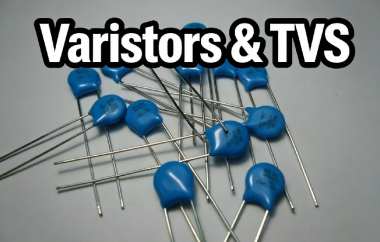
In modern electronic product design, circuit protection has become an indispensable part, especially in scenarios involving high-frequency data lines, digital interfaces, and power surges, where engineers need to select appropriate protective components to ensure system stability and safety. Varistors and TVS diodes are two of the most commonly used overvoltage protection components, and they differ significantly in working principles, response speed, energy absorption capacity, and parameter specifications. This article systematically analyzes the definitions, key parameters, and application differences of these two types of devices.
Catalog
IV. Differences Between Varistors and TVS
I. What is a Varistor?
A varistor is a resistor with nonlinear voltage-current characteristics, mainly used to clamp voltage when the circuit is subjected to overvoltage, absorbing excess current to protect sensitive components. Its English name is Voltage Dependent Resistor (VDR), also called a Varistor. Modern varistors are typically made of zinc oxide (ZnO), a semiconductor ceramic formed by divalent zinc and hexavalent oxygen, giving it significant nonlinear properties. From a material perspective, it belongs to the II-VI group of oxide semiconductors. In the Chinese market, varistors are also called surge absorbers or transient voltage suppressors. The working principle of a varistor is that when the voltage applied to the device is below its threshold, the current is almost zero, equivalent to an open circuit, whereas when the voltage exceeds the threshold, the resistance drops rapidly, the current surges, acting like a closed switch, thereby absorbing surge energy and limiting voltage peaks. Varistors offer a wide range of sizes (SMD, 5mm–53mm), voltage ratings (18V–1800V), strong surge tolerance, single-device current handling up to 70kA or more, fast response, low leakage current, and multiple lead and packaging options, making them widely used in power surge suppression and low-frequency circuit protection.
II. What is a TVS?
A TVS diode (Transient Voltage Suppressor) is a high-efficiency device specifically designed for transient overvoltage protection, capable of responding at sub-nanosecond levels. It can instantaneously convert high impedance to low impedance, directing high-energy transient currents to ground or the power line, effectively protecting downstream sensitive components. As a diode-based protection device, a TVS diode can complete avalanche breakdown absorption in picoseconds to nanoseconds when subjected to a reverse transient surge and clamp the voltage within a predetermined range. TVS diodes offer fast response, high transient power capability, low leakage current, tight breakdown voltage tolerance, stable clamping voltage, small size, and high reliability. They are widely applied in computer systems, communication equipment, household appliances, industrial instruments, protection of digital interfaces (such as RS232/422/485, USB, LAN, ADSL), automotive electronics, and sensor protection, effectively guarding against transient overvoltage caused by lightning, switching, or operational errors.
III. TVS Parameters
The key parameters of a TVS diode include the reverse working voltage Vrwm, minimum breakdown voltage VBR, breakdown current IR, maximum clamping voltage VC, maximum peak pulse current IPP, capacitance C, maximum peak pulse power PM, and clamping time TC. Vrwm indicates the maximum continuous DC or pulse voltage the TVS can withstand under normal conditions, with the current flowing through it not exceeding the maximum reverse leakage current ID; VBR is the device’s minimum avalanche breakdown voltage, usually measured at the specified IR; VC is the maximum clamping voltage when a 20-microsecond pulse current IPP passes through the device, and the ratio of VC to VBR, called the clamping factor, typically ranges from 1.2 to 1.4, reflecting surge suppression capability; C is the capacitance measured at a specified frequency and directly affects signal integrity in high-speed lines; PM represents the device’s maximum peak pulse power, which correlates with surge current handling and ambient temperature; TC is the time from zero voltage to the breakdown voltage VBR, less than 1×10^-12 seconds for unipolar TVS and less than 1×10^-11 seconds for bipolar TVS. Together, these parameters determine the protection effectiveness and application range of a TVS diode.
IV. Differences Between Varistors and TVS
Varistors and TVS diodes differ significantly in structure, response characteristics, and application scenarios. Varistors are compact, low-cost, and can handle larger surge currents, with current capacity increasing with size up to tens or even hundreds of kiloamperes, but their nonlinearity is limited, leading to higher clamping voltage at high currents and higher leakage at low voltages. TVS diodes exhibit Zener-like nonlinear behavior with very low leakage before breakdown and precise clamping voltage after breakdown, making them suitable for high-speed signals and sensitive component protection, although their current-handling capacity is lower than that of large varistors. In terms of response speed, TVS diodes operate at picosecond levels, while varistors are generally in the nanosecond range. Regarding capacitance, low-capacitance TVS variants exist for high-speed interfaces. In reliability and lifespan, TVS diodes are highly stable and resistant to aging, whereas varistors may degrade over time under high-energy conditions. Overall, varistors are more suitable for high-energy power surge suppression, while TVS diodes are better for transient protection in precision, high-speed circuits.
V. Conclusion
In electronic circuit design, correctly understanding the working principles and parameter differences between varistors and TVS diodes is essential for achieving circuit stability and safety. Varistors excel in high-energy surge absorption, while TVS diodes, with fast response, precise clamping, and high reliability, are ideal for protecting high-speed data lines and sensitive components. Engineers should consider circuit characteristics, surge energy levels, response speed, and signal frequency when selecting and configuring varistors and TVS diodes to achieve optimal protection and system reliability.


