
Ceramic vs. Quartz Resonators: What's the Difference?


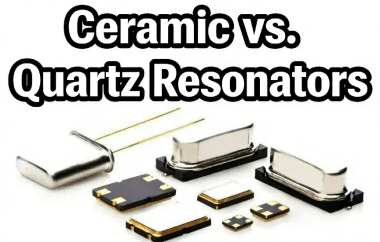
In modern electronic components, oscillator devices are core elements that provide clock signals and frequency references. Common types of oscillators include ceramic resonators and quartz crystal resonators. While both can generate frequency signals, they differ significantly in terms of material, precision, stability, application scenarios, and cost. For electronic design engineers, understanding the characteristics and differences between these two types of resonators is essential for proper component selection, improving product performance, and optimizing costs. This article starts with the basic concepts and provides a detailed introduction to the definitions, performance features, and practical application differences of ceramic and quartz crystal resonators.
Catalog
I. What is a Ceramic Resonator?
II. What is a Quartz Crystal Resonator?
III. Differences Between Ceramic and Quartz Resonators
I. What is a Ceramic Resonator?
A ceramic resonator is a frequency component that utilizes the piezoelectric effect of piezoelectric ceramic materials. Its internal chip is made of piezoelectric ceramic material, which produces mechanical vibrations when voltage is applied, generating signals at specific frequencies. In the Chinese electronics industry, ceramic resonators are often referred to as “Taozhen.” They are typically packaged in plastic, with common dimensions of 7.5 × 9 × 3.5 mm, and typical products include the 455 kHz series. Another type of packaging uses a mixture of epoxy resin and phenolic materials, which is cured at high temperatures to form a hard ceramic shell, usually brown or blue in color, such as the ZTT 4.0 MHz series. Ceramic resonators are characterized by small size, low cost, and fast start-up time, making them suitable for consumer electronics and microcontroller clock circuits where high frequency accuracy is not critical.
II. What is a Quartz Crystal Resonator?
A quartz crystal resonator is a resonator made from natural or synthetic quartz crystals, also commonly called a crystal oscillator. Quartz resonators generate stable frequency signals through the piezoelectric effect of the crystal, offering high precision, strong stability, and excellent resistance to interference. Although quartz crystal resonators have been in use for decades, their superior frequency stability has kept them central to the field of electronics. Especially with the rapid development of information technology, quartz resonators play an irreplaceable role as standard frequency sources or pulse signal sources in applications such as long-distance communications, satellite communications, mobile phone systems, GPS navigation, aerospace, high-speed computers, and precision instruments. Modern portable devices require quartz resonators to be smaller, surface-mounted, low-noise, high-precision, and highly stable, which has driven continuous technological innovation.
III. Differences Between Ceramic and Quartz Resonators
1. Material and Manufacturing Process
Quartz crystal resonators are made by cutting natural or synthetic quartz crystals, with the oscillation frequency directly determined by the crystal's cut direction, thickness, and size. Ceramic resonators are manufactured by sintering artificially synthesized piezoelectric ceramic powder at high temperatures, with frequency mainly determined by the ceramic thickness. Overall, quartz crystals have uniform natural material properties and high quality factor (Q), while ceramic materials can be mass-produced at low cost.
2. Frequency Accuracy and Stability
Quartz crystal resonators have high precision, with frequency errors typically ranging from ±10 ppm to ±300 ppm, suitable for high-precision instruments and communication devices. Ceramic resonators have lower accuracy, generally between ±300 ppm and ±5000 ppm, making them suitable for consumer electronics with less strict frequency requirements, such as remote controls, mobile phones, USB peripherals, and gaming devices.
3. Start-Up Time
Ceramic resonators start oscillating very quickly, often within nanoseconds after power-on, whereas quartz resonators take longer, typically milliseconds. The fast response of ceramic resonators is a major advantage in low-cost, high-response applications.
4. Structural Differences
Quartz resonators consist mainly of the crystal itself and have no internal capacitors. Ceramic resonators usually include both a piezoelectric element and an internal capacitor, though the internal capacitor can be omitted upon customer request, leaving only the piezoelectric element. These structural differences also influence circuit design and packaging choices.
5. Cost and Application Scenarios
Ceramic resonators are cost-effective due to the materials and manufacturing process, making them ideal for low-precision, cost-sensitive electronics. Quartz resonators, with higher precision and stability, are more expensive and are preferred in communications, precision instruments, navigation equipment, and high-end electronics.
IV. Conclusion
Both ceramic and quartz resonators have their advantages and limitations. For cost-sensitive electronic products with less stringent frequency requirements, ceramic resonators are an ideal choice. In applications where frequency stability, anti-interference performance, and high precision are critical, quartz resonators are irreplaceable. Understanding the differences in material, precision, response time, structure, and cost helps electronic design engineers make informed decisions during product development and component selection, improving performance and optimizing cost. With ongoing technological advances, the performance gap between ceramic and quartz resonators may narrow, but each will continue to maintain its key advantages in specific application areas.


