
Analog IC vs Digital IC: What's the Difference?


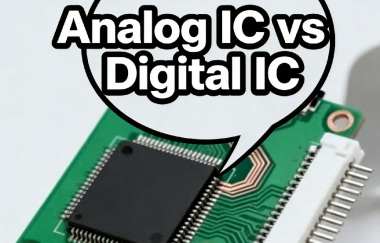
In the electronic components industry, ICs (Integrated Circuits) are the core components of modern electronic devices. Depending on the type of signal they process, ICs can be classified as analog ICs or digital ICs. Analog ICs handle continuous signals, such as light, sound, temperature, and speed—physical quantities in the natural world—while digital ICs process discrete pulse signals. Understanding the differences between analog and digital ICs is essential for electronic product design, selection, and long-term maintenance. This article provides a comprehensive analysis of both types.
Catalog
III. Classification of Analog ICs
IV. Four Key Characteristics of Analog ICs
I. What is an Analog IC?
Analog ICs are integrated circuits used to process continuous analog signals. These signals can be represented as continuously varying voltages or currents and can be analyzed in the form of sine waves, triangular waves, or other continuous waveforms. Analog ICs are primarily responsible for amplification, regulation, conversion, and filtering, transforming physical signals from the environment into electrical signals or converting electrical signals into controllable outputs. Typical applications include audio amplifiers, sensor interfaces, signal conditioning circuits, and power management.
Analog ICs can be divided into two types based on technology: one type is pure analog ICs, which only process continuous signals; the other is mixed-signal ICs, which handle both analog and digital signals. In terms of applications, analog ICs can be further classified into standard types and special application types. Standard types include amplifiers, voltage regulators/references, interfaces, data converters, and comparators, while special application types are primarily used in communication, automotive electronics, computer peripherals, and consumer electronics.
II. What is a Digital IC?
Digital ICs process discrete pulse signals, with outputs typically in the form of high-low square waves. Digital ICs focus on logic operations, data processing, and storage, with the design goal of achieving high computational speed at minimal cost. Compared with analog ICs, digital ICs emphasize computational efficiency, high integration, and low power consumption. Common digital ICs include microprocessors (CPU), microcontrollers (MCU), memory (RAM, ROM), logic gates, and various programmable logic devices (FPGA, CPLD).
Most digital ICs are manufactured using CMOS technology, which provides low power consumption and high integration at low voltages. This allows digital ICs to iterate quickly, but their lifecycle is relatively short, typically around 1 to 2 years.
III. Classification of Analog ICs
l Analog ICs can be classified by function and application:
l Linear ICs: Only process analog signals, such as operational amplifiers, comparators, and voltage regulators.
l Mixed-Signal ICs: Process both analog and digital signals, such as analog-to-digital converters (ADC) and digital-to-analog converters (DAC).
l Standard Application ICs: Widely used in audio, interface circuits, and power management for basic functionality.
l Special Application ICs: Targeted for communication, automotive electronics, computer peripherals, and consumer electronics.
l The design goal for each type of analog IC emphasizes high reliability, low noise, and low distortion, while also considering power consumption and stability.
IV. Four Key Characteristics of Analog ICs
Analog ICs have four significant characteristics in design and application:
1. Long Lifecycle
Analog ICs typically emphasize high signal-to-noise ratio, low distortion, and stability. Once the design goals are achieved, their lifecycle can exceed 10 years. For example, the audio operational amplifier NE5532, introduced in the late 1970s, is still widely used in multimedia speakers today, with a lifecycle exceeding 25 years. In contrast, digital IC design focuses on speed-to-cost ratio, resulting in a shorter lifecycle.
2. Specialized Manufacturing Processes
Analog ICs rarely use CMOS technology and instead employ Bipolar, BiCMOS, BCD, CD, or even high-frequency processes such as SiGe or GaAs. These processes ensure high-voltage output and low distortion but require more expertise from designers and semiconductor foundries.
3. Close Relationship with Components
In analog IC design, considerations must be made for component matching, layout symmetry, frequency characteristics, and current amplification to ensure low noise and minimal distortion. Resistors, capacitors, and inductors all affect analog IC performance, requiring designers to have an in-depth understanding of component characteristics. Digital ICs are generally insensitive to these factors at logic levels.
4. Limited Design Tools and Long Testing Cycles
Analog IC design tools are far fewer than those for digital ICs, and the design process is complex and time-consuming. Designers must be familiar with IC manufacturing processes, wafer production, and component characteristics, usually requiring 3–5 years of experience to become proficient, while top-level designers may need over 10 years. Additionally, testing and certification cycles for analog ICs are long, especially for products involving high voltage or special packaging, such as BCD processes and wafer-level WCPS packaging.
V. Conclusion
Overall, analog and digital ICs each have distinct advantages and limitations. Analog ICs are suitable for applications requiring high reliability, long lifespan, and signal accuracy, while digital ICs emphasize high-speed computation and low cost, suitable for logic operations and data processing. In electronic product design, a rational combination of analog and digital ICs can achieve optimal performance. Understanding the differences between the two helps engineers make informed decisions in selection, development, and production, ensuring product stability and long-term performance.


