
Supercapacitors vs Lithium-Ion Batteries: What’s the Difference?


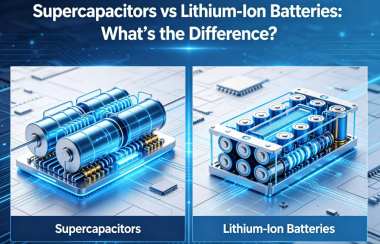
Against the backdrop of global energy structure transformation and the rapid development of the new energy industry, energy storage technology has become a critical component in electronic components and power systems. Among them, supercapacitors and lithium-ion batteries are the two most widely used energy storage devices today. They differ significantly in working mechanisms, performance characteristics, and application scenarios. Supercapacitors are known for their high power density and ultra-long cycle life, while lithium-ion batteries dominate the market due to their high energy density and mature industrial supply chain. A deep understanding of their differences helps achieve better energy configuration and system design in electronic devices, electric vehicles, and industrial systems.
What Are Supercapacitors and Lithium-Ion Batteries?
A supercapacitor, also known as an electrochemical capacitor, is an energy storage device positioned between traditional capacitors and batteries. It stores energy primarily through charge separation at the interface between the electrode and the electrolyte, enabling rapid charge and discharge capability and extremely high cycle stability.
A lithium-ion battery is a secondary battery system that stores and releases electrical energy through the intercalation and de-intercalation of lithium ions between the positive and negative electrodes. Its core characteristic is energy storage based on electrochemical reactions, which provides high energy density and long-duration power supply capability.
Comparison of Working Principles
Supercapacitors are mainly based on the electric double-layer capacitance effect and pseudocapacitance effect. When voltage is applied to the electrode, charges rapidly accumulate at the electrode-electrolyte interface to form an electric double layer, while reversible surface reactions may also occur in some materials, enabling energy storage. Since the process is primarily physical, charge and discharge are extremely fast, with minimal structural change in materials.
Lithium-ion batteries rely on electrochemical reaction mechanisms. During charging, lithium ions are extracted from the cathode and embedded into the anode through the electrolyte; during discharging, the process is reversed, releasing electrons to generate electric current. This involves crystal structure changes, resulting in higher energy density but slower charge and discharge rates.
Comparison of Performance Characteristics
In terms of energy density, supercapacitors typically range from 5–15 Wh/kg, while lithium-ion batteries are significantly higher. Lithium iron phosphate (LFP) batteries reach about 120–150 Wh/kg, and ternary lithium batteries can reach 180–200 Wh/kg or more. Therefore, lithium batteries have a clear advantage in long-duration power supply applications.
Regarding cycle life, supercapacitors can achieve more than one million charge-discharge cycles, whereas lithium-ion batteries generally range from several thousand to around ten thousand cycles, with noticeable capacity degradation over time.
In terms of power density and charging speed, supercapacitors have a significant advantage, capable of charging and discharging within seconds, making them suitable for high-frequency energy exchange scenarios. Lithium-ion batteries, however, require longer charging time.
In terms of cost structure, lithium-ion batteries benefit from a mature supply chain and large-scale production, resulting in continuously decreasing unit costs. Supercapacitors, however, are still relatively expensive due to material and manufacturing limitations.
Comparison of Applications
Supercapacitors are mainly used in high-power, short-duration, and frequent charge-discharge scenarios, such as automotive starter systems, regenerative braking in rail transit, elevator energy recovery systems, and grid frequency regulation. They are also used in electric buses, port machinery, and industrial equipment for peak power compensation or auxiliary energy supply.
Lithium-ion batteries are widely used in consumer electronics, electric vehicles, energy storage stations, and portable power systems. In power systems, they are commonly used for peak shaving, load shifting, and smoothing renewable energy output, making them the mainstream energy storage solution today.
Environmental Comparison
From an environmental perspective, supercapacitors typically use carbon-based electrode materials and relatively stable electrolytes, without involving heavy metals or complex chemical reactions. Therefore, their environmental impact during production and recycling is relatively low.
Although lithium-ion batteries offer higher efficiency, their production involves mining of lithium, cobalt, nickel, and other metals. Improper disposal of used batteries may lead to environmental pollution and resource waste. As a result, battery recycling systems and green manufacturing technologies have become key development priorities in the industry.
Technology Development Trends
The development direction of supercapacitors focuses on improving energy density and reducing cost. Hybrid supercapacitor technologies introduce battery-type energy storage mechanisms to significantly enhance energy density and expand application scenarios. In addition, new electrode materials and dry electrode processes are expected to further improve performance and reduce manufacturing costs.
Lithium-ion batteries are evolving toward higher energy density and improved safety. Solid-state electrolyte technology is gradually maturing, aiming to eliminate safety risks associated with traditional liquid electrolytes. Meanwhile, silicon-based anodes, high-nickel cathodes, and structural optimization are continuously improving battery performance.
Conclusion
Overall, supercapacitors and lithium-ion batteries are not competing alternatives but complementary technologies in the energy storage field. Supercapacitors offer unmatched advantages in high power output, ultra-fast charge and discharge, and long cycle life, making them indispensable in specific high-power applications. Lithium-ion batteries, on the other hand, dominate long-duration energy supply and large-scale energy storage due to their high energy density and mature industrial ecosystem. In the future, with the development of hybrid energy storage systems, the coordinated application of both technologies will become an important direction for optimizing energy systems.


