
What Is the Difference Between a Laser Diode and a Photodiode?


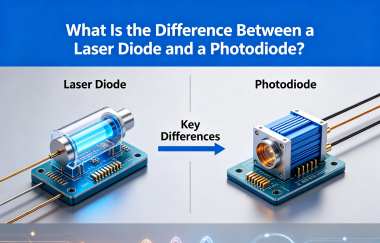
In the electronic components industry, Laser Diodes (LD) and Photodiodes (PD) are two highly critical fundamental devices. Although both belong to semiconductor devices based on PN junction structures, they differ fundamentally in energy conversion direction, working mechanisms, and application scenarios. LD is responsible for converting electrical energy into highly directional laser output, while PD converts incoming optical signals into electrical signals. Together, they form the core foundation of optical communication, optical sensing, and optoelectronic detection systems.
I. What are Laser Diodes and Photodiodes?
A Laser Diode (LD) is an active light-emitting device that operates based on the principle of stimulated emission in semiconductors. It achieves optical amplification and emits laser beams through current injection. Its core structure typically consists of a PN junction and multiple heterostructures, including an active layer that enables population inversion and optical gain processes.
A Photodiode (PD) is a passive optoelectronic conversion device based on the photogenerated carrier effect. When light irradiates a PN junction or PIN structure, photon energy excites electron-hole pairs, generating a measurable current in an external circuit and enabling conversion from optical signals to electrical signals.
II. Working Principles of Laser Diodes and Photodiodes
The working principle of a Laser Diode is mainly based on stimulated emission and optical resonant cavity feedback mechanisms. When a forward bias voltage is applied to the PN junction, a large number of electrons and holes are injected into the active region and recombine. Once population inversion conditions are met, stimulated emission photons are generated. Through the reflection of the resonant cavity, the optical signal is continuously amplified, eventually emitting a highly directional and coherent laser beam from the end face.
The working principle of a Photodiode is based on the internal photoelectric effect. When photons enter the semiconductor material, their energy causes valence band electrons to transition to the conduction band, generating electron-hole pairs. Under the built-in electric field of the PN junction, these carriers are quickly separated, forming a photocurrent. The output current is approximately linearly related to the incident light intensity, making it suitable for light intensity detection and signal conversion.
III. Characteristics and Advantages of Laser Diodes and Photodiodes
Laser Diodes feature small size, high efficiency, fast response speed, and strong wavelength design flexibility. Due to their excellent monochromaticity and directionality, they play an irreplaceable role in high-speed optical communication systems. In addition, their low power consumption and high integration capability make them suitable for portable optoelectronic devices.
Photodiodes offer high sensitivity, a wide spectral response range, and a simple structure. Their response speed can reach nanosecond or even picosecond levels, making them suitable for high-speed optical signal detection. At the same time, PDs exhibit low noise characteristics, performing excellently in precision optical measurement and weak light detection applications.
IV. Application Fields of Laser Diodes and Photodiodes
Laser Diodes are widely used in optical fiber communication systems, optical storage devices, laser printers, industrial laser processing, medical laser therapy, and LiDAR systems. In data centers and high-speed communication networks, LDs serve as core optical source devices for high-speed optical interconnects.
Photodiodes are mainly used in optical communication receivers, optical power detection, ambient light sensing, industrial automation inspection, medical imaging equipment, and security monitoring systems. In optical fiber communication systems, PDs are commonly used to receive optical signals and convert them into electrical signals for information demodulation and data recovery.
V. Conclusion
Although Laser Diodes and Photodiodes are both based on semiconductor PN junction structures, their functional directions are completely opposite. Laser Diodes are active light source devices responsible for converting electrical energy into optical energy, while Photodiodes are passive detection devices responsible for converting optical energy into electrical energy. Together, they form a complementary relationship in optical communication, optoelectronic sensing, industrial inspection, and consumer electronics, jointly driving the development and application advancement of modern optoelectronic technology.


