
How Do RTDs and Thermistors Differ in Temperature Characteristics?


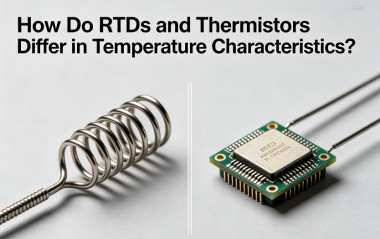
In the electronics components industry, temperature sensors are key fundamental devices that enable precise system control. Among them, resistance temperature detectors (RTDs) and thermistors are the two most widely used types of temperature sensing devices. Although both are based on the basic physical principle that “resistance changes with temperature,” they differ significantly in material structure, temperature response characteristics, measurement accuracy, and application scenarios. With the development of smart manufacturing, automotive electronics, and consumer electronics, the requirements for temperature measurement accuracy and cost control continue to increase, making the selection and application strategy of these two devices an important topic in engineering design.
I. What are RTDs and thermistors?
A resistance temperature detector (RTD) is a temperature-measuring device that uses the principle that the resistance of a metal changes regularly with temperature. Common materials include platinum, nickel, and copper, with platinum RTDs being the most widely used due to their high stability and high accuracy. Typical examples include Pt100 and Pt1000 series products that comply with the IEC 60751 standard.
A thermistor, on the other hand, is a temperature-sensitive component made of semiconductor materials whose resistance changes significantly with temperature in a nonlinear manner. Based on temperature coefficients, thermistors are mainly divided into two types: NTC (Negative Temperature Coefficient) and PTC (Positive Temperature Coefficient), both of which are widely used in consumer electronics and protection circuits.
II. Working principles of RTDs and thermistors
The working principle of RTDs is based on the physical mechanism that the scattering of free electrons in a metal conductor changes with temperature, thereby altering its resistance. As temperature increases, lattice vibrations in the metal intensify, increasing electron movement resistance and causing a near-linear rise in resistance. This linear relationship allows RTDs to provide high accuracy and good predictability over a wide temperature range.
The working principle of thermistors is based on the significant change in carrier concentration in semiconductor materials with temperature. As temperature rises, the number of charge carriers in an NTC thermistor increases, causing its resistance to drop rapidly; in contrast, a PTC thermistor experiences a sharp increase in resistance near a specific temperature due to structural changes in the crystal lattice. Therefore, thermistors exhibit a highly nonlinear temperature response characteristic.
III. Characteristics and advantages of RTDs and thermistors
The main characteristics of RTDs are high measurement accuracy, long-term stability, and excellent repeatability. They perform particularly well over a wide temperature range of -200°C to 850°C, making them suitable for industrial-grade precision temperature measurement systems. However, their disadvantages include higher cost and more complex measurement circuitry requirements, often needing high-precision data acquisition systems.
The advantages of thermistors include simple structure, low cost, high sensitivity, and fast response speed, making them suitable for applications with rapid temperature changes. However, their nonlinear characteristics are more pronounced, measurement accuracy is relatively lower, and long-term stability is not as good as RTDs. Therefore, temperature compensation or calibration is usually required.
IV. Applications of RTDs and thermistors
RTDs are widely used in industrial automation control systems, petrochemical equipment, medical instruments, and high-precision laboratory temperature measurement systems. For example, in PLC control systems, Pt100 RTDs are commonly used for temperature monitoring in reactors, boilers, and precision temperature control equipment.
Thermistors are more commonly used in consumer electronics and cost-sensitive devices, such as smartphones, power adapters, lithium battery protection circuits, and household appliance temperature protection systems. Among them, NTC thermistors are often used for temperature sensing and inrush current suppression, while PTC thermistors are commonly used for over-temperature protection and resettable fuse functions.
V. Conclusion
Overall, RTDs and thermistors each have their own advantages and application scenarios in the field of temperature measurement. RTDs are known for high precision and high stability, making them more suitable for industrial-grade and scientific research applications. Thermistors, on the other hand, are favored for their low cost and high sensitivity, playing an important role in consumer electronics and protection circuits. In practical engineering design, the appropriate temperature sensor should be selected based on measurement accuracy requirements, cost budget, and environmental conditions to achieve the best balance between system performance and economic efficiency.


