
How Do Relays Provide Leakage Protection?


In modern electronic and electrical systems, circuit safety has always been one of the core issues in design and application. With the rapid development of household appliances, industrial equipment, and new energy systems, leakage current risks have become a major hidden danger affecting equipment stability and personal safety. As a key safety module, the leakage protection circuit can quickly disconnect the power supply when abnormal current is detected, thereby effectively preventing electric shock accidents and equipment damage. In the electronics component industry, the relay serves as a core actuating component, playing an essential role in circuit switching control and is an indispensable basic device for achieving automated safety protection.
I. What is a Relay?
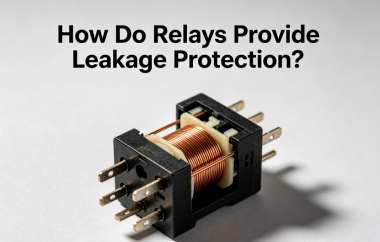
A relay is an electromagnetic switching device that uses a small current to control a large current, and it is widely used in automatic control and power protection systems. Its basic structure typically consists of an electromagnetic coil, an iron core, a contact system, and a spring mechanism. When the coil is energized, it generates a magnetic field that drives the contacts to move, thereby enabling the circuit to be switched on or off. Due to its capabilities of signal isolation and power amplification control, the relay plays an important role in industrial control, power systems, and safety protection circuits, especially serving as the final actuating unit in leakage protection systems.
II. Principle of Leakage Protection
The core principle of leakage protection is based on the law of current balance. Under normal operating conditions, the current in the live wire and the neutral wire are equal in magnitude and opposite in direction, resulting in a net sum of zero. However, when leakage occurs, part of the current flows through abnormal paths (such as the human body or grounding paths), causing the current balance to be disrupted.
The leakage protection device determines whether an abnormal condition occurs by detecting the differential current between the live and neutral wires. When this difference exceeds a preset threshold, the system immediately identifies it as a leakage fault and activates the protection mechanism, achieving rapid power disconnection.
III. Composition and Working Principle of Leakage Protection Circuit
A leakage protection circuit typically consists of three main parts: the detection circuit, the comparison circuit, and the execution circuit.
The detection circuit is responsible for real-time monitoring of the circuit current. It usually uses current transformers or induction coils to sample the current in the live and neutral wires and convert it into electrical signals for output.
The comparison circuit analyzes the detected signal and compares it with a preset safety threshold. When the detected differential current exceeds the safe value, the comparison circuit outputs a trigger signal indicating a dangerous condition.
The execution circuit responds immediately upon receiving the trigger signal and drives the relay to disconnect the main power circuit, thereby cutting off the current path and ensuring safety protection. After the fault is cleared, the system can be restored to normal power supply through manual or automatic reset.
The overall working process can be summarized as: current detection—signal comparison—trigger execution—circuit disconnection, forming a complete closed-loop protection mechanism.
IV. Application Fields of Leakage Protection Circuits
Leakage protection circuits have extensive application value in multiple fields, especially in scenarios with high safety requirements.
In residential and commercial building distribution systems, leakage protection devices are widely used in socket circuits and main distribution protection to prevent electric shock accidents. In industrial equipment and electric tools, the system effectively prevents electrical accidents caused by insulation aging.
In the medical equipment field, leakage protection circuits ensure the safety of patients and operators and guarantee the stable operation of precision instruments. In new energy vehicle charging systems, leakage protection is also a core safety module used to prevent electrical risks during charging. Additionally, in complex power environments such as stage lighting and audio systems, this circuit also plays an important safety protection role.
V. Importance of Leakage Protection
Leakage current is a highly concealed but extremely dangerous electrical fault that may cause equipment damage, short circuits, fires, or even personal injury and fatalities. Due to its sudden and unpredictable nature, it is difficult to rely on manual intervention for timely handling.
Leakage protection devices use automatic monitoring and rapid disconnection mechanisms to respond to abnormal conditions within milliseconds, significantly reducing the probability of accidents. At the same time, they not only improve the overall safety level of electrical systems but also provide fundamental assurance for the reliable operation of modern electrical equipment. Therefore, leakage protection has become a mandatory safety requirement in various electrical design standards.
VI. Conclusion
As an important component of modern electrical safety systems, the leakage protection circuit achieves rapid response and effective control of abnormal circuit conditions by detecting current balance changes combined with relay-based execution mechanisms. Its core value lies in ensuring stable equipment operation and electrical safety for users.
With the development of electronic technology and intelligent control, leakage protection systems are continuously evolving toward higher sensitivity, intelligence, and integration. In future electrical engineering and electronic equipment design, the proper application of leakage protection technology will remain a key approach to enhancing system safety and reliability.


