
What Are the Applications of Reactors?


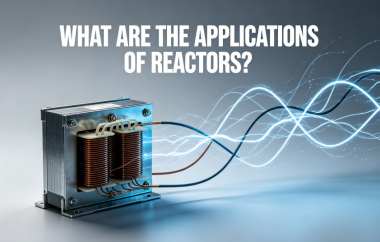
In the electronic components industry, the reactor (Reactor / Inductor) is a fundamental and critical electrical component widely used in power transmission and distribution systems, industrial equipment, and power electronic devices. The core function of a reactor is to store and release energy through electromagnetic induction, thereby suppressing or regulating current variations and achieving purposes such as current limiting, filtering, reactive power compensation, and voltage stabilization.
With the development of new energy, smart grids, and industrial automation, the importance of reactors in power systems continues to increase. In particular, they have become indispensable key components in high-voltage transmission, variable frequency drive systems, and harmonic mitigation applications.
I. What Is a Reactor?
A reactor is an electronic component based on the principle of electromagnetic induction, typically composed of coil windings. It can be designed with either an air-core structure or an iron-core structure. Its essence is to utilize inductive properties to oppose alternating current, known as “reactance.”
From a functional perspective, a reactor can be understood as a device that converts electrical energy into magnetic field energy for temporary storage. When the current changes, the stored magnetic energy is released back into the circuit, thereby controlling the rate of current change.
In engineering applications, reactors are often classified as a type of inductor. However, in power systems, the term “reactor” is commonly used to emphasize its operating characteristics under high-voltage and high-power conditions.
II. Working Principle of Reactors
The working principle of reactors is based on Faraday’s law of electromagnetic induction and Lenz’s law. When alternating current flows through a coil, an alternating magnetic field is generated around it. This magnetic field induces a reverse electromotive force in the conductor, thereby opposing changes in current.
When the current increases, the reactor generates a reverse electromotive force to suppress the rise in current. When the current decreases, the stored magnetic energy is released to maintain current stability. Therefore, reactors exhibit the characteristic of “blocking AC while allowing DC (or low-frequency components).”
The reactance value of a reactor is closely related to inductance and frequency. The higher the frequency, the greater the reactance, which means it has a strong inherent ability to suppress high-order harmonics. This characteristic makes reactors essential in power quality improvement and harmonic mitigation applications.
III. Applications of Reactors
In power systems and the electronics industry, reactors are widely used, with functions mainly focused on current limiting, filtering, compensation, and system stability.
In reactive power compensation systems, shunt reactors are typically used to absorb excess capacitive reactive power in the system, thereby improving voltage stability. In harmonic suppression applications, series reactors are used in combination with capacitors to form resonant circuits that effectively filter specific harmonic frequencies.
In power electronic equipment, reactors are commonly installed at the input and output sides of variable frequency drives (VFDs) to reduce grid harmonic pollution and suppress inrush currents caused by switching operations, thereby improving system reliability.
In high-voltage transmission systems, reactors are also used to control voltage distribution along long-distance transmission lines, reducing voltage rise issues during light-load or no-load conditions and enhancing transmission stability.
IV. Applications of Reactors in Different Scenarios
1. Series Reactor
Series reactors are typically used together with power capacitors. They are mainly used to suppress harmonics, limit inrush current during switching operations, and reduce switching overvoltage. They help improve voltage waveform quality, increase power factor, and protect capacitors and other electrical equipment.
This type of reactor is widely applied in power systems, metallurgy, shipbuilding, chemical production, and large-scale infrastructure projects. It is an important component of reactive power compensation systems.
2. Filter Reactor
Filter reactors are usually connected with shunt capacitor banks to form LC filter circuits, which are used to absorb and suppress specific harmonic frequencies. In industrial systems with high power quality requirements, filter reactors are core components for harmonic mitigation.
Their applications cover power systems, machinery manufacturing, paper production, communication facilities, and large industrial parks, helping to reduce equipment heating, malfunction, and system losses.
3. Current-Limiting Reactor
Current-limiting reactors are mainly used to restrict short-circuit currents. When a fault occurs in a power system, they reduce the peak short-circuit current through their reactance characteristics, thereby protecting circuit breakers and other equipment.
This type of reactor is widely used in power plants, substations, and large industrial power distribution systems, playing a critical role in improving system safety.
4. Shunt Reactor
Shunt reactors are mainly used in ultra-high-voltage transmission systems to compensate for line capacitance effects and prevent voltage rise during light-load or no-load conditions.
They improve voltage distribution, reduce line losses, enhance transmission efficiency, and increase system stability, making them essential in long-distance power transmission projects.
5. Variable Frequency Drive (VFD) Reactor
VFD reactors are typically installed at the input or output side of variable frequency drives. They are used to suppress grid surge currents and switching overvoltages while reducing harmonic pollution caused by the drive system.
In industrial automation, VFD reactors are widely used in motor drive systems, helping to improve equipment lifespan and operational stability. They are suitable for manufacturing industries, port machinery, and large-scale mechanical systems.
6. Split Reactor
A split reactor is a special type of reactor with a center tap structure. It is mainly used to limit short-circuit currents and improve system operational safety.
It is commonly used in power plants and large industrial power supply systems. In complex grid structures, it effectively enhances fault handling capability and overall system reliability.
V. Conclusion
As a key foundational component in power systems and the electronics industry, reactors play an irreplaceable role in power quality control, system protection, and stable operation of electrical networks. With the rapid development of high-frequency power electronics technology and large-scale integration of renewable energy, the demand for reactors in harmonic mitigation, smart grids, and efficient power transmission systems continues to grow.
In the future, reactors will evolve toward higher efficiency, smaller size, lower losses, and greater intelligence, playing an increasingly important role in renewable energy systems, electric vehicle charging infrastructure, and high-end industrial equipment.


