
What Is a Temperature Compensated Crystal Oscillator (TCXO)?


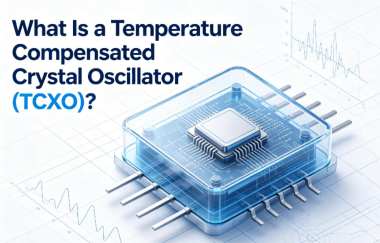
With the rapid development of wireless communication, the Internet of Things (IoT), satellite positioning, 5G equipment, and high-precision electronic systems, the demand for stable clock signals in electronic devices continues to increase. Although conventional crystal oscillators offer advantages such as low cost and compact size, their output frequency can be easily affected by changes in ambient temperature, resulting in frequency drift. A Temperature Compensated Crystal Oscillator (TCXO) was developed to address this challenge. By using temperature compensation technology, TCXO reduces the impact of temperature variations on crystal frequency, providing more accurate and stable clock signals.
I. What Is a Temperature Compensated Crystal Oscillator (TCXO)?
A Temperature Compensated Crystal Oscillator (TCXO) is an electronic component that improves the temperature-frequency characteristics of a crystal oscillator by adding a temperature compensation circuit. Quartz crystals have excellent mechanical vibration stability and can generate precise clock signals. However, their resonant frequency slightly changes with variations in ambient temperature. A TCXO uses a compensation circuit to generate a correction value opposite to the temperature-induced frequency drift of the crystal, thereby minimizing frequency variations caused by temperature changes.
II. Frequency Characteristics of TCXO
The performance of a crystal oscillator is mainly evaluated through parameters such as frequency stability, frequency-temperature characteristics, phase noise, spectral purity, and output characteristics.
Frequency stability is an important indicator that measures the ability of a crystal oscillator to maintain a constant output frequency. It is usually expressed in ppm (parts per million). The frequency stability of conventional crystal oscillators can be affected by temperature, voltage fluctuations, and aging. Through temperature compensation technology, TCXO can improve frequency stability to the range of 10⁻⁷ to 10⁻⁶, meeting the requirements of most communication and precision electronic systems.
Frequency-temperature characteristics refer to the change in output frequency when the ambient temperature varies within a specified range. Since quartz crystals naturally experience temperature-related frequency drift, TCXO uses compensation networks to adjust oscillator parameters, ensuring stable frequency output across a wide temperature range.
In addition, crystal oscillator performance also includes phase noise and spectral purity. Phase noise reflects the short-term frequency stability of the oscillator output signal, while spectral purity measures noise and unwanted spurious components in the output signal. For high-speed communication, radar, and navigation systems, low phase noise and high spectral purity are essential for maintaining signal quality.
III. Working Principle of Temperature Compensated Crystal Oscillator (TCXO)
The core principle of TCXO is to correct the frequency drift of quartz crystals caused by temperature variations through a temperature compensation circuit. Based on different compensation methods, TCXOs are mainly divided into direct compensation and indirect compensation types.
A direct compensation TCXO uses thermistors, capacitors, resistors, and other components to form a compensation network. When the ambient temperature changes, the resistance of the thermistor and the circuit parameters also change accordingly. The compensation circuit then generates a corresponding adjustment to offset the temperature-induced frequency drift of the crystal. This method features a simple structure, lower cost, and is suitable for compact electronic devices with relatively moderate accuracy requirements.
An indirect compensation TCXO generates a compensation voltage through a temperature detection circuit and controls components such as varactor diodes to adjust the equivalent capacitance of the crystal oscillator circuit, thereby correcting the output frequency. This method can achieve higher frequency stability. Digital temperature compensation technology uses temperature sensors and digital algorithms to perform precise frequency corrections, providing even higher accuracy. However, it requires more complex circuits and has higher costs.
Compared with standard crystal oscillators, TCXOs can significantly reduce frequency errors caused by temperature fluctuations, allowing electronic systems to maintain stable operation under different environmental conditions.
IV. Main Applications of TCXO
Due to their high stability, compact size, and low power consumption, temperature compensated crystal oscillators are widely used across various electronic industries.
In the mobile communication sector, TCXOs serve as critical timing components in smartphones, base stations, and wireless communication modules, providing stable frequency references for RF transmission and reception systems. With the continued growth of 5G communication and IoT devices, demand for low-power and high-precision TCXOs continues to increase.
In satellite navigation systems, including GPS and BeiDou positioning systems, accurate timing references are essential. TCXOs provide stable clock signals that improve positioning accuracy and enhance system reliability.
In industrial control systems, test and measurement equipment, and smart electronic devices, TCXOs help ensure the accuracy of data acquisition, signal processing, and communication synchronization. In addition, high-performance TCXOs play an important role in aerospace systems, network equipment, and broadcasting applications where precise timing signals are required.
V. Conclusion
A Temperature Compensated Crystal Oscillator (TCXO) is a high-precision crystal oscillator that improves frequency stability through temperature compensation technology. Compared with conventional crystal oscillators, TCXOs effectively reduce frequency drift caused by temperature changes while offering advantages such as low power consumption, compact size, and excellent cost performance.


