
Thermal XO vs. TCXO: What's the Difference?


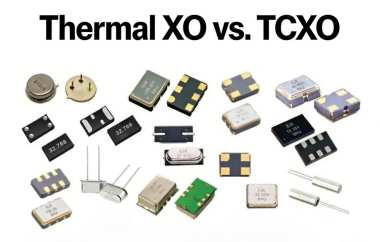
Thermal crystal oscillators and temperature-compensated crystal oscillators are common but easily confused types of crystal oscillators in electronic design. Their design goal is to cope with the impact of temperature changes on the output frequency of the crystal oscillator, but their implementation principles and technical paths are completely different, making them suitable for different application scenarios and performance requirements. This article will start from the basic definitions and provide a detailed analysis of the differences between thermal crystal oscillators and temperature-compensated crystal oscillators.
Catalog
I. What is a thermal crystal oscillator?
II. What is a temperature-compensated crystal oscillator?
III. Thermal crystal oscillator vs. TCXO
I. What is a thermal crystal oscillator?
A thermal crystal oscillator, fully known as a thermistor-compensated crystal oscillator, achieves temperature compensation by integrating a thermistor network around the oscillator circuit. The resistance of the thermistor changes with the ambient temperature, which in turn adjusts the load capacitance applied to the crystal or the circuit gain, providing a certain degree of correction for frequency drift. This type of compensation is analog, the circuit is relatively simple, and the cost is low. It can provide better frequency stability than a standard crystal oscillator within a conventional temperature range, but its compensation accuracy is limited.
II. What is a temperature-compensated crystal oscillator?
A temperature-compensated crystal oscillator, fully referred to as TCXO, uses a more complex and precise digital compensation mechanism. Its core design integrates a temperature sensor and a high-precision compensation circuit within the module. The temperature sensor monitors the ambient temperature in real time and sends the data to the control chip. The chip then uses a pre-stored temperature-frequency deviation curve and a digital-to-analog converter to generate a correction voltage, which is applied to the varactor in the oscillator circuit to accurately pull back the frequency deviation. As a result, a TCXO can achieve a frequency stability that is an order of magnitude higher than that of a thermal crystal oscillator.
III. Thermal crystal oscillator vs. TCXO
The differences between thermal crystal oscillators and temperature-compensated crystal oscillators can be compared from several dimensions. The primary difference lies in frequency accuracy and temperature stability. The typical accuracy of a thermal crystal oscillator is ±10ppm or lower, while a temperature-compensated crystal oscillator can easily reach ±0.5ppm to ±2.5ppm, showing a clear performance advantage. Secondly, regarding the compensation mechanism, thermal crystal oscillators use analog passive compensation, while temperature-compensated crystal oscillators adopt digital active compensation, which is more intelligent and precise. The third difference is circuit complexity and cost. Thermal crystal oscillators have a simple structure and low cost, whereas temperature-compensated crystal oscillators, which integrate a digital compensation system, have higher design and manufacturing costs. Finally, in terms of application areas, thermal crystal oscillators are widely used in consumer electronics where cost sensitivity and non-critical accuracy are factors, while temperature-compensated crystal oscillators are key components in communication base stations, GPS/Beidou navigation devices, high-end testing instruments, and various industrial equipment that require high-precision synchronization. A practical example is that a phone relying only on network data with navigation accuracy at the hundred-meter level may use a thermal crystal oscillator, while devices with high-precision satellite positioning capabilities and navigation accuracy at the meter level must rely on temperature-compensated crystal oscillators to provide a stable clock reference.
IV. Conclusion
In summary, choosing between a thermal crystal oscillator and a temperature-compensated crystal oscillator essentially involves balancing accuracy, cost, and application requirements. For most everyday consumer electronics, the performance provided by a thermal crystal oscillator is sufficient and economical. However, in any professional field where clock signal stability is critical, the precision advantage of a temperature-compensated crystal oscillator is indispensable.


