
What Factors Affect the Performance of Supercapacitors?


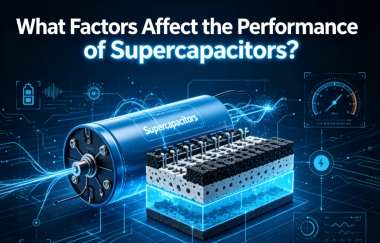
In the electronic components industry, supercapacitors have gradually become an important energy storage solution beyond traditional batteries due to their advantages of fast charging and discharging, high power density, and ultra-long cycle life. Supercapacitors combine the high power output capability of traditional capacitors with the energy storage characteristics of batteries, making them widely applicable in new energy vehicles, rail transportation, smart grids, consumer electronics, and industrial equipment.
Catalog
II. Main Characteristics of Supercapacitors
III. Main Factors Affecting Supercapacitor Performance
I. What Is a Supercapacitor?
A supercapacitor, also known as an ultracapacitor or electrochemical capacitor, is a new type of electronic component that stores energy through the charge storage mechanism at the interface between electrodes and electrolytes. Unlike traditional batteries that rely on chemical reactions, supercapacitors mainly store electrical energy through electric double-layer capacitance (EDLC) or pseudocapacitance effects.
II. Main Characteristics of Supercapacitors
1. High Power Density
Supercapacitors have a much higher power density than conventional batteries and can release or absorb large amounts of energy within a very short period. This feature makes them suitable for devices requiring instant high-power output, such as new energy vehicle starting systems, industrial equipment peak power compensation, and backup power systems.
2. Long Cycle Life
The charge and discharge cycles of supercapacitors can typically reach hundreds of thousands or even millions of times, which is significantly higher than that of traditional lithium-ion batteries. Since their energy storage process mainly relies on physical adsorption or rapid electrochemical reactions, electrode material degradation is relatively low, resulting in a much longer service life.
3. Fast Charging and Discharging Capability
Supercapacitors can complete charging and discharging processes within seconds to minutes, while traditional batteries usually require much longer charging times. This rapid response capability makes them particularly suitable for frequent start-stop operations, energy recovery systems, and short-term power supply applications.
4. High Safety and Stability
Compared with traditional batteries, supercapacitors offer higher safety under extreme conditions such as overcharging, over-discharging, and high temperatures, with a lower risk of combustion or explosion. In addition, their wide operating temperature range allows them to maintain stable performance in complex environments.
5. Environmental Benefits
Supercapacitors do not produce significant pollutants during operation and have a longer service life, reducing the frequency of replacing energy storage components in electronic devices. Therefore, they are considered a more environmentally friendly energy storage technology.
III. Main Factors Affecting Supercapacitor Performance
1. Capacitance
Capacitance is an important parameter for measuring the charge storage capability of a supercapacitor. It is mainly affected by factors such as the specific surface area of electrode materials, electrolyte properties, and internal structural design. A higher capacitance allows a supercapacitor to store more energy.
2. Operating Voltage
Operating voltage directly affects the energy density of a supercapacitor. Increasing the rated operating voltage can improve energy storage capacity, but the stability of the electrolyte and the voltage tolerance of materials must also be considered to avoid reducing the device’s lifespan.
3. Internal Resistance
Internal resistance determines energy loss and output efficiency during the charging and discharging process of a supercapacitor. A lower equivalent series resistance (ESR) can reduce energy loss, improve power density, and enhance overall operating efficiency.
4. Temperature Characteristics
Temperature variations can affect electrolyte ion mobility, electrode material performance, and internal impedance. At low temperatures, the capacitance and power output of supercapacitors may decrease, while excessively high temperatures can accelerate material aging and reduce service life.
5. Electrode Materials
Electrode materials are one of the key factors influencing supercapacitor performance. Activated carbon features a large specific surface area and relatively low cost, making it the most widely used material currently. Carbon nanotubes and graphene, with their excellent electrical conductivity and structural advantages, are widely studied for high-performance supercapacitor applications.
6. Electrolyte Performance
The electrolyte determines the ion transport capability, voltage range, and stability of supercapacitors. Different types of electrolytes affect the energy density, operating temperature range, and cycle life of devices, so the appropriate electrolyte needs to be selected according to specific application requirements.
7. Structural Design
The internal structure of a supercapacitor, including electrode thickness, separator materials, electrolyte distribution, and current collector design, can significantly affect its overall performance. Optimized structural design can reduce internal resistance, improve energy utilization efficiency, and enhance reliability.
IV. Conclusion
As an efficient energy storage component, supercapacitors offer significant advantages in fast charging and discharging, high power output, and long cycle life. With continuous advancements in electrode materials, electrolyte technologies, and manufacturing processes, the challenges of energy density and cost are gradually being improved.


