
What Is the Difference Between Varistors and ESD Suppressors?


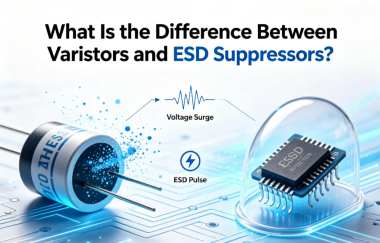
In the electronic components industry, varistors and ESD suppressors are two common protection devices widely used in consumer electronics, communication equipment, automotive electronics, and industrial control systems. Since both can handle abnormal voltage conditions, many engineers may confuse them during component selection. So, what are the differences between varistors and ESD suppressors? What application scenarios are they suitable for? This article will provide a detailed explanation from the perspectives of working principles, structural characteristics, and practical applications.
Catalog
II. What Is an ESD Suppressor?
III. Differences Between Varistors and ESD Suppressors
IV. How to Choose Between a Varistor and an ESD Suppressor?
I. What Is a Varistor?
A varistor is an electronic component that is sensitive to voltage changes. Its English name is Varistor, and it mainly utilizes the nonlinear resistance characteristics of materials to achieve overvoltage protection. Common varistors are typically manufactured using metal oxide materials such as zinc oxide (ZnO). When the applied voltage is within the normal operating range, a varistor maintains a high resistance value and has little impact on the normal operation of the circuit.
When transient overvoltage conditions such as surge voltage, lightning strikes, or power fluctuations occur, and the voltage across the varistor exceeds its varistor voltage rating, its internal resistance rapidly decreases, changing from a high-resistance state to a low-resistance state. This allows the varistor to absorb and discharge excessive electrical energy, clamp the abnormal voltage within a safe range, and protect downstream electronic components from damage.
Varistors are mainly used in power input circuits, AC circuit protection, motor equipment, household appliances, and industrial equipment. They are especially suitable for handling high-energy surge events. For example, in power adapters and household electronic products, varistors can absorb transient high voltages from the power grid, preventing critical components such as chips and capacitors from failing due to overvoltage.
II. What Is an ESD Suppressor?
An ESD suppressor is a protection device specifically designed to prevent damage caused by electrostatic discharge (Electrostatic Discharge, ESD). It is also known as an ESD protector or electrostatic protection component. Its primary function is to quickly release electrostatic energy when electronic devices are exposed to transient high-voltage shocks caused by human static electricity, device-to-device discharge, or other ESD events, thereby preventing damage to sensitive components.
Electrostatic discharge typically features high voltage, short duration, and extremely fast rise time. Although the energy level may be relatively small, it can still break down the tiny internal structures of integrated circuits. Therefore, ESD suppressors require extremely fast response speeds and low parasitic parameters to protect high-speed signal lines and sensitive electronic components.
Common ESD protection devices include transient voltage suppressor (TVS) diodes, ESD diodes, and other semiconductor protection components. These devices are usually installed near USB ports, HDMI interfaces, mobile device connectors, touchscreens, and communication lines. By providing a low-impedance discharge path, they quickly direct electrostatic current to ground, reducing the impact on internal circuits.
III. Differences Between Varistors and ESD Suppressors
Although varistors and ESD suppressors are both circuit protection components, they have significant differences in terms of protection targets, response speed, application scenarios, and performance characteristics.
First, their primary protection targets are different. Varistors are mainly used to protect against surge voltages and overvoltage events, such as power fluctuations and high-energy surges caused by lightning strikes. In contrast, ESD suppressors are primarily designed to protect against transient high-voltage damage caused by electrostatic discharge. Their protection targets are usually highly sensitive electronic components such as integrated circuits, processors, and sensors.
Second, their operating characteristics are different. Varistors rely on the nonlinear resistance characteristics of their materials. When the voltage exceeds a certain threshold, the resistance decreases rapidly and absorbs excess energy, making them suitable for handling large surge currents. However, due to their relatively high parasitic capacitance, varistors are generally not suitable for protecting high-speed signal lines.
ESD suppressors, on the other hand, emphasize ultra-fast response and low parasitic capacitance. They can turn on within nanoseconds and quickly discharge electrostatic current, making them more suitable for high-speed data interfaces and compact electronic devices. For example, high-speed signal lines in smartphones, laptops, and wearable devices commonly use ESD protection components.
In addition, the installation locations of these two components are also different. Varistors are typically installed at power input terminals to protect the entire circuit system, while ESD suppressors are usually placed near external interfaces to prevent external static electricity from entering internal circuits.
IV. How to Choose Between a Varistor and an ESD Suppressor?
In practical electronic circuit design, varistors and ESD suppressors are not completely interchangeable. Instead, they are selected and combined based on different protection requirements.
If the application environment involves significant power surges, grid interference, or lightning risks, a varistor is usually the more suitable choice because it can withstand higher transient energy. If the main concern is electrostatic discharge from human contact or connector plugging and unplugging, an ESD suppressor should be prioritized due to its fast response speed and low capacitance characteristics.
For some high-reliability electronic products, engineers often use both types of protection components together. For example, a varistor may be installed at the power input stage to suppress high-energy surge events, while ESD protection devices are placed near data interfaces to prevent electrostatic damage, creating a multi-level protection solution.
V. Conclusion
Although varistors and ESD suppressors are both used for electronic circuit protection, they serve different protection purposes. Varistors are mainly designed to handle high-energy overvoltage and surge events by reducing resistance and absorbing abnormal voltage energy. ESD suppressors, meanwhile, are primarily used for transient electrostatic discharge protection by rapidly diverting electrostatic current away from sensitive electronic components.


