
What Is the Difference Between SCR and Fast Thyristor Turn-Off Time?


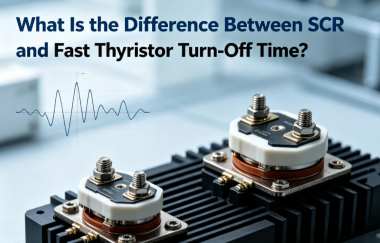
In the electronic components industry, the thyristor is a common high-power semiconductor device widely used in motor control, power regulation, inverters, and industrial control systems. The turn-off time of a thyristor is an important parameter for evaluating its switching performance. Especially in high-frequency switching applications, the turn-off speed directly affects system efficiency, response speed, and operating stability.
Different types of thyristors have significant differences in turn-off characteristics. Standard thyristors (SCRs) are mainly designed for low-frequency and high-power applications, while fast thyristors are optimized for high-frequency and high-speed switching scenarios. Understanding the differences in turn-off time between the two types helps engineers select the right device according to specific application requirements.
Catalog
I. What Is Thyristor Turn-Off Time?
IV. Comparison of Turn-Off Time Between Standard Thyristors and Fast Thyristors
I. What Is Thyristor Turn-Off Time?
Thyristor turn-off time (Turn-off Time, tq) refers to the time required for a thyristor to transition from the fully conducting state to the fully blocking state. Once a thyristor is turned on, it remains in the conducting state even after the gate trigger signal is removed. The device can only return to the blocking state after the anode current drops below the holding current and a certain recovery time has passed, allowing it to withstand forward voltage without being triggered again.
The turn-off time is mainly related to the carrier storage effect inside the thyristor. During conduction, a large number of carriers accumulate inside the device, and these charges require a certain amount of time to dissipate, which affects the switching speed. A shorter turn-off time enables a higher switching frequency, making the thyristor more suitable for fast switching applications.
II. Standard Thyristor (SCR)
A standard thyristor, also known as a Silicon Controlled Rectifier (SCR), is a traditional high-power semiconductor switching device featuring high voltage capability, large current handling capacity, and high reliability.
The turn-off time of a standard thyristor is usually longer because its internal structure is mainly optimized for higher current capability and voltage withstand performance. During conduction, a large number of carriers accumulate inside the device, requiring more time for charge recovery, which limits its switching speed.
Generally, the turn-off time of a standard thyristor ranges from several microseconds to tens of microseconds, and some high-power devices may require even longer recovery times. Therefore, standard SCRs are more suitable for low-frequency or line-frequency applications, such as AC voltage regulation, motor control, industrial rectification, and power control systems.
Since a standard thyristor cannot be turned off directly through the gate signal, it usually relies on natural commutation at the AC zero-crossing point or requires an auxiliary commutation circuit to achieve turn-off. This further limits its application in high-frequency switching systems.
III. Fast Thyristor
A fast thyristor is a high-speed switching thyristor developed from the standard SCR, with the main goal of reducing turn-off time and increasing switching frequency.
To achieve faster turn-off performance, fast thyristors typically use optimized chip structures, improved doping processes, and reduced carrier storage designs. These improvements minimize internal charge accumulation and allow the device to recover its blocking capability more quickly.
The turn-off time of fast thyristors can typically be reduced to hundreds of nanoseconds to several microseconds. Compared with standard thyristors, they provide faster response speed and higher operating frequencies. As a result, they are widely used in applications requiring rapid switching, such as switching power supplies, inverters, pulse power systems, high-frequency heating equipment, and UPS (Uninterruptible Power Supply) systems.
However, while fast thyristors improve switching speed, they may sacrifice some current-handling capability and voltage performance. Therefore, in ultra-high-power applications, engineers need to balance performance requirements based on the specific system design.
IV. Comparison of Turn-Off Time Between Standard Thyristors and Fast Thyristors
The biggest difference between standard thyristors and fast thyristors lies in their switching speed. Due to longer carrier lifetimes, standard SCRs have longer turn-off times and are generally suitable for low-frequency control applications ranging from tens of hertz to several hundred hertz.
Fast thyristors significantly reduce the recovery process by minimizing the carrier storage effect. Their shorter turn-off time allows them to support higher-frequency switching operations.
From a performance perspective:
Standard Thyristor:
· The turn-off time is typically several microseconds to tens of microseconds;
· Provides higher voltage ratings and larger current-handling capability;
· Offers lower cost and high reliability;
· Mainly used in low-frequency and high-power circuits.
Fast Thyristor:
· The turn-off time is typically hundreds of nanoseconds to several microseconds;
· Provides faster switching speed and is suitable for high-frequency operation;
· Uses more optimized internal structures, resulting in higher manufacturing costs;
· Mainly used in high-frequency inverters, power conversion systems, and fast control applications.
It should be noted that turn-off time is not the only factor when selecting a thyristor. In practical designs, engineers also need to consider parameters such as rated voltage, current capacity, forward voltage drop, thermal performance, and operating frequency.
V. Conclusion
Although standard thyristors (SCRs) and fast thyristors share similar operating principles, their internal structures and manufacturing processes result in significant differences in turn-off time. Standard thyristors offer high reliability and strong power-handling capability, making them more suitable for low-frequency and high-power applications. Fast thyristors, with their shorter turn-off time and higher switching speed, are better suited for high-frequency power electronic equipment.


