
How Long Can a Supercapacitor Store Energy?


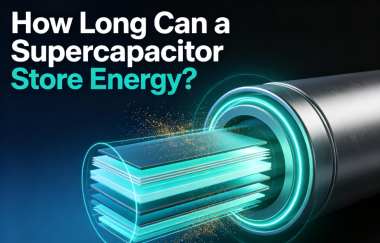
In the electronic components industry, a supercapacitor, also known as an ultracapacitor or electrochemical capacitor, is an electronic component capable of rapidly storing and releasing electrical energy. Compared with traditional batteries, supercapacitors offer higher power density, faster charging and discharging speeds, and longer cycle life. As a result, they are widely used in new energy vehicles, industrial equipment, energy storage systems, and backup power applications. However, because their energy density is lower than that of chemical power sources such as lithium batteries, supercapacitors are generally not suitable for long-term energy storage. So, how long can a supercapacitor actually store energy? What factors affect its storage time? This article provides a detailed explanation.
Catalog
II. Working Principle of Supercapacitors
III. Factors Affecting Supercapacitor Energy Storage Time
IV. Applications of Supercapacitors and Their Energy Storage Time
V. Maintenance and Lifespan of Supercapacitors
I. What Is a Supercapacitor?
A supercapacitor is an advanced energy storage device positioned between traditional capacitors and batteries. It mainly stores energy through charge separation at the interface between electrodes and electrolytes. Compared with conventional capacitors, supercapacitors have much larger capacitance, reaching farad-level or even thousands of farads, allowing them to store significantly more electrical energy.
Based on different energy storage mechanisms, supercapacitors can be divided into electric double-layer capacitors (EDLCs), pseudocapacitors, and hybrid supercapacitors. Among them, EDLCs store energy mainly through the formation of an electric charge layer on the electrode surface, while pseudocapacitors store energy through reversible redox reactions occurring on the surface of electrode materials.
II. Working Principle of Supercapacitors
During the charging process, an external power source drives electrons into the negative electrode, while ions in the electrolyte move toward the electrode surface. This process forms an electric double layer between the electrode and electrolyte, allowing electrical energy to be stored.
During discharge, the charges stored on the electrode surface are released through the external circuit to provide power for the load. Since this energy storage process does not rely on complex chemical reactions, supercapacitors can complete charging and discharging within seconds to minutes and can withstand hundreds of thousands or even millions of charge-discharge cycles.
III. Factors Affecting Supercapacitor Energy Storage Time
The energy storage time of a supercapacitor is not fixed and mainly depends on factors such as capacitance, voltage, load conditions, and operating environment.
First, the capacitance and rated voltage of a supercapacitor determine how much energy it can store. The stored energy is related to both capacitance and the square of voltage. A larger capacitance and higher operating voltage allow the supercapacitor to store more energy, resulting in longer power supply duration.
Second, the discharge current directly affects energy storage time. Supercapacitors are designed for short-term, high-power output. When the load current is high, the stored energy is released faster, and the operating time is usually only a few seconds to several minutes. Under low-power conditions, the power supply duration can be extended.
In addition, internal resistance, self-discharge rate, and ambient temperature also affect the actual performance of supercapacitors. Higher internal resistance increases energy losses, while excessively high or low temperatures can affect electrolyte performance and ion movement efficiency. Meanwhile, supercapacitors experience a certain level of self-discharge during long-term storage, causing the voltage to gradually decrease.
IV. Applications of Supercapacitors and Their Energy Storage Time
The energy storage time of supercapacitors varies depending on different application scenarios.
In new energy vehicles, supercapacitors are mainly used as auxiliary energy storage devices for applications such as vehicle startup, rapid acceleration, and regenerative braking. They can absorb and release large amounts of energy within seconds, improving system efficiency, but they are generally not used as the primary energy source for vehicle range.
In industrial equipment and automation systems, supercapacitors are commonly used as temporary backup power sources. During short-term power interruptions, they can provide power support for several seconds to several minutes, allowing equipment to save data or perform safe shutdown operations.
In renewable energy systems, supercapacitors can be used to smooth the output fluctuations of intermittent energy sources such as solar and wind power, improving grid stability. Their energy storage duration is typically from seconds to minutes, focusing mainly on power regulation rather than long-term energy storage.
For portable electronic devices, supercapacitors can be used for fast charging and peak power compensation. However, due to their limited energy density, they cannot completely replace lithium batteries for long-duration power supply.
V. Maintenance and Lifespan of Supercapacitors
Although supercapacitors have a long service life, proper maintenance is still important. First, operation beyond the rated voltage should be avoided, as overvoltage may accelerate electrolyte degradation and reduce service life. At the same time, operating temperatures should be controlled according to manufacturer specifications to prevent long-term exposure to extreme heat.
In addition, when multiple supercapacitor cells are connected in series, voltage balancing management is required to prevent individual cells from being damaged due to excessive voltage. Regular inspection of voltage levels, physical appearance, and connection conditions can also help ensure long-term stable operation.
Under normal conditions, the cycle life of supercapacitors can reach hundreds of thousands or even millions of cycles, far exceeding that of conventional batteries. Therefore, they are highly suitable for applications requiring frequent charging and discharging.
VI. Conclusion
The energy storage time of supercapacitors is affected by multiple factors, including capacitance, voltage, discharge current, ambient temperature, and application conditions. In general, supercapacitors are more suitable for providing short-term, high-power energy support rather than long-term energy storage.
With advantages such as rapid charging and discharging, high reliability, and extremely long cycle life, supercapacitors will continue to play an important role in new energy vehicles, industrial control systems, smart devices, and renewable energy applications. Through proper selection and effective management, the energy storage efficiency and service life of supercapacitors can be further improved.


