
Which Is More Durable: Lithium Batteries or Supercapacitors?


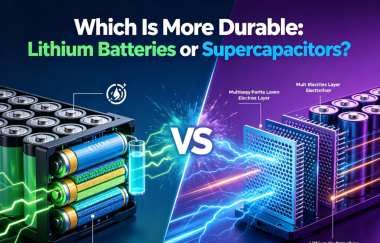
In electronic devices, industrial control systems, electric transportation, and energy storage systems, lithium batteries and supercapacitors are both widely used energy storage components. When choosing an energy storage solution, many people ask an important question: Which is more durable, a lithium battery or a supercapacitor? In practice, durability cannot be judged solely by service life. Factors such as cycle life, depth of charge and discharge, operating temperature, charge and discharge rate, and the specific application environment should also be considered. From the perspective of electronic component applications, lithium batteries are better suited for storing relatively large amounts of energy over extended periods, while supercapacitors are more suitable for high-frequency and rapid charge-discharge applications.
Catalog
III. Which Is More Durable: Lithium Batteries or Supercapacitors?
I. What Is a Lithium Battery?
A lithium battery is a type of battery that stores and releases energy through electrochemical reactions involving lithium. Among them, lithium-ion batteries are currently widely used in electronic devices and energy storage systems. Lithium batteries offer relatively high energy density, low self-discharge rates, and a well-established industrial supply chain, making them widely used in smartphones, laptops, electric vehicles, portable devices, and energy storage systems.
The durability of lithium batteries is typically evaluated based on cycle life and capacity retention. A complete charge-discharge cycle does not necessarily mean simply charging the battery once and discharging it once. Instead, a cycle is generally determined based on the cumulative amount of energy discharged. Because cycle life varies significantly depending on the battery chemistry and product design, it is inaccurate to assume that all lithium batteries can only withstand 500 cycles.
The service life of a lithium battery is also affected by temperature, charge and discharge rates, charging cutoff voltage, depth of discharge, and long-term storage conditions. High temperatures, overcharging, over-discharging, and prolonged operation at extremely high or low states of charge can accelerate capacity degradation. Therefore, using a lithium battery within its recommended operating temperature range and under appropriate charging and discharging conditions can generally help extend its actual service life.
II. What Is a Supercapacitor?
A supercapacitor, also known as an ultracapacitor or electrochemical capacitor, is an energy storage device that occupies a position between conventional capacitors and batteries. It offers high power density and very fast charge-discharge capabilities, allowing it to accept and release substantial amounts of energy within a short period. As a result, supercapacitors are commonly used for peak-power assistance, energy recovery, backup power, and transient power applications.
Compared with lithium batteries, one of the most significant durability advantages of supercapacitors is their very long cycle life. Their energy storage mechanism mainly relies on charge separation at the electrode-electrolyte interface and related electrochemical processes, rather than relying heavily on repeated bulk chemical reactions as conventional batteries do. Under appropriate operating conditions, supercapacitors can therefore withstand far more charge-discharge cycles than typical lithium batteries.
However, the statement that supercapacitors have an “almost unlimited service life” does not mean that they never age. Supercapacitors are also affected by operating voltage, ambient temperature, ripple current, and long-term operating conditions. Continuous operation at high voltage or elevated temperatures can accelerate the aging of electrolytes and materials, resulting in increased equivalent series resistance (ESR) and reduced capacitance. Therefore, in practical designs, supercapacitors should still be operated according to the rated voltage, temperature range, and service-life specifications provided by the manufacturer.
III. Which Is More Durable: Lithium Batteries or Supercapacitors?
If charge-discharge cycle life is the primary criterion, supercapacitors are generally much more durable than lithium batteries. For applications that require frequent charge and discharge cycles, such as energy recovery, transient power support in industrial equipment, and certain regenerative braking systems, supercapacitors can withstand a very large number of cycles and therefore offer a significant advantage in this respect.
If energy storage capacity and continuous power supply are the main considerations, lithium batteries have a clear advantage. Lithium batteries generally have much higher energy density than supercapacitors, allowing them to store more energy within the same volume and weight and provide power to equipment for longer periods. This is one of the main reasons why lithium batteries remain widely used in smartphones, electric vehicles, and portable electronic devices.
The two technologies also differ in terms of temperature performance. Supercapacitors generally offer strong high-power performance, but prolonged operation at high temperatures can still affect their service life. Lithium batteries are more sensitive to temperature, particularly during high-temperature operation, low-temperature charging, and high-rate charging or discharging. Their performance and service life can be significantly affected under such conditions. Therefore, determining which technology is more durable requires consideration of the actual operating environment rather than simply comparing theoretical cycle counts.
From an electronic system design perspective, lithium batteries are better suited for long-duration power supply, while supercapacitors are better suited for high-frequency power delivery. In some high-reliability systems, the two technologies can also be used together. The lithium battery can provide continuous energy, while the supercapacitor handles short-duration, high-power demands, thereby reducing the high-rate charge and discharge stress placed on the lithium battery.
IV. Conclusion
Overall, supercapacitors are generally more durable than lithium batteries when cycle life is the primary criterion, while lithium batteries have an advantage in energy storage capacity and long-duration power supply. The actual service life of a lithium battery depends on factors such as battery chemistry, operating temperature, charging and discharging conditions, and battery management. Similarly, the service life of a supercapacitor is affected by operating voltage, temperature, and current conditions.
Therefore, there is no single answer to the question of which is more durable, a lithium battery or a supercapacitor. For electronic devices that require high energy density and long-duration power supply, lithium batteries are generally more suitable. For applications requiring rapid charge and discharge, high cycle life, and high peak-power output, supercapacitors often offer greater advantages. When selecting an energy storage technology, engineers should consider energy requirements, power requirements, cycle frequency, operating temperature, and expected service life together.


