
Are Supercapacitors More Eco-Friendly Than Batteries?


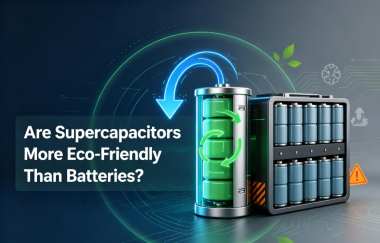
In the electronic components industry, supercapacitors and batteries are both common energy storage devices and are widely used in new energy vehicles, industrial equipment, consumer electronics, smart grids, and backup power systems. Although both can store and release electrical energy, they differ significantly in energy storage mechanisms, charging and discharging speeds, energy density, cycle life, and environmental impact. So, what exactly is the difference between supercapacitors and batteries? Which one has greater advantages in terms of environmental friendliness?
Catalog
I. What Are Supercapacitors and Batteries?
II. Differences Between Supercapacitors and Batteries for Energy Storage
III. Which Is More Environmentally Friendly: Supercapacitors or Batteries?
I. What Are Supercapacitors and Batteries?
A supercapacitor, also known as an ultracapacitor, is an energy storage device that falls between a conventional capacitor and a battery. It mainly stores charge through the electric double layer formed at the interface between the electrode and electrolyte. Some types also involve rapid surface redox reactions, known as pseudocapacitance. Because energy storage mainly relies on charge separation at the interface, supercapacitors can achieve very fast charging and discharging while offering high power density and a long cycle life.
Batteries, on the other hand, primarily store and release energy through electrochemical reactions. Taking common lithium-ion batteries as an example, lithium ions migrate between the cathode and anode during charging and discharging, accompanied by redox reactions within the electrode materials. Compared with supercapacitors, batteries generally have a higher energy density, making them more suitable for devices that require long-term power supply and extended operating time.
II. Differences Between Supercapacitors and Batteries for Energy Storage
The most fundamental difference between the two lies in their energy storage mechanisms. Supercapacitors mainly store energy through physical charge adsorption and interfacial effects at the electrode surface, while batteries store energy through reversible electrochemical reactions. This difference directly affects their performance characteristics.
In terms of charging and discharging speed, supercapacitors have a clear advantage. They can complete charging and discharging within a very short period and can quickly deliver high power, making them suitable for applications with high instantaneous power requirements. Batteries generally have slower charging and discharging rates and are more suitable for providing stable and continuous energy.
Supercapacitors also generally have an advantage in terms of cycle life. Because their energy storage process does not rely as heavily on repeated deep chemical changes in electrode materials as batteries do, they can withstand a very large number of charge and discharge cycles. Under appropriate operating conditions, supercapacitors can achieve hundreds of thousands of cycles or even more, while the cycle life of batteries is affected by factors such as battery chemistry, depth of discharge, temperature, and usage conditions.
However, supercapacitors are not superior to batteries in every aspect. The main advantage of batteries is their higher energy density. They can generally store more energy at the same weight or volume, making them more suitable for smartphones, laptops, electric vehicles, and energy storage systems that require long-term power supply. Supercapacitors, in contrast, are more suitable for applications requiring rapid charging and discharging, peak power output, and frequent cycling.
III. Which Is More Environmentally Friendly: Supercapacitors or Batteries?
The question of which is more environmentally friendly cannot be answered simply by replacing one type of device with the other, because the environmental impact of energy storage devices depends on multiple factors, including raw materials, manufacturing processes, service life, energy efficiency, and recycling and disposal.
From the perspective of service life, supercapacitors generally have a longer cycle life. If a device requires frequent charging and discharging, supercapacitors can reduce the need for replacement caused by the shorter service life of some energy storage devices, potentially providing certain environmental advantages over the entire life cycle. In addition, some supercapacitors use materials such as activated carbon and metal oxides, and their material systems have different environmental risks compared with some conventional battery chemistries.
However, this does not mean that all supercapacitors are inherently “green.” Supercapacitors also involve electrode materials, electrolytes, current collectors, and other structural materials, and their manufacturing, transportation, and end-of-life disposal can all have environmental impacts. At the same time, modern lithium-ion batteries should not be equated with older cadmium- or mercury-containing batteries. It is inaccurate to broadly assume that all batteries contain highly toxic heavy metals. The battery industry is also continuously developing material recycling, second-life applications, and resource recovery technologies to reduce environmental impacts throughout the life cycle.
Therefore, if an application emphasizes frequent charging and discharging and an exceptionally long cycle life, supercapacitors may offer certain life-cycle advantages. If the application places greater importance on high energy density and long-term power supply, batteries are generally more suitable. For some devices, combining supercapacitors with batteries and taking advantage of the strengths of both technologies can also be a more practical energy storage solution.
IV. Conclusion
Although supercapacitors and batteries are both used to store electrical energy, they differ significantly in their operating mechanisms and performance characteristics. Supercapacitors offer fast charging and discharging, high power density, and a long cycle life, while batteries provide higher energy density and are more suitable for long-term continuous power supply. In terms of environmental impact, supercapacitors may have advantages in some applications because of their longer cycle life, but it cannot be simply concluded that supercapacitors are more environmentally friendly than all types of batteries. In practical applications, the choice should be based on a comprehensive evaluation of energy requirements, power requirements, cycle frequency, service life, and environmental impact throughout the entire life cycle.


