
What Are the Internal Factors Behind Ceramic Capacitor Failure?


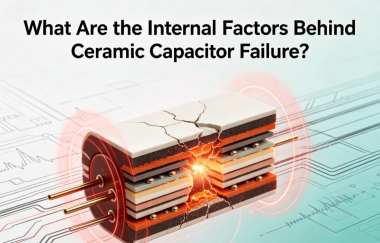
In the electronic components industry, ceramic capacitors are widely used in power supplies, automotive electronics, communication equipment, industrial control systems, and consumer electronics because of their compact size, low losses, fast response, and relatively high reliability. However, ceramic capacitors are not immune to failure. When exposed to voltage, temperature variations, mechanical stress, humidity, and other factors over an extended period, their capacitance, insulation resistance, loss characteristics, and other electrical properties may change. In severe cases, the capacitor may experience an open circuit or short circuit. Understanding the internal causes of ceramic capacitor failure is important for component selection, product design, and reliability control.
Catalog
I. What Is Ceramic Capacitor Failure?
II. How Does a Ceramic Capacitor Work?
III. Internal Factors Behind Ceramic Capacitor Failure
IV. Measures to Improve Ceramic Capacitor Reliability
I. What Is Ceramic Capacitor Failure?
Ceramic capacitor failure refers to a condition in which a capacitor can no longer meet its specified electrical performance or reliability requirements. Common failure symptoms include capacitance loss or drift, reduced insulation resistance, increased dielectric loss, increased leakage current, and, in severe cases, short circuits or open circuits.
The reliability of a ceramic capacitor depends not only on its rated voltage and operating temperature but also on the dielectric material, internal electrode structure, manufacturing processes, and actual operating environment. Therefore, analyzing capacitor failures requires consideration of material, structural, and external stress factors.
II. How Does a Ceramic Capacitor Work?
A ceramic capacitor mainly consists of ceramic dielectric layers and internal electrodes arranged in alternating layers. When voltage is applied across the capacitor, an electric field is generated within the dielectric, allowing the capacitor to store electrical energy. When required by the external circuit, the capacitor can release the stored charge, enabling functions such as filtering, decoupling, bypassing, coupling, and energy storage.
Multilayer ceramic capacitors (MLCCs) achieve high capacitance in a compact package by increasing the number of dielectric layers and the effective electrode area. However, as dielectric layers become thinner, material defects, localized electric fields, and mechanical stress can have a more significant impact on reliability.
III. Internal Factors Behind Ceramic Capacitor Failure
1. Internal Electric Field and Localized Electrical Stress
When a ceramic capacitor operates for an extended period at a voltage close to its rated value, the dielectric is continuously exposed to an electric field. If the ceramic dielectric contains microscopic pores, cracks, or local compositional variations, the electric field may become concentrated in these areas, resulting in higher localized electrical stress. Prolonged exposure can reduce insulation resistance and increase leakage current, and severe conditions may eventually lead to dielectric breakdown.
2. Dielectric Aging and Performance Changes
The electrical properties of ceramic dielectrics are affected by temperature and time. For high-dielectric-constant ceramic materials such as X5R and X7R, capacitance can change with DC bias and temperature. Long-term operation may also cause capacitance to gradually decrease over time. If the operating conditions exceed the specified limits of the component, these performance changes may become more pronounced.
3. Material Defects and Internal Structural Non-Uniformity
The density, grain structure, pores, and impurities within a ceramic dielectric can all affect capacitor reliability. Small defects may become locations where electric fields are concentrated and may gradually develop under long-term electrical and thermal stress. If a defect extends through a dielectric layer or affects an internal electrode, it can reduce insulation performance and may eventually result in dielectric breakdown.
4. Effects at the Electrode-Dielectric Interface
There are complex interfaces between the internal electrodes and ceramic dielectric layers in MLCCs. If material compatibility, sintering processes, or interface control is inadequate, localized defects may form or interface reliability may be reduced. Under prolonged temperature, voltage, and environmental stress, these weak areas may gradually deteriorate, ultimately affecting the insulation performance and service life of the capacitor.
IV. Measures to Improve Ceramic Capacitor Reliability
First, the dielectric type, rated voltage, and temperature rating should be selected according to the actual operating conditions. Long-term operation close to the component's rated limits should be avoided. For high-reliability applications, designers should also consider DC bias, temperature variations, and capacitance degradation rather than focusing solely on the nominal capacitance value.
Second, the manufacturing consistency of the ceramic dielectric and internal electrodes should be improved. Optimizing processes such as powder preparation, forming, stacking, and sintering can help reduce potential defects such as pores, cracks, and impurities. Strict quality control of materials and manufacturing processes is also necessary to improve batch-to-batch consistency.
In addition, PCB design and assembly processes can also affect MLCC reliability. Ceramic capacitors are relatively brittle, and stresses caused by soldering, PCB bending, and mechanical shock may lead to internal cracks. Therefore, appropriate pad design and assembly processes should be adopted to reduce board-flexing stress and mechanical impact. For demanding applications, MLCCs with enhanced flex-crack resistance can also be considered.
V. Conclusion
Ceramic capacitor failure is generally not caused by a single factor but by the combined effects of internal material defects, electrical stress, dielectric aging, interface reliability, and external mechanical and thermal stresses. Improving ceramic capacitor reliability requires proper component selection, control of operating stress, optimized materials and manufacturing processes, and reduced mechanical damage during assembly. For high-reliability electronic equipment, controlling the entire process from component selection and PCB design to production testing can help effectively reduce the risk of ceramic capacitor failure.


