
What Are the Differences Between Solid-State and Electrolytic Capacitors?


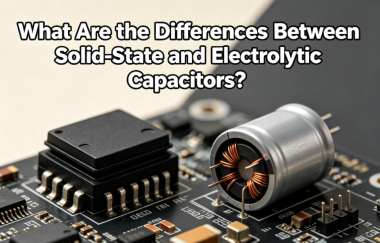
In the electronic components industry, capacitors are common passive components widely used for energy storage, filtering, bypassing, coupling, and voltage stabilization. In electronic equipment, both solid-state capacitors and electrolytic capacitors are widely used, but they differ significantly in dielectric materials, equivalent series resistance (ESR), service life, temperature performance, capacitance, and application scenarios. So, what is the difference between solid-state capacitors and electrolytic capacitors? Understanding their operating characteristics and advantages can help engineers select the appropriate capacitor based on specific circuit requirements.
Catalog
I. What Are Solid-State Capacitors and Electrolytic Capacitors?
II. Differences Between Solid-State Capacitors and Electrolytic Capacitors
III. Advantages of Solid-State Capacitors
IV. Advantages of Electrolytic Capacitors
V. How Should You Choose Between Solid-State Capacitors and Electrolytic Capacitors?
I. What Are Solid-State Capacitors and Electrolytic Capacitors?
A solid-state capacitor generally refers to an electrolytic capacitor that uses a solid conductive material as its electrolyte. Solid polymer aluminum electrolytic capacitors are a common type. Unlike conventional liquid aluminum electrolytic capacitors, which use a liquid electrolyte, solid-state capacitors use a solid electrolyte such as a conductive polymer. As a result, they generally offer lower equivalent series resistance and better high-frequency performance.
An electrolytic capacitor generally refers to a capacitor that uses an electrolyte and a metal oxide film to form its dielectric structure. Common types include aluminum electrolytic capacitors and tantalum electrolytic capacitors. In an aluminum electrolytic capacitor, for example, the dielectric layer is primarily a thin aluminum oxide film formed on the surface of the aluminum anode, while the electrolyte forms part of the cathode system. Electrolytic capacitors can typically provide relatively high capacitance in a compact package, making them widely used in power filtering, rectifier smoothing, and low-frequency energy storage circuits.
II. Differences Between Solid-State Capacitors and Electrolytic Capacitors
One of the most significant differences between solid-state capacitors and conventional liquid aluminum electrolytic capacitors is the state of their electrolyte. Solid-state capacitors use a solid conductive polymer or similar solid electrolyte, whereas conventional aluminum electrolytic capacitors generally use a liquid electrolyte. This structural difference affects their ESR, ripple current capability, temperature characteristics, and long-term reliability.
In terms of ESR, solid-state capacitors generally have lower equivalent series resistance. A lower ESR helps reduce resistive power losses during high-frequency operation and provides better ripple current handling. This is one reason why solid-state capacitors are commonly used in processor power supplies, graphics cards, power modules, and other circuits that require good high-frequency performance.
In terms of service life and temperature performance, solid-state capacitors do not contain the liquid electrolyte found in conventional liquid electrolytic capacitors. Therefore, they are not subject to typical failure mechanisms associated with electrolyte evaporation and drying. Solid-state capacitors generally offer good high-temperature stability and long service life. However, this does not mean that they are immune to failure under all operating conditions. Their service life can still be affected by operating temperature, applied voltage, ripple current, manufacturing processes, and other factors.
In terms of capacitance and voltage ratings, conventional electrolytic capacitors generally offer a wider range of capacitance values and are available in a broad selection of voltage ratings, including relatively high-voltage specifications. Solid-state capacitors are also available in various capacitance and voltage ratings, but their specific ranges depend on the capacitor type, construction, and manufacturing technology. Therefore, it is not accurate to assume that solid-state capacitors can only be used in low-voltage circuits.
III. Advantages of Solid-State Capacitors
One of the main advantages of solid-state capacitors is their low ESR. Low ESR helps reduce losses in high-frequency circuits and can improve power output stability, making these capacitors suitable for circuits that require good transient response and high-frequency filtering performance.
Solid-state capacitors also generally offer good high-temperature performance and long-term stability. Because they use a solid electrolyte, their performance is less affected by electrolyte evaporation and drying. As a result, they are widely considered for applications such as computer motherboards, servers, power modules, industrial equipment, and automotive electronics where long-term reliability is important.
In addition, solid-state capacitors generally provide good ripple current capability and high-frequency characteristics. In power filtering and decoupling circuits that require fast response, their low ESR can help reduce voltage fluctuations and improve overall circuit stability.
IV. Advantages of Electrolytic Capacitors
One of the main advantages of conventional electrolytic capacitors is their relatively high capacitance. Under comparable size and cost conditions, electrolytic capacitors can generally provide higher capacitance, making them suitable for applications such as power input and output filtering, rectifier smoothing, and energy storage.
Electrolytic capacitors are available in a wide variety of specifications, with a broad selection of capacitance values, voltage ratings, and package sizes. This allows them to meet the requirements of many different electronic devices. In particular, aluminum electrolytic capacitors remain widely used in power circuits that require relatively high capacitance and voltage ratings.
From a cost perspective, conventional aluminum electrolytic capacitors generally offer good cost performance. In circuits that do not have particularly demanding requirements for ESR, high-frequency performance, or extremely long service life, an electrolytic capacitor with an appropriate capacitance, voltage rating, and temperature rating can provide a practical and economical solution.
V. How Should You Choose Between Solid-State Capacitors and Electrolytic Capacitors?
Choosing between a solid-state capacitor and an electrolytic capacitor should not be based on capacitance alone. Engineers should also consider rated voltage, operating temperature, ESR, ripple current, service life, physical size, cost, and other electrical and mechanical requirements.
If a circuit requires low ESR, good high-frequency performance, high ripple current capability, and long-term reliability, solid-state capacitors may be a suitable option. For example, processor power supplies, graphics card power circuits, server power supplies, and high-frequency DC-DC converters often place greater emphasis on these characteristics.
If a circuit places greater emphasis on high capacitance, a broad voltage range, cost efficiency, and energy storage capability, electrolytic capacitors remain a common choice. They are widely used in power filtering, rectifier smoothing, and various low-frequency circuits.
VI. Conclusion
Solid-state capacitors and electrolytic capacitors do not have an absolute advantage over one another. Their main differences lie in electrolyte composition, ESR, frequency characteristics, service life, capacitance, voltage ratings, and cost. Solid-state capacitors generally offer low ESR, good high-frequency performance, and good long-term stability, while electrolytic capacitors provide high capacitance, a wide range of available specifications, and relatively low cost. In practical electronic circuit design, the appropriate capacitor should be selected according to operating voltage, ripple current, operating temperature, capacitance requirements, expected service life, and other specific application requirements.


