
What Is Transformer Differential Protection?


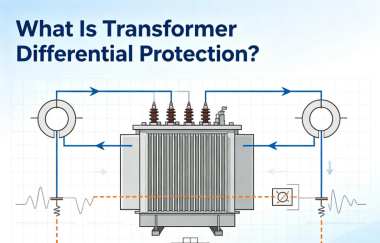
Transformers are important equipment in power systems. If internal faults such as winding short circuits, turn-to-turn faults, or lead faults cannot be cleared promptly, they may cause serious equipment damage and even affect the stability of the entire power system. Transformer differential protection is a fast main protection function designed to detect internal transformer faults. It determines whether a fault has occurred within the protected zone by comparing the magnitude and phase relationship of currents on different sides of the transformer. This article introduces the basic principles of transformer differential protection and key commissioning methods.
Catalog
I. Transformer Differential Protection Principle
II. Transformer Differential Protection Commissioning Methods
I. Transformer Differential Protection Principle
The basic principle of transformer differential protection is to use current transformers installed on two or more sides of the transformer to collect current signals. These currents are then compared after compensation for factors such as CT ratios, phase relationships, and transformer connection configurations. Under normal operating conditions or during faults outside the protected zone, the currents entering and leaving the protected zone are ideally balanced, resulting in only a small differential current. Therefore, the protection device does not operate.
When an internal short circuit or other fault occurs inside the transformer, the relationship between the currents on both sides changes significantly, causing the differential current detected by the protection device to increase. When the differential current reaches the specified operating condition and satisfies the corresponding restraint characteristics, the differential protection issues a trip signal to the relevant circuit breakers, thereby quickly isolating the fault.
In practical transformer differential protection systems, the CT ratio, polarity, and transformer winding connection group can all affect the comparison of currents on different sides. Therefore, modern microprocessor-based differential protection devices typically use software-based ratio and phase compensation to ensure that currents from different voltage levels and connection configurations can be compared correctly.
In addition, differential protection generally uses a restrained differential protection characteristic to prevent unwanted operation caused by external short circuits, high load currents, or transient CT saturation. Some transformer differential protection systems also use inrush-current detection or second-harmonic restraint to identify the magnetizing inrush current that may occur when a transformer is energized without load, thereby improving protection reliability.
II. Transformer Differential Protection Commissioning Methods
The main purpose of transformer differential protection commissioning is to verify that the current acquisition circuits, protection settings, differential protection criteria, and tripping circuits all operate correctly according to the design requirements. Commissioning should normally be performed in accordance with the protection device manufacturer's technical documentation, design drawings, and applicable field testing procedures.
1. Check the Current Transformers and Secondary Circuits
Before commissioning, check the CT ratios, polarity, wiring configuration, and secondary circuits on all sides of the transformer. Confirm that the corresponding current input terminals of the protection device are correctly wired. The insulation, grounding, and terminal connections of the secondary circuits should also be inspected.
CT polarity and ratio are particularly important in transformer differential protection. If the CT polarity is reversed or the ratio parameters are configured incorrectly, abnormal differential current may occur even when the primary equipment is operating normally. Therefore, dedicated test equipment is normally used in the field to verify CT polarity, ratio, and circuit connections.
2. Verify Transformer Parameters and Protection Settings
The relevant differential protection parameters should be checked according to the transformer's rated capacity, rated voltage, winding connection group, CT ratios, and protection device model. Key items include the differential pickup value, restraint characteristic, and high-set or instantaneous differential protection settings, where applicable.
For microprocessor-based differential protection devices, the transformer connection group, phase compensation method, and rated current settings for each side should also be verified. Because the specific setting items vary between protection device models, parameters should not simply be copied from other equipment.
3. Perform Secondary Injection Tests
Secondary injection testing is an important method for commissioning transformer differential protection. A relay test set is used to inject preset current magnitudes and phase angles into the protection device to simulate different operating and fault conditions and verify the protection characteristics.
During testing, the differential protection pickup value, operating value, restraint characteristic, and phase relationship can be verified according to the configured protection settings. For example, when an internal fault within the protected zone is simulated, the test should confirm that the protection device correctly issues an operating signal when the differential current reaches the required operating condition. When an external fault or normal load condition is simulated, the test should verify that the protection provides sufficient restraint to prevent unwanted operation.
4. Check the Trip and Signaling Circuits
After the differential protection operates, the output relays, trip circuits, circuit breaker trip coils, and related signaling circuits should be checked to ensure that they function correctly. A trip transfer test can be performed to confirm that the trip command issued by the protection device is correctly transmitted to the relevant circuit breaker.
It should be noted that trip circuit testing must be performed in accordance with the applicable site safety measures and approved test procedures to prevent unintended tripping when primary equipment is energized or in service.
5. Check the Non-Operating Characteristics
Differential protection must not only operate correctly during internal faults but must also remain stable during normal operation and external faults. Therefore, commissioning should also include tests under normal load conditions, external short-circuit conditions, and other operating conditions that may produce differential or unbalanced currents.
These tests help verify the restraint function of the protection device and its ability to withstand factors such as CT errors and transient saturation. Only when both the operating characteristics and restraint characteristics meet the applicable design requirements can the commissioning of the differential protection be considered substantially complete.
III. Conclusion
Transformer differential protection compares compensated currents on different sides of a transformer to quickly identify internal faults within the protected zone. It is one of the important main protection functions for transformers. Its reliable operation depends not only on the protection device itself but also on CT ratios, polarity, transformer connection groups, secondary circuits, and protection settings.
During actual commissioning, particular attention should be paid to CT and secondary circuit checks, verification of protection parameters, secondary injection tests, verification of operating and restraint characteristics, and trip circuit transfer tests. After commissioning, acceptance testing and periodic inspections should be performed in accordance with applicable regulations and the protection device manufacturer's requirements. This helps ensure that transformer differential protection can quickly and accurately isolate a fault when an internal transformer fault occurs.


