
What Are the Advantages of Three-Phase SSRs?


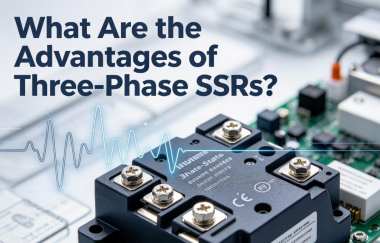
With the development of industrial automation, power control, and electronic technology, three-phase solid state relays have become widely used in industrial heating equipment, motor control, and automated production systems. Compared with traditional electromechanical relays, three-phase solid state relays use semiconductor devices to switch electrical circuits. They offer several advantages, including no mechanical contacts, fast switching speeds, and low operating noise. Understanding their definition, working principle, and main advantages helps engineers select suitable devices based on load type, operating voltage, and control requirements.
Catalog
I. What Is a Three-Phase Solid State Relay?
II. How Does a Three-Phase Solid State Relay Work?
III. Main Advantages of Three-Phase Solid State Relays
I. What Is a Three-Phase Solid State Relay?
A three-phase solid state relay (SSR) is an electronic switching device that uses semiconductor switching components to control three-phase circuits. It is typically used to control the connection and disconnection between a three-phase AC power supply and a load. Its internal structure generally consists of an input control circuit, an isolation circuit, a triggering or driving circuit, and power semiconductor devices. Common power devices include silicon-controlled rectifiers (SCRs) and triacs. The specific configuration depends on the product's rated current, voltage, and application requirements.
Unlike traditional relays that rely on electromagnetic coils and mechanical contacts for switching, three-phase solid state relays use electronic signals to control the conduction and turn-off of semiconductor devices. As a result, they do not require mechanical contacts. However, not all three-phase solid state relays share the same internal circuitry. Their control methods, output configurations, and compatible loads should be verified in the product datasheet.
II. How Does a Three-Phase Solid State Relay Work?
A three-phase solid state relay operates by using an input control signal to drive internal semiconductor switches, thereby controlling the conduction and interruption of a three-phase AC circuit. Its typical operating process consists of the following three stages.
1. Receiving the Control Signal
When a controller, programmable logic controller (PLC), or other control device sends a valid input signal, the input circuit of the solid state relay receives it and transfers it to the power switching devices through internal isolation and driving circuits. The input and output terminals are typically electrically isolated to reduce the impact of the high-voltage load side on the control system.
2. Switching On the Three-Phase Circuit
When the input signal meets the triggering requirements, the internal power semiconductor devices enter the conducting state, allowing the three-phase power supply to deliver electricity to the load. Some AC solid state relays use zero-cross switching, which turns on the load when the AC voltage approaches zero. Other models use random-fire switching, allowing them to respond to control signals at different phases of the AC cycle.
3. Disconnecting the Load
When the control signal is removed, the solid state relay stops driving the switching devices according to their operating characteristics. In common thyristor-based AC solid state relays, the power devices typically turn off when the load current falls below the holding current. Therefore, the actual turn-off process may not occur at exactly the same moment the input signal is removed.
For three-phase loads, the solid state relay must control the corresponding power lines according to its design. In practical applications, engineers should verify the compatible three-phase voltage, load current, control input range, and heat dissipation requirements to prevent overheating or device damage caused by improper selection.
III. Main Advantages of Three-Phase Solid State Relays
1. No Mechanical Contacts and Longer Service Life
Three-phase solid state relays use semiconductor devices for switching and do not experience the repeated impact and mechanical wear associated with traditional relay contacts. With appropriate electrical and thermal design, they are suitable for applications requiring frequent switching. However, semiconductor devices remain susceptible to temperature, voltage, current, and surge stress. The absence of mechanical contacts does not mean that the device cannot fail.
2. Fast Switching Response for Automated Control
Solid state relays generally offer fast switching responses, making them suitable for equipment that requires frequent switching or automated control. For example, in industrial temperature control systems, a controller can adjust the switching of heating loads according to temperature changes, providing greater flexibility in the control process. The actual response time depends on the device structure, triggering method, and load characteristics.
3. Low Operating Noise and Reduced Contact Arcing
Because solid state relays have no moving mechanical contacts, they do not generate mechanical switching noise or the contact arcing commonly associated with mechanical relay interruption. This makes them suitable for industrial control environments where noise and electrical interference are concerns. However, solid state relays can still generate electromagnetic interference, depending on the switching method, load, and circuit design.
4. Compact Structure and Easy Integration
Many three-phase solid state relays feature compact packages, making them easier to install in electrical control cabinets and automated equipment. Their electronic control interfaces also facilitate integration with PLCs, temperature controllers, and other control systems. However, high-current models typically require suitable heatsinks and sufficient installation space for effective heat dissipation.
5. Lower Maintenance Requirements for Frequent Switching
Because mechanical contacts do not need regular inspection or replacement, three-phase solid state relays can reduce certain maintenance tasks. Nevertheless, during long-term operation, engineers should still inspect heat dissipation conditions, wiring connections, and load current. Appropriate overcurrent and overtemperature protection should also be provided according to application requirements.
It is important to note that solid state relays have an on-state voltage drop, which generates power losses and heat. Some AC solid state relays also exhibit a small leakage current when switched off. Therefore, when controlling motors or other inductive loads, engineers should select suitable models based on load characteristics and determine whether additional protection devices are required. In applications requiring reliable electrical isolation for safety, turning off the control signal alone must not be considered proof that the load is completely disconnected from the power supply.
IV. Conclusion
A three-phase solid state relay is an electronic switching device that uses semiconductor components to control the conduction and interruption of three-phase circuits. Its main advantages include the absence of mechanical contacts, fast switching response, low operating noise, reduced maintenance requirements, and easy integration. These characteristics make it suitable for industrial heating, automated control, and certain three-phase AC load applications. When selecting a device, engineers should consider not only its rated voltage and current but also the load type, triggering method, heat dissipation requirements, leakage current, and protection measures. Evaluating these factors alongside the product datasheet helps ensure reliable performance and effective operation in the intended application.


