
What Are Supercapacitors' Pros and Cons?


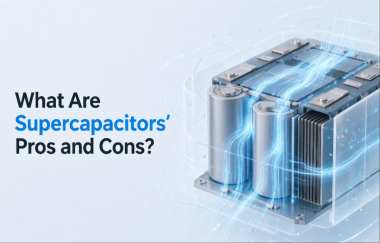
Supercapacitors are energy storage components known for their high power density, fast charging and discharging capabilities, and long cycle life. They are widely used in electric vehicles, industrial equipment, smart grids, and consumer electronics. Compared with conventional lithium-ion batteries, supercapacitors can deliver or absorb large amounts of electrical energy within a short period, making them suitable for applications that require rapid energy response and frequent charge-discharge cycles. However, they also have certain limitations in energy density, cost, and energy storage duration. Understanding their working principles, advantages, and disadvantages helps engineers select the right energy storage solution for specific circuit requirements.
Catalog
II. How Does a Supercapacitor Work?
III. Advantages of Supercapacitors
IV. Disadvantages of Supercapacitors
I. What Is a Supercapacitor?
A supercapacitor, also known as an electrochemical capacitor, is an energy storage component that bridges the gap between conventional capacitors and rechargeable batteries. It primarily stores electrical energy through the formation of an electrical double layer at the electrode-electrolyte interface, as well as fast surface redox reactions in certain electrode materials.
Compared with conventional capacitors, supercapacitors offer much higher capacitance and can store more electrical charge. Compared with traditional batteries, they provide faster charging and discharging speeds and generally longer cycle life. As a result, supercapacitors are commonly used in short-term backup power supplies, peak power compensation, energy recovery systems, and voltage stabilization applications.
II. How Does a Supercapacitor Work?
Supercapacitors store energy primarily through charge accumulation on electrode surfaces. Their energy storage mechanisms mainly include electric double-layer capacitance (EDLC) and pseudocapacitance.
Electric double-layer capacitance stores electrical energy through the formation of an electrical double layer between the electrodes and the electrolyte. When a supercapacitor is connected to a power source, positive and negative ions move toward the oppositely charged electrode surfaces, forming layers of accumulated charge. This storage mechanism mainly relies on physical adsorption rather than bulk chemical reactions, as commonly found in conventional batteries. As a result, EDLC supercapacitors offer fast charge-discharge performance and long cycle life.
Pseudocapacitance, on the other hand, stores electrical energy through fast and reversible redox reactions occurring on or near the electrode surfaces. Compared with purely electric double-layer storage, pseudocapacitive materials can generally provide higher specific capacitance. However, their performance depends on material properties and reaction stability.
III. Advantages of Supercapacitors
1. High Power Density and Fast Charging and Discharging
Supercapacitors can support high-current charging and discharging within a short period, making them suitable for equipment that requires instant high-power output. Typical applications include motor starting systems, industrial control equipment, and regenerative braking systems in electric vehicles.
2. Long Cycle Life
Unlike conventional batteries, whose performance is affected by repeated bulk chemical reactions, supercapacitors generally experience less structural and chemical degradation during charge-discharge cycles. Under appropriate operating voltage and temperature conditions, their cycle life can typically reach hundreds of thousands to millions of cycles.
3. High Charge-Discharge Efficiency
Supercapacitors generally have low internal resistance, which helps reduce energy losses during charging and discharging. Under suitable operating conditions, they can achieve high energy conversion efficiency, making them suitable for applications involving frequent energy recovery and release.
4. Wide Operating Temperature Range
Some supercapacitors can operate across a relatively wide temperature range. Compared with certain battery technologies, they offer advantages in low-temperature and high-power applications. However, the actual operating temperature range depends on the specific product and should always be verified against the manufacturer's datasheet.
5. Fast Power Response
Supercapacitors can quickly deliver or absorb electrical energy, making them suitable for transient power compensation, voltage fluctuation suppression, and short-term backup power applications. These capabilities help improve the operational stability of electronic equipment and power systems.
IV. Disadvantages of Supercapacitors
1. Low Energy Density
Low energy density is one of the most significant limitations of supercapacitors. Compared with lithium-ion batteries, they store considerably less energy per unit of weight or volume. Therefore, they are not ideal for applications that require large energy storage capacity or long-duration power supply.
2. Relatively High Self-Discharge Rate
Supercapacitors gradually lose stored charge even when they are disconnected from external loads due to internal leakage and other factors. Therefore, they are less suitable for applications that require long-term energy storage with minimal power loss.
3. Limited Operating Voltage
The rated operating voltage of an individual supercapacitor cell is relatively low, with approximately 2.7V being common for many conventional products. When a higher system voltage is required, multiple cells are typically connected in series. A voltage balancing circuit is also generally needed to prevent individual cells from exceeding their rated voltage.
4. Relatively High Cost
Although supercapacitors offer long service life, their initial purchase cost and cost per unit of stored energy can still be higher than those of conventional battery technologies in certain applications. Therefore, engineers need to consider power requirements, service life, and overall system costs when selecting an energy storage solution.
5. Voltage Drops During Discharge
Unlike batteries, which can maintain a relatively stable output voltage over much of their discharge cycle, supercapacitors experience a noticeable decrease in terminal voltage as their stored charge is released. Consequently, some applications require DC-DC converters to maintain a stable voltage for connected loads.
6. Performance Degradation Under High Temperature and Voltage
Long-term operation at high temperatures or close to the rated voltage limit can accelerate supercapacitor degradation and reduce service life. Therefore, properly controlling operating temperature, charging voltage, and current is essential for maintaining performance and extending service life.
V. Conclusion
With their high power density, fast charging and discharging capabilities, and long cycle life, supercapacitors play an important role in electric vehicles, industrial automation, power systems, and consumer electronics. However, their relatively low energy density, noticeable self-discharge, and limited operating voltage restrict their use in long-duration energy storage applications.
In practical electronic circuit design, supercapacitors are not simply replacements for conventional batteries. Instead, they are energy storage solutions with distinct performance advantages. Supercapacitors are particularly suitable for equipment requiring rapid charging and discharging, instant high-power output, and frequent energy recovery. For applications that require continuous power over extended periods, lithium-ion batteries and other battery technologies are generally more suitable. In some systems, supercapacitors and batteries can also be used together to balance energy density and power performance.


