
What Is an Energy Storage Capacitor and How Does It Work?


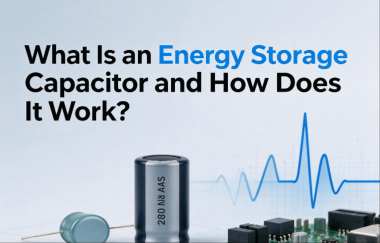
An energy storage capacitor is a common capacitor application in electronic circuits. It is primarily used to store electrical energy and release it when needed. It can provide current support to a load over a short period, helping circuits handle transient power demands and maintain relatively stable supply voltages. Therefore, energy storage capacitors are widely used in power management, camera flashes, motor drives, pulse circuits, and new energy power electronic systems. Understanding their working principles, main functions, and applications helps engineers make informed decisions in circuit design and electronic component selection.
Catalog
I. What Is an Energy Storage Capacitor?
II. Functions of Energy Storage Capacitors
III. Applications of Energy Storage Capacitors
IV. Differences Between Filter Capacitors and Energy Storage Capacitors
I. What Is an Energy Storage Capacitor?
An energy storage capacitor is a capacitor that stores electrical energy in an electric field and releases it when required. When a circuit is powered on, the capacitor accumulates electric charge during the charging process, storing electrical energy in its electric field. When the circuit experiences a temporary power demand, the capacitor can discharge and deliver energy to the load.
An energy storage capacitor is not a separate structural category of capacitor. Instead, the term describes how a capacitor is used based on its function in a circuit. Ceramic capacitors, film capacitors, aluminum electrolytic capacitors, and supercapacitors can all be used for different energy storage applications, depending on their capacitance, voltage rating, equivalent series resistance (ESR), discharge capability, and operating conditions.
II. Functions of Energy Storage Capacitors
1. Storing and Releasing Electrical Energy
Energy storage capacitors store electrical energy when the power supply has sufficient capacity and release it when the load requires additional energy. This helps meet temporary increases in power demand.
2. Stabilizing Supply Voltage
When the circuit experiences sudden load changes or transient current demands, energy storage capacitors can provide additional current to reduce voltage fluctuations and improve circuit stability.
3. Providing Transient Current Support
In camera flashes, motor drives, and pulse power circuits, energy storage capacitors can release stored energy over a short period to provide transient current support for the load. Their actual output capability depends on capacitance, ESR, operating voltage, and circuit design.
4. Improving Power Supply Response
When used in power supply circuits, energy storage capacitors can help compensate for brief input voltage drops and rapid load current changes, allowing the system to better handle transient power demands.
III. Applications of Energy Storage Capacitors
Energy storage capacitors play important roles in various electronic devices and power systems. Common applications include the following:
1. Power Management
In switching power supplies, DC-DC converters, and other power management circuits, energy storage capacitors are commonly used to store and release electrical energy. They help reduce voltage fluctuations caused by load changes and provide a relatively stable power supply for electronic devices.
2. Camera Flashes
Camera flashes are a typical application of energy storage capacitors. A flash circuit usually charges a high-voltage capacitor through a voltage-boosting circuit. When a photo is taken, the capacitor rapidly releases its stored energy, allowing the flash to produce an intense burst of light within a very short time.
3. Motor Drives
In motor drive systems, energy storage capacitors can provide energy buffering for the inverter's DC bus. They help meet transient power demands during motor startup, acceleration, and sudden load changes while reducing DC bus voltage fluctuations.
4. New Energy and Energy Storage Systems
In solar inverters, wind power equipment, and electric vehicle power systems, energy storage capacitors are commonly used for DC bus support, power buffering, and transient energy management. They help systems respond to short-term power variations. Their primary function is to provide transient energy buffering rather than replace batteries or other long-term energy storage devices.
5. Pulse Power Circuits
In laser equipment, pulse power supplies, and certain industrial devices, energy storage capacitors can accumulate electrical energy in advance and release it rapidly when needed to meet short-duration, high-power requirements.
IV. Differences Between Filter Capacitors and Energy Storage Capacitors
Filter capacitors and energy storage capacitors are both common applications of capacitors in electronic circuits, but their primary functions are different.
Filter capacitors are mainly used to reduce voltage ripple and electrical noise, making the output voltage smoother. They are commonly found in rectifier circuits, power supply input and output stages, and signal processing circuits. By presenting different impedance characteristics to signals at different frequencies, they help suppress unwanted voltage fluctuations and noise. Common types of filter capacitors include ceramic capacitors, aluminum electrolytic capacitors, and film capacitors. The appropriate type depends on the circuit's operating frequency, required capacitance, and performance requirements.
Energy storage capacitors are primarily designed to store electrical energy and release it when required to meet transient power demands. They are commonly used in camera flashes, motor drives, pulse power supplies, and new energy power electronic systems. Their selection depends on requirements such as capacitance, voltage rating, ESR, and charging and discharging capabilities.
The main difference lies in their design priorities. Filter capacitors focus more on ripple suppression and noise filtering, while energy storage capacitors emphasize energy storage, discharge speed, and transient power delivery. However, these two functions are not mutually exclusive. The same capacitor can perform both filtering and energy storage functions, depending on the circuit design and actual operating conditions.
V. Conclusion
Energy storage capacitors store and release electrical energy to provide energy buffering and transient power support in electronic circuits. They play important roles in power management, camera flashes, motor drives, new energy systems, and pulse power equipment. Compared with filter capacitors, which primarily suppress voltage ripple and electrical noise, energy storage capacitors place greater emphasis on energy storage and discharge capabilities. When selecting capacitors for practical circuit designs, engineers should consider operating voltage, required capacitance, ESR, ripple current, charging and discharging frequency, and operating temperature to ensure circuit stability and reliability.


