
How Does a Sound-and-Light Delay Switch Work?


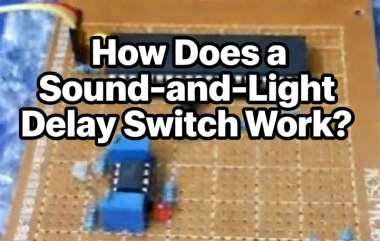
In modern electronics and energy-saving applications, the sound-and-light controlled delay switch circuit board is a widely used smart control module. It is mainly installed in public areas such as hallways, corridors, garages, and restrooms, where it automatically senses environmental light and sound to intelligently manage lighting. This design not only saves a significant amount of electricity but also extends the lifespan of light fixtures, providing users with the convenience of hands-free operation. Its core lies in the clever combination of acoustic sensing, optical detection, and electronic delay technology, ensuring that lighting only activates when the light is insufficient and needed, and automatically turns off after a short period, achieving a perfect balance between efficiency and environmental friendliness.
Catalog
I. Composition of the Sound-and-Light Delay Switch
II. What is Sound-and-Light Control?
III. Simple Sound-and-Light Switch
I. Composition of the Sound-and-Light Delay Switch
A typical sound-and-light delay switch circuit board is mainly composed of three core parts working together. The first part is the sound control unit, whose key component is an electret microphone that captures environmental sounds, such as footsteps or claps, and converts them into weak electrical pulse signals. The second part is the light control unit, whose key component is a photoresistor, which changes its resistance dramatically depending on the ambient light, producing distinct high or low voltage levels that determine whether the activation conditions are met. The third part is the delay control unit, usually made up of a timing integrated circuit, such as the classic 555 chip or the CD4011 digital IC, together with external resistors and capacitors forming an RC charging and discharging circuit, which maintains a set conduction time after being triggered. In addition, the circuit includes a power supply rectification and filtering module, a signal amplification unit, and an electronic switch such as a SCR or relay, forming a complete automatic control system.
II. What is Sound-and-Light Control?
Sound-and-light control is an electronic method that uses changes in environmental sound and light intensity as trigger conditions to automatically control the switching of a circuit. Specifically, for a sound-and-light delay switch, it refers to a device that, when ambient light drops below a set threshold, such as at night, detects sound signals of a specific intensity to activate the switch, automatically turning on the power to the load, usually a lighting fixture, and then turning it off automatically after a preset duration. This process requires no physical contact, achieving fully automated, non-contact control. The technology combines sensors, analog circuits, and digital logic processing, representing a typical application of electronics for everyday energy-saving purposes.
III. Simple Sound-and-Light Switch
A simple and practical sound-and-light delay switch is compact, low-cost, stable, and easy to build, making it ideal for electronics enthusiasts for DIY projects and practical use. Such switches often use general-purpose digital ICs, for example, the CD4011, which contains four independent NAND gates, as the core logic control, making the circuit structure simple and reliable. They can be installed in residential hallways but are also fully suitable for offices, schools, and factory workshops that require automated intermittent lighting. To make one yourself, you just follow a clear circuit diagram and assemble common components such as an electret microphone, photoresistor, SCR, and a few resistors and capacitors, with a high success rate and significant practical value.
IV. Working Principle
The circuit's working principle follows a clear logical sequence. First, the power module uses a diode bridge and capacitor filtering to provide a stable DC voltage for the entire control circuit. During the day, with sufficient ambient light, the photoresistor's resistance is low, which makes the light control output low and blocks the downstream sound control path, keeping the switch off regardless of any sound. At night or in dim lighting, the photoresistor's resistance increases, causing the light control output to go high and lifting the block on the sound control channel. At this point, when the electret microphone picks up a valid sound, the generated electrical signal is coupled through a capacitor to the amplification circuit, such as a linear amplifier built with a NAND gate. The amplified signal produces a high-level trigger while the sound is present. This high-level signal, combined with the high-level signal from the light control, is sent to the main control logic gate made of NAND gates. When both conditions—darkness and sound—are met, the main gate outputs a high level, triggering the SCR to conduct and turning on the light.
While the light is on, the trigger signal charges a capacitor in the RC delay circuit through a diode. After the sound stops, the capacitor discharges slowly through a resistor, keeping the main logic gate input high for a set period. As the capacitor voltage gradually drops below the threshold, the main logic gate output flips to low, causing the SCR to turn off at the AC zero-cross point, and the light goes out, completing a full "trigger-delay-off" cycle. The delay duration can be precisely set by adjusting the resistor or capacitor values.
V. Conclusion
In summary, the sound-and-light delay switch circuit board is a prime example of electronic components cleverly applied to everyday energy-saving tasks. Its core function relies on the photoresistor and electret microphone to sense light and sound, while logic ICs handle condition checking and delay management to drive the power switch. Understanding its composition and working principle not only helps in selecting, installing, and maintaining these devices but also lays a solid foundation for designing and building similar smart control circuits. As technology advances, future switches may integrate more precise sensors and IoT interfaces, but the core idea of environment-based sensing and delayed automatic shutoff will continue to play a key role in energy-saving applications.


