
Relay vs Transistor PLC: What's the Difference?


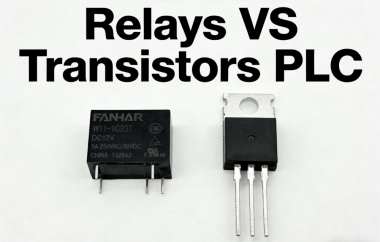
In the field of industrial automation control, the output unit of a programmable logic controller (PLC) is the key interface that connects the control system with on-site actuators. Common output types mainly include relay output, transistor output, and thyristor output. Among them, relay output and transistor output are the most widely used, and they differ significantly in working principles, performance characteristics, and application scenarios. This article systematically explains the core differences between relay-output PLCs and transistor-output PLCs.
Catalog
II. What is transistor output?
I. What is relay output?
Relay output is a mechanical contact switch. Inside the PLC, the CPU energizes a small relay coil, which drives metal contacts to open or close, thereby controlling the external load circuit through these contacts. Because the contacts and the coil are isolated by mechanical movement and an air gap, complete electrical isolation is achieved. The output side is a “dry contact” and does not provide its own power supply.
II. What is transistor output?
Transistor output is a semiconductor, non-contact switch. Inside the PLC, the CPU uses an optocoupler for isolation to drive the conduction and cutoff of a transistor (such as a MOSFET or BJT), and controls the on-off of the external load current using semiconductor characteristics. Although there is optocoupler-based signal isolation between the input and output, the output stage itself does not have the physical isolation contacts that a relay provides.
III. Key differences
1. Load compatibility
When it comes to load compatibility, relay PLCs have a clear advantage. Relay outputs can drive both AC and DC loads, with a wide voltage range from DC 24V to AC 220V, and the current per output point is typically around 2A. This makes them suitable for directly controlling power-type loads such as motors and solenoid valves.
In comparison, transistor PLCs can only drive DC loads. Typical operating voltages range from DC 5V to DC 30V, and the output current per point is usually between 0.2A and 0.5A. Overall load capacity is clearly lower than that of relay outputs. When the load power is relatively large, an external relay or solid-state relay is often required to amplify the drive capability.
2. Response speed and output frequency
Relays are mechanical devices, so their operation requires a certain amount of physical time. The response time is typically around 10 ms, and they are not suitable for high-frequency switching. Frequent operation accelerates contact wear and directly affects service life.
Transistor outputs are purely electronic switches with response times as low as 0.2 ms or even faster. They can easily handle high-frequency outputs, with switching frequencies reaching tens of kHz. This makes them especially suitable for high-speed applications such as pulse control and positioning control.
3. Shock resistance and overload characteristics
When dealing with inrush current or inductive loads (such as lamps or electromagnetic coils), relays have relatively strong overload tolerance, and short-term high current surges are less likely to cause damage.
Transistors have weaker overload capability. In situations with large surge currents, they usually need to be derated, and freewheeling diodes or protection circuits must be added for inductive loads. Otherwise, the output devices can be easily damaged.
4. Position and pulse control applications
One of the biggest advantages of transistor PLCs is their pulse output capability. Positioning control and stepper or servo motor control usually require high-speed and stable pulse signals, which is exactly where transistor outputs perform best.
Due to slow response speed, contact bounce, and lifespan limitations, relay PLCs are not suitable for direct pulse output or positioning control. If a relay PLC is used for such functions, additional dedicated positioning modules are often required, which significantly increases both cost and system complexity.
5. Dry contact versus powered output
Relay outputs are dry contact outputs and do not carry their own power supply. Users can flexibly choose the load power source as needed, whether AC or DC, which gives them a wide range of applications. However, in some precision control scenarios, contact bounce or signal glitches may occur.
Transistor outputs (including thyristor outputs) are powered outputs with specific requirements for load power supply, voltage level, and polarity. Additional protection measures are also needed when driving inductive loads. That said, signal consistency and stability are generally higher.
IV. Conclusion
In summary, relay PLCs are strong at driving both AC and DC loads with higher current capacity, making them suitable for low-frequency, high-power applications, but they are slower and have a limited lifespan. Transistor PLCs excel at high-frequency operation with fast response and an almost unlimited service life, but they are limited to low-voltage DC loads and have restricted current capability.


