
Photodiode vs Phototransistor: What's the difference?


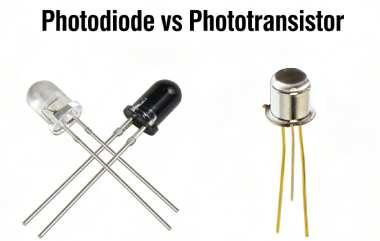
In electronic components and optoelectronic systems, photodiodes and phototransistors are two commonly used light-to-electric conversion devices. They can convert light signals into electrical signals and serve as core components in optical communication, photometric measurement, and automated control systems. Understanding the characteristics, working principles, and application scenarios of these devices is crucial for designing efficient and reliable optoelectronic systems. This article will provide a systematic explanation of the performance features and operating mechanisms of photodiodes and phototransistors.
Catalog
I. Photodiodes
1. What is a Photodiode?
A photodiode is a semiconductor device based on a PN junction or a PIN structure that can directly convert light energy into electrical signals. It generates photocarriers when light falls on the PN junction, producing a current or voltage signal that corresponds to the light intensity. Due to its simple structure and fast response, photodiodes are widely used in optical communication, light detection, and precise measurement applications.
2. Key Features
· High Sensitivity: Photodiodes can detect extremely weak light signals and convert them into current or voltage output, allowing them to operate effectively in low-light environments.
· Fast Response: They respond extremely quickly, often on the nanosecond scale, making them suitable for high-speed light signal detection, such as fiber optic communication and light pulse measurement.
· Wide Spectral Response: Photodiodes can detect light across a wide wavelength range, from ultraviolet to near-infrared, meeting the requirements of various light sources and applications.
3. Working Principle
The operation of a photodiode is based on the photovoltaic effect. When light hits the PN junction, the energy of the photons is absorbed by the semiconductor, exciting electrons from the valence band to the conduction band and creating electron-hole pairs. Under the electric field of the PN junction, electrons move toward the N-type region while holes move toward the P-type region, resulting in a photocurrent. The magnitude of the photocurrent is proportional to the intensity of the incident light.
4. Operating Modes
Photodiodes generally operate in two modes: photocurrent mode and photovoltage mode.
In photocurrent mode, the photodiode outputs a photocurrent, which is typically converted into a voltage signal through an external load resistor. This mode is suitable for applications requiring high sensitivity.
In photovoltage mode, the diode is not connected to a load resistor, and it outputs a voltage signal directly. The voltage is proportional to the light power, which is commonly used in optical communication and light-to-electric conversion scenarios.
II. Phototransistors
1. What is a Phototransistor?
A phototransistor is a light-to-electric conversion device developed based on a conventional transistor, with its base region sensitive to light. The base current generated by light is amplified internally by the transistor, producing a larger collector current output. This allows the phototransistor to amplify light signals. Compared to photodiodes, phototransistors offer higher signal gain and greater sensitivity.
2. Key Features
· Amplification Capability: The internal transistor converts the incoming light signal into an electrical current and amplifies it, providing usable output even under low-light conditions.
· Bidirectional Conductivity: Phototransistors can convert light signals into current output and, under certain circuit conditions, allow light-electric interchange, which improves flexibility in optical communication and light-control applications.
· Good Temperature Stability: The output current is less affected by temperature changes, maintaining stable performance across a wide temperature range, which is suitable for industrial automation and outdoor applications.
3. Working Principle
The working principle of a phototransistor is similar to that of a photodiode, but with an added internal current amplification process. When light hits the device, photons generate electron-hole pairs, which enter the base region and trigger transistor conduction. The base current is amplified by the transistor’s gain (β), resulting in a larger collector current output. This enables the amplification and conversion of light signals. With external circuit design, the output current can be further adjusted to meet different application requirements.
III. Conclusion
Photodiodes and phototransistors each have their strengths and are suited for different optoelectronic applications. Photodiodes are known for their fast response and linear output, making them ideal for precise measurements and high-speed optical communication. Phototransistors provide higher output current through internal current amplification, making them suitable for light-controlled switches and weak-light detection. Choosing and applying these two types of devices appropriately is a key part of electronic design and optoelectronic system development. They play essential roles in optical communication, light-to-electric conversion, automated control, and photometric measurement.


