
Polarized vs Non-Polarized Capacitors: What's the Difference?


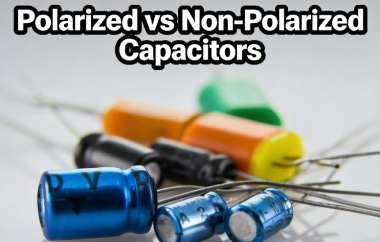
In the field of electronic components, capacitors are among the most fundamental and essential passive components. Engineers and electronics enthusiasts often encounter two common types when designing circuits or laying out PCBs: polarized capacitors and non-polarized capacitors. These two types of capacitors differ significantly in terms of definition, structure, applications, characteristics, technical specifications, and selection strategies. Understanding their differences is crucial for ensuring circuit reliability, optimizing performance, and making proper component choices. This article will systematically explore the key differences between polarized and non-polarized capacitors from multiple perspectives.
Catalog
IV. Characteristics Comparison
I. Definition
· Polarized capacitors: A polarized capacitor is a type of capacitor with a clearly defined positive and negative terminal. It must be connected according to its polarity in the circuit. The positive terminal should connect to the positive side of the circuit, and the negative terminal should connect to the negative side. Incorrect connection may damage the capacitor or even cause a short circuit. Polarized capacitors are commonly used in scenarios that require storing and releasing larger amounts of energy, such as power supply filtering and voltage stabilization. Common types include aluminum electrolytic capacitors, tantalum capacitors, and conductive polymer capacitors.
· Non-polarized capacitors: A non-polarized capacitor does not have polarity restrictions and can be installed in any direction in a circuit. It can function properly even if the positive and negative connections are reversed. Non-polarized capacitors are widely used in AC signal paths, coupling, filtering, and precision signal processing circuits. Common types include ceramic capacitors, film capacitors, and mica capacitors.
II. Structure
· Polarized capacitor structure: Polarized capacitors are generally composed of multiple layers of dielectric material and metal electrodes stacked together. Common dielectrics include aluminum oxide film, tantalum oxide film, or organic films. The positive electrode is usually made of aluminum or tantalum, while the negative electrode is made of carbon, niobium oxide, or other conductive materials. The dielectric layer separates the positive and negative electrodes, ensuring the capacitor's reliability in DC environments. Because the dielectric has a directional property, polarized capacitors must be connected according to the marked polarity.
· Non-polarized capacitor structure: The structure of non-polarized capacitors is relatively simple. They typically consist of two metal electrodes sandwiched between solid dielectric materials such as ceramic, polyester film, polypropylene film, or mica. The internal materials do not impose any restrictions on voltage direction, so they can be installed in either direction within the circuit. This design makes non-polarized capacitors more stable and reliable in high-frequency and AC circuits.
III. Application Areas
· Polarized capacitors are mainly used in DC circuits that require large energy storage and filtering, such as power supply smoothing, voltage regulation, and power amplification.
· Non-polarized capacitors are suited for AC signals, coupling, filtering, and high-frequency applications, where polarity is not an issue and flexibility in layout is required.
IV. Characteristics Comparison
· Polarized capacitors: They generally have larger capacitance, ranging from microfarads (µF) to millifarads (mF). They are suitable for DC circuits and have a maximum rated voltage; exceeding this voltage may damage the capacitor. Voltage and temperature can significantly affect their performance.
· Non-polarized capacitors: Their capacitance is relatively smaller, usually ranging from picofarads (pF) to microfarads (µF). They can be used in AC or DC circuits. They have no polarity restriction, offer good frequency response, and maintain high stability. Their high-frequency performance generally surpasses that of most polarized capacitors.
V. Technical Specifications
· Polarized capacitors: Key specifications include capacitance, rated voltage, temperature coefficient, maximum leakage current, and equivalent series resistance (ESR). These parameters guide circuit design and layout to ensure stable and reliable performance.
· Non-polarized capacitors: Key specifications include capacitance, rated voltage, size, and package type. Although they do not have a voltage polarity limitation, designers still need to consider capacitance and frequency characteristics for circuit stability.
VI. Selection Recommendations
· For polarized capacitors: Choose capacitors that match the circuit's voltage and capacitance requirements. Make sure the positive and negative terminals are correctly connected to avoid shorts or damage in DC circuits.
· For non-polarized capacitors: You can be more flexible in placing them on the circuit. Choose the appropriate capacitance and voltage rating according to the circuit requirements, especially for high-frequency or AC signal paths.
VII. Conclusion
Polarized and non-polarized capacitors are two types of capacitors that differ completely in performance, structure, and applications. Polarized capacitors are suitable for DC power, filtering, and large energy storage but must strictly follow polarity. Non-polarized capacitors are ideal for AC signals and high-frequency circuits, offering flexible installation and high reliability. Mastering the differences and selection principles of these two types of capacitors is essential for electronic design engineers, PCB designers, and circuit technicians to create efficient and reliable designs. Choosing the right capacitor not only improves circuit performance but also extends equipment life and reduces the risk of failure.


