
FFC vs FPC Cables: What's the Difference?


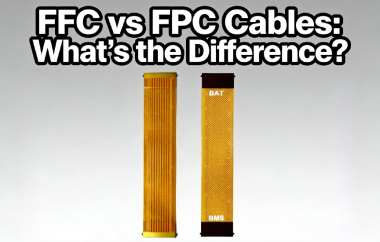
In modern electronic product design and manufacturing, flat cables play a key role as flexible interconnection solutions that link different electronic modules and circuit boards together. In particular, FFC (Flat Flexible Cable) and FPC (Flexible Printed Circuit) cables are widely used in consumer electronics, industrial control systems, and communication equipment. Understanding the differences between the two is valuable for design engineers, procurement professionals, and technology enthusiasts alike.
Catalog
II. Characteristics of Flat Cables
V. Differences Between FFC and FPC Cables
I. What Is a Flat Cable?
A flat cable generally refers to a flattened group of conductive wires used to connect internal modules within electronic devices, and it is also commonly called a flexible circuit or flexible interconnect cable. In industry terms, flat cables are mainly used for data or power transmission in moving parts and confined spaces, such as the data cable connecting a computer motherboard to a hard drive or optical drive, the cable connecting a smartphone motherboard to a display, or the internal board-to-board connections inside equipment.
In terms of structure, common flat cable forms include round-end types (R-FFC, typically used for direct soldering) and flat gold-finger ends (commonly inserted into connectors). In modern miniaturized electronic devices, flat cables have become an important solution for replacing traditional wire harnesses.
It is important to clarify that, strictly speaking, “flat cable” is a broad term, while FPC is the professional term for a flexible printed circuit board. However, in actual market communication and application discussions, the two are often collectively referred to as flat cables.
II. Characteristics of Flat Cables
As a flexible interconnection solution, flat cables must meet the following basic requirements:
1. Flat cables are small in size and light in weight, and they were originally designed to replace bulky wire harnesses. In today’s cutting-edge electronic assembly boards, flat cables are often the only solution that meets miniaturization and mobility requirements. A flat cable, sometimes called a flexible printed circuit, is created by etching copper circuits onto a polymer substrate or printing polymer thick-film circuits onto it. For devices that are thin, lightweight, and structurally compact and complex, design solutions range from single-sided conductive traces to complex multilayer three-dimensional assemblies. The total weight and volume of flat cables can be reduced by up to 70% compared with traditional round wire harness methods. Flat cables can also be reinforced with strengthening materials or stiffeners to achieve additional mechanical stability.
2. Flat cables can move, bend, and twist without damaging the conductors, and they can conform to different shapes and special packaging dimensions. Their only real limitation is the available space. Because they can withstand millions of dynamic flex cycles, flat cables are well suited for continuous or periodic motion interconnection systems and can become an integral part of the final product's functionality. In contrast, solder joints on rigid PCBs tend to fail after only a few hundred cycles due to thermal and mechanical stress.
3. Flat cables offer excellent electrical performance, dielectric properties, and heat resistance.
4. Flat cables provide higher assembly reliability and quality. They reduce the amount of hardware required for internal interconnections, such as solder joints, jumper wires, backplane traces, and cables commonly used in traditional electronic packaging, thereby improving overall assembly reliability and quality. Because traditional interconnection hardware composed of multiple complex systems is more prone to component misalignment during assembly, flat cables significantly lower this risk. With the advancement of quality engineering, ultra-thin flexible systems are often designed to be assembled in only one way, eliminating many of the human errors typically associated with discrete wiring projects.
III. What Is an FFC Cable?
FFC (Flat Flexible Cable) is a type of flexible flat cable made by laminating multiple parallel flat copper conductors between upper and lower insulating films. It is essentially a point-to-point connection cable and does not involve complex circuit etching processes. The conductor pitch can be selected according to standard specifications, with common pitches including 0.5 mm, 0.8 mm, 1.0 mm, 1.25 mm, 1.27 mm, 1.5 mm, 2.0 mm, and 2.54 mm.
The structure of FFC is relatively simple, the production process is mature, and it offers clear cost advantages, which makes it widely used in consumer electronics. It is especially suitable for standardized data connections between moving components and motherboards, as well as PCB-to-PCB connections. Because its price is usually lower than that of FPC, many companies prefer FFC solutions to optimize overall BOM costs when functional requirements allow.
IV. What Is an FPC Cable?
FPC (Flexible Printed Circuit) is a flexible circuit board formed by chemically etching circuit patterns onto a flexible copper-clad laminate (FCCL) substrate. Depending on design requirements, FPC can be manufactured in single-sided, double-sided, or even multilayer structures, and it can integrate vias, plating layers, and shielding layers.
An FPC cable is essentially a flexible circuit board with electrical functionality. In addition to basic connection functions, it can also handle complex signal routing, power management, and even partial circuit integration. In practical applications, FPC is used in antenna modules, touchscreen connections, capacitive panel control, battery connection modules, and more. Because it supports complex routing and high-density layouts, it plays a critical role in highly integrated products such as smartphones, laptops, and wearable devices.
Compared with FFC, FPC has a more complex manufacturing process and higher cost, but it offers superior advantages in space utilization, signal integrity, and system integration.
V. Differences Between FFC and FPC Cables
From a manufacturing perspective, FPC forms circuit patterns through chemical etching on flexible copper-clad laminates, enabling various routing paths and single-sided, double-sided, or multilayer structures. In contrast, FFC is produced by pressing flat copper conductors between two insulating films, resulting in a simpler structure with parallel straight-line conductors.
· In terms of structural complexity, FPC supports complex circuit design and three-dimensional spatial layouts, while FFC is mainly used for standardized straight-line connections.
· Regarding thickness and structure, FPC is typically thinner and capable of higher integration levels, whereas FFC has a simpler structure and may be slightly thicker overall.
· From a cost perspective, FFC uses more simplified materials and processes, resulting in a significantly lower unit cost than FPC. Therefore, when functional requirements permit, many companies prefer to choose FFC solutions.
· From an application standpoint, FFC is sufficient for simple signal or power transmission needs. However, when high-speed signals, impedance control, multifunction integration, or complex spatial structures are involved, FPC offers clear technical advantages.
VI. Conclusion
In electronic product design and manufacturing, FFC and FPC cables each have their own advantages and suitable application scenarios. If the goal is standardized, cost-effective, and straightforward connections, FFC is a common and economical solution. When high-density routing, complex signal requirements, space optimization, and system integration are priorities, FPC provides stronger technical capabilities. In many modern devices, both solutions coexist, and selecting between them based on functional requirements is standard engineering practice.


