
Cement vs Damping Resistor: What's the Difference?


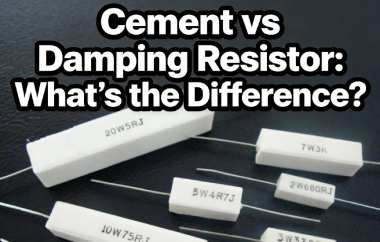
In the electronic components industry, resistors are basic and essential passive components. Different types of resistors are named according to their structure, materials, or functions, such as cement resistors and damping resistors. This article will analyze in detail the differences between cement resistors and damping resistors in terms of their definitions, structures, functions, and application scenarios.
Catalog
II. What is a Damping Resistor?
III. Differences Between Cement Resistors and Damping Resistors
I. What is a Cement Resistor?
A cement resistor is a type of power resistor and belongs to the category of wire-wound resistors. Its manufacturing process involves winding the resistance wire around a non-alkaline, heat-resistant ceramic core, then placing it into a square ceramic frame, and filling and sealing it with a special heat-resistant cement. The outer shell of a cement resistor is primarily made of ceramic materials, usually high-alumina ceramic or feldspar ceramic. The term “cement” in cement resistor does not refer to construction cement but is a colloquial term for heat-resistant clay.
According to the manufacturing process and materials, cement resistors can be divided into ordinary cement resistors and cement wire-wound resistors. Their common characteristics are high power rating and the ability to withstand high current, making them suitable for circuits with large current requirements, such as being connected in series with motors to limit starting current. Cement resistors are generally large in size, resistant to vibration, moisture, and heat, have good heat dissipation, and are cost-effective. They are widely used in power adapters, audio equipment, audio crossovers, instruments, televisions, and automotive electronics.
II. What is a Damping Resistor?
A damping resistor is a type of resistor named according to its function in a circuit. Its main role is to suppress oscillations and resonance within a circuit. To prevent a loop from producing sustained oscillations, damping resistors are connected in series or parallel at appropriate points in the circuit to dissipate energy that might otherwise cause oscillation.
Damping resistors are widely used in circuits such as rectifier transformers, switching power supplies, and motor control. For example, placing a damping resistor at the output of a rectifier transformer can effectively absorb high-order harmonics in the secondary circuit and prevent resonance at the output, thus protecting the transformer and the connected load. In motor control circuits, damping resistors can be used to control induced current during braking, preventing motor damage caused by excessive current.
It is important to note that damping resistors are not restricted to a specific physical structure. They can be cement resistors, metal film resistors, or other types of resistors, as long as they can perform the damping function.
III. Differences Between Cement Resistors and Damping Resistors
Although cement resistors and damping resistors may overlap in certain applications, they have clear fundamental differences.
· Naming basis: Cement resistors are named based on their materials and structure, emphasizing high power handling and heat dissipation. Damping resistors are named based on their circuit function, emphasizing oscillation suppression and improvement of circuit dynamic response.
· Function and application: Cement resistors are mainly used for carrying high current, limiting startup current, or dissipating voltage, commonly seen in high-power applications such as power adapters, motor control, and audio crossovers. Damping resistors, on the other hand, are used to improve circuit dynamic performance and reduce ringing or overshoot, mainly appearing at rectifier transformer outputs, filter networks, switching power supplies, and motor braking circuits.
· Interchangeability: Cement resistors can be used as damping resistors, but damping resistors do not necessarily need to be cement resistors. The key factor is the function performed rather than the material used. Engineers can choose different types of resistors based on circuit characteristics to balance damping performance and power handling.
Additionally, cement resistors are typically larger in size and resistant to heat and moisture, while the selection and layout of damping resistors depend more on the circuit’s resonance characteristics and dynamic response requirements. In some specialized designs, combining the two appropriately can achieve the best balance of circuit safety and stability.
IV. Conclusion
Although cement resistors and damping resistors may be applied interchangeably in engineering practice, they have fundamental differences in their definitions, naming basis, and primary functions. Cement resistors emphasize high power handling and heat dissipation, suitable for high-current scenarios. Damping resistors emphasize oscillation suppression and improving circuit dynamic response and can be implemented using various types of resistors.


