
How Do Supercapacitors Charge and Discharge?


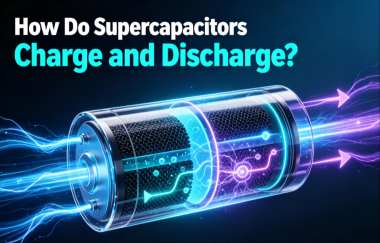
In the electronic components industry, a supercapacitor is an advanced energy storage device featuring high power density, fast charging and discharging capability, and an extremely long cycle life. It is widely used in electric vehicles, smart grids, industrial equipment, backup power systems, and consumer electronics. Unlike traditional batteries that store energy through chemical reactions, supercapacitors mainly store energy through the rapid accumulation and release of charges on electrode surfaces, allowing them to complete charging and discharging within seconds to minutes.
Catalog
II. Charging Process of Supercapacitors
III. Discharging Process of Supercapacitors
IV. Considerations for Supercapacitor Charging and Discharging
I. What Is a Supercapacitor?
A supercapacitor is an energy storage component positioned between traditional capacitors and batteries. It is also known as an ultracapacitor, electric double-layer capacitor (EDLC), or electrochemical capacitor. Its energy storage mechanisms mainly include electric double-layer capacitance and pseudocapacitance.
In the electric double-layer capacitance storage process, positive and negative ions in the electrolyte move toward the two electrode surfaces under an applied voltage, forming a charge separation layer to store electrical energy. Pseudocapacitance, on the other hand, relies on reversible oxidation-reduction reactions occurring on the surface of electrode materials to generate additional charges and increase energy storage capacity.
Because supercapacitors do not rely on complex chemical reactions like traditional batteries, they offer advantages such as low internal resistance, fast charging and discharging speed, and a high number of charge-discharge cycles.
II. Charging Process of Supercapacitors
The charging process of a supercapacitor is essentially the redistribution and accumulation of charges on the electrode surface. When a charging power source applies voltage to the supercapacitor, ions in the electrolyte move toward the corresponding electrodes and form an electric double layer at the interface between the electrode and electrolyte. Meanwhile, some electrode materials undergo oxidation-reduction reactions, further increasing the amount of stored charge.
Common charging methods for supercapacitors include the following:
Constant Current Charging:
Constant current charging is one of the most commonly used charging methods. The charging device supplies a stable current to the supercapacitor until the voltage reaches its rated value. This method ensures a more uniform charging process and prevents excessive heat generation caused by excessive current.
Constant Voltage Charging:
In constant voltage charging, the voltage is maintained at a preset level after reaching the target value. As the supercapacitor gradually becomes fully charged, the charging current continuously decreases. When the current drops to a specified range, the charging process is completed. This method effectively prevents overcharging and improves safety.
Pulse Charging:
Pulse charging completes the charging process by applying intermittent current pulses. It can reduce heat accumulation caused by continuous charging, improve charging efficiency, and enhance the charging performance of supercapacitors in some high-performance energy storage systems.
III. Discharging Process of Supercapacitors
The discharging process of a supercapacitor occurs when the charges stored on the electrode surface are released through an external circuit to provide electrical energy to a load. When the supercapacitor is connected to a load, ions on the electrode surface gradually return to their original state, and the stored energy is converted into output current.
Due to their low equivalent series resistance (ESR), supercapacitors can release large amounts of energy quickly, making them particularly suitable for applications requiring instant high-power output.
Common discharge methods include:
Constant Current Discharging:
In constant current discharge mode, the supercapacitor supplies power to the load at a fixed current. Due to its low internal resistance, it can maintain high power output even during rapid discharge, making it suitable for applications such as startup assistance and motor drive systems.
Constant Power Discharging:
Constant power discharge automatically adjusts the output current according to load requirements to maintain stable power output. This method is suitable for equipment that requires stable power supply, such as industrial control systems and backup power devices.
IV. Considerations for Supercapacitor Charging and Discharging
When using supercapacitors, charging and discharging conditions must be properly controlled to ensure stable performance and extend service life.
First, voltage control is essential. Supercapacitors must operate within their rated voltage range. Charging beyond the specified voltage may cause electrolyte decomposition, performance degradation, or even permanent damage to the device.
Second, proper temperature management is required. During charging and discharging, supercapacitors generate a certain amount of heat due to internal resistance. Long-term operation in high-temperature environments can accelerate aging. Therefore, reasonable thermal management solutions are necessary in high-power applications.
In addition, when multiple supercapacitors are connected in series, voltage balancing management is required. Due to differences in capacitance and internal resistance between individual capacitors, some units may experience excessive voltage, affecting the reliability of the entire system.
At the same time, practical applications should include protection circuits such as overvoltage, overcurrent, and short-circuit protection to prevent damage caused by abnormal operating conditions.
V. Conclusion
Supercapacitors achieve rapid energy storage and release through electric double-layer charge accumulation and electrochemical reactions. Their charging and discharging processes feature fast speed, high efficiency, and long cycle life. By selecting appropriate charging methods, controlling operating voltage, managing temperature, and implementing proper protection designs, the performance of supercapacitors can be fully optimized.


