
What Factors Affect Supercapacitor Voltage?


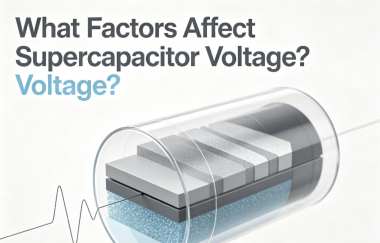
Supercapacitors offer fast charging and discharging, high power density, and a long cycle life, making them widely used in energy storage, backup power supplies, industrial control, automotive electronics, and other fields. For supercapacitors, the operating voltage not only determines the safe operating range but also directly affects their energy storage capability. Therefore, understanding the key factors that affect supercapacitor voltage is important for component selection and circuit design.
Catalog
I. What Is the Operating Voltage of a Supercapacitor?
II. How Does a Supercapacitor Work?
III. Key Factors Affecting Supercapacitor Voltage
I. What Is the Operating Voltage of a Supercapacitor?
The operating voltage of a supercapacitor refers to the voltage range within which it can be safely charged and discharged under specified conditions. Unlike conventional batteries, the terminal voltage of a supercapacitor changes significantly during charging and discharging. Its stored energy is related to both capacitance and the square of voltage, so increasing the operating voltage can effectively improve its energy density.
It is important to note that the rated voltage of a supercapacitor is not a maximum voltage that can be exceeded arbitrarily. If the terminal voltage exceeds the specified limit, it may cause electrolyte decomposition, gas generation, increased leakage current, or even damage to the device.
II. How Does a Supercapacitor Work?
Supercapacitors primarily store charge through the electric double layer formed at the interface between the electrode and electrolyte. Some types also use fast and reversible redox reactions for energy storage. During charging, ions in the electrolyte move toward the electrode surface with the opposite charge and form a charge layer. During discharging, the ions redistribute and release the stored electrical energy.
The actual operating voltage of a supercapacitor is limited by its electrochemical stability window. In other words, the electrolyte, electrode, and their interface must remain stable within a specified voltage range; otherwise, unwanted side reactions may occur.
III. Key Factors Affecting Supercapacitor Voltage
1. Electrolyte Stability
The electrolyte is one of the key factors limiting the operating voltage of a supercapacitor. Different electrolytes have different electrochemical stability windows, which determine the voltage range that the device can safely withstand.
For example, aqueous electrolytes are prone to water electrolysis, so the operating voltage of a single-cell supercapacitor is generally lower than that of systems using organic electrolytes. Organic electrolytes can provide a wider voltage window, and common commercial supercapacitor cells typically have rated voltages of approximately 2.5 V to 3 V, depending on the device structure and material system.
2. Electrode Material Characteristics
The chemical stability, surface structure, and electrochemical properties of electrode materials also affect the operating voltage of a supercapacitor. Double-layer capacitor electrodes based on activated carbon, for example, need to operate within the stability range of the electrolyte. Otherwise, electrolyte decomposition, surface side reactions, and increased leakage current may occur.
Therefore, electrode materials do not determine the voltage independently. Instead, they work together with the electrolyte to establish the overall electrochemical stability window of the device.
3. Capacitor Structural Design
The electrode composition, separator, electrolyte, and packaging structure of a supercapacitor can all affect its final rated voltage. For aqueous asymmetric supercapacitors, appropriately designing the positive and negative electrode materials and their capacity ratio can expand the stable operating voltage range to a certain extent.
For applications requiring higher voltages, multiple individual cells are generally connected in series to form a supercapacitor module rather than simply applying an excessive voltage to a single cell. However, when cells are connected in series, voltage imbalance between individual cells must also be considered. When necessary, voltage balancing or equalization circuits should be used.
4. Temperature and Operating Conditions
Operating temperature, charging and discharging current, and operating time can also affect the actual voltage characteristics of a supercapacitor. Excessively high temperatures may accelerate side reactions involving the electrolyte and electrode materials, while low temperatures may increase the equivalent series resistance (ESR), resulting in a more significant voltage drop during charging and discharging.
In addition, during high-current discharge, the terminal voltage of a supercapacitor is affected by the voltage drop caused by its equivalent series resistance (ESR). As a result, the actual terminal voltage in a circuit may be lower than the theoretical open-circuit voltage.
IV. Conclusion
The operating voltage of a supercapacitor is not determined by a single factor. Instead, it is jointly affected by electrolyte stability, electrode materials, capacitor structure, temperature, and charging and discharging conditions. Among these factors, the electrolyte and electrode materials determine the basic electrochemical stability range of the device, while structural design and operating conditions further affect its actual operating voltage.


