
What Is the Difference Between a Transformer and an Induction Motor?


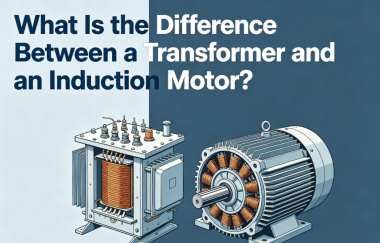
In electrical equipment and industrial automation, transformers and induction motors are both widely used devices. Although both rely on electromagnetic principles, they perform fundamentally different functions. So, what is the difference between a transformer and an induction motor? How does a transformer work, and how does an induction motor convert electrical energy into mechanical energy? Understanding these basic principles can help engineers select and apply the right equipment for power systems, motor drives, and electronic applications.
Catalog
II. How Does a Transformer Work?
III. What Is an Induction Motor?
IV. Differences Between a Transformer and an Induction Motor
I. What Is a Transformer?
A transformer is a static electrical device that uses the principle of electromagnetic induction to change AC voltage levels and transfer electrical energy. Its main components include a magnetic core, primary winding, and secondary winding. When AC voltage is applied to the primary winding, it produces an alternating magnetic flux in the core. This changing magnetic flux induces an electromotive force in the secondary winding, allowing electrical voltage to be increased or decreased.
The voltage conversion of a transformer mainly depends on the turns ratio between the primary and secondary windings. Under ideal conditions, the secondary-to-primary voltage ratio is approximately equal to the secondary-to-primary turns ratio. Therefore, a higher number of turns in the secondary winding can provide a higher output voltage, while fewer turns can provide a lower output voltage. In practical transformers, winding resistance, leakage flux, core losses, and other factors affect the actual output voltage and efficiency.
II. How Does a Transformer Work?
The basic working principle of a transformer can be summarized as AC producing alternating magnetic flux, which then induces an electromotive force. When AC flows through the primary winding, the magnetic flux in the core continuously changes. This alternating magnetic flux is coupled to the secondary winding and induces an electromotive force according to Faraday’s law of electromagnetic induction.
A transformer has no mechanical moving parts and therefore does not generate mechanical output through rotation. Instead, its primary function is to convert electrical energy between different AC voltage levels. Transformers are widely used in power transmission and distribution, industrial power supplies, control circuits, and the power sections of electronic equipment.
III. What Is an Induction Motor?
An induction motor, also called an asynchronous motor, is a rotating electrical machine that converts electrical energy into mechanical energy. Its main components include the stator, rotor, magnetic core, windings, bearings, and shaft. The stator generates a rotating magnetic field, while the rotor develops induced current and electromagnetic torque under the influence of this field.
When a three-phase induction motor is connected to a three-phase AC supply, the stator windings generate a rotating magnetic field. This magnetic field moves relative to the rotor conductors and induces current in the rotor. The interaction between the rotor current and the rotating magnetic field produces electromagnetic torque, causing the rotor to rotate.
A key characteristic of an induction motor is that its rotor speed normally remains below synchronous speed during operation. The difference between synchronous speed and rotor speed is known as slip. If the rotor reached synchronous speed, there would be no relative motion between the rotor and rotating magnetic field, so no induced current would be generated in the rotor. As a result, electromagnetic torque could not be maintained. Therefore, a certain amount of slip is necessary for an induction motor to continue producing torque.
IV. Differences Between a Transformer and an Induction Motor
Although a transformer and an induction motor both involve electromagnetic induction, the difference between a transformer and an induction motor can be clearly seen in their functions, structures, operating principles, and applications.
First, their functions are different. A transformer is mainly used to change AC voltage levels, including stepping voltage up or down and providing electrical isolation. An induction motor primarily converts electrical energy into rotational mechanical energy to drive fans, pumps, compressors, conveyors, and other machinery.
Second, their structures are different. A transformer generally consists of a magnetic core and one or more windings and has no rotating components, making it a static electrical device. An induction motor consists of a stator and rotor and includes mechanical components such as bearings and a shaft, making it a rotating electrical machine.
Their operating principles are also different. A transformer relies on alternating magnetic flux to induce an electromotive force between windings and achieve voltage conversion. An induction motor uses the rotating magnetic field generated by the stator to induce current in the rotor. The interaction between the magnetic field and rotor current then produces electromagnetic torque.
Their key parameters differ as well. Transformers typically use parameters such as rated capacity, turns ratio, rated voltage, short-circuit impedance, no-load loss, and load loss. Induction motors are generally evaluated using rated power, rated speed, rated torque, efficiency, power factor, and slip.
In terms of applications, transformers are mainly used for voltage conversion and electrical isolation in power transmission and distribution systems, industrial power supplies, and electronic equipment. Induction motors are widely used in industrial automation, machinery, pumps, fans, compressors, conveyor systems, and other applications requiring rotational mechanical power.
V. Conclusion
In summary, the main difference between a transformer and an induction motor is how they handle and convert electrical energy. A transformer is a static device that primarily uses electromagnetic induction to change AC voltage levels and transfer electrical energy, while an induction motor is a rotating machine that converts electrical energy into mechanical energy through a rotating magnetic field, electromagnetic induction, and electromagnetic torque.


