
What Are the Protection Methods for Transformer Energization?


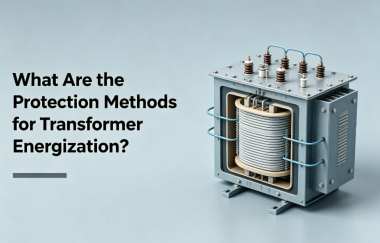
A transformer is an important power conversion device in power systems and electrical equipment, primarily used to change AC voltage levels. When a transformer is energized for the first time or re-energized after maintenance, a relatively large transient current often occurs. This phenomenon is commonly known as transformer inrush current. If the protection settings are not properly configured, the inrush current may be mistakenly identified as an internal fault, causing the circuit breaker to trip. Therefore, correctly understanding the characteristics of transformer energization and adopting appropriate protection methods are essential for ensuring the safe energization and operation of transformers.
It should be noted that transformer “energization” is not the same as system overvoltage caused by lightning or other factors. During transformer energization, the main concerns are the magnetizing inrush current, switching overvoltage, and the resulting risk of protection misoperation, rather than simply treating all transient electrical phenomena as “surge voltage.”
Catalog
I. What Is Transformer Energization?
II. Working Principle of Transformer Energization
III. Protection Methods During Transformer Energization
I. What Is Transformer Energization?
Transformer energization refers to the process of closing the power-side circuit breaker when a transformer is in a no-load or lightly loaded condition, suddenly connecting it to the power grid. Due to factors such as the voltage phase angle at the moment of switching, residual magnetism in the core, and the core’s magnetization characteristics, the transformer core may temporarily enter deep saturation, resulting in a relatively large magnetizing inrush current.
The magnetizing inrush current usually contains a significant non-periodic component and may last from several cycles to several seconds before gradually decaying as the core flux returns to its normal operating range. Although inrush current does not necessarily indicate a transformer fault, its magnitude can reach several times the rated current, potentially affecting transformer protection systems and overall power grid operation.
II. Working Principle of Transformer Energization
During normal transformer operation, the AC voltage establishes alternating magnetic flux in the core, and the magnetic flux is limited by the magnetization characteristics of the core. When a transformer is re-energized after being disconnected from the power supply, the actual magnetic flux may deviate significantly from its normal operating range if the transformer is energized at an unfavorable voltage phase angle while residual magnetism remains in the core. Once the magnetic flux exceeds the linear magnetization region, the core enters saturation, causing the magnetizing inductance to decrease rapidly and the primary-side current to increase sharply, resulting in magnetizing inrush current.
Therefore, the core task of the protection system during transformer energization is not simply to “detect a large current and immediately trip the circuit breaker,” but to distinguish between normal magnetizing inrush current and actual internal transformer fault current. Modern transformer differential protection systems typically use second-harmonic restraint, waveform identification, and other criteria to suppress protection misoperation caused by magnetizing inrush current. These methods are combined with overcurrent, overvoltage, gas, and other protection functions to improve overall protection reliability.
III. Protection Methods During Transformer Energization
First, differential protection should be properly configured. Transformer differential protection is primarily used to detect internal short-circuit faults within the transformer windings and their lead areas, and it is an important main protection function for large transformers. Because magnetizing inrush current and internal short-circuit current have different waveform and harmonic characteristics, protection devices can use criteria such as second-harmonic content to identify magnetizing inrush current. This helps prevent protection misoperation during energization while ensuring that internal faults can be cleared quickly.
Second, overcurrent protection should be properly configured. Overcurrent protection can serve as backup protection for internal transformer faults and external short-circuit faults. During transformer energization, protection systems based solely on instantaneous current magnitude may operate incorrectly because of the high magnitude of magnetizing inrush current. Therefore, protection settings and operating delays should be properly configured according to the transformer capacity, rated current, system short-circuit capacity, and protection coordination requirements.
Third, overvoltage protection should be strengthened. Transformer energization may be accompanied by switching overvoltage. This is particularly relevant under certain grid operating conditions, such as when long transmission lines or unloaded lines are involved, as excessive voltage may place additional stress on transformer insulation. Metal-oxide surge arresters are commonly used to limit overvoltage magnitude. Combined with the substation grounding system and insulation coordination design, they can improve the transformer’s ability to withstand switching overvoltage and lightning overvoltage.
In addition, transformer protection should be combined with dedicated protection functions for the transformer itself. For oil-immersed transformers, gas protection, pressure relief protection, oil temperature protection, and winding temperature protection can monitor transformer operating conditions from different perspectives. If an abnormal internal fault occurs during energization, these protection functions can work together with differential and overcurrent protection to provide complementary protection and improve fault detection and clearing capabilities.
During actual energization, the relevant power system operating procedures should also be followed. Before energizing the transformer, operators should check its insulation condition, grounding condition, protection devices, and circuit breaker operating status, while also verifying the protection settings and the status of relevant protection links. For high-capacity transformers, an appropriate energization method can also be selected according to system conditions to reduce the impact of magnetizing inrush current on the equipment and protection system.
IV. Conclusion
During transformer energization, the main concerns are not simply instantaneous high voltage, but rather magnetizing inrush current, switching overvoltage, and the risk of protection misoperation. Differential protection must primarily address the challenge of distinguishing magnetizing inrush current from internal faults, while overcurrent protection, overvoltage protection, gas protection, and other transformer protection functions together form a multi-layer protection system. Through appropriate protection configuration, accurate protection settings, and standardized energization procedures, the risks of false tripping and equipment damage during transformer energization can be effectively reduced, helping ensure the safe and stable operation of the power system.


