
EDLC vs. Pseudocapacitors: What’s the Difference?


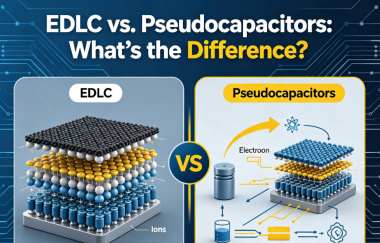
With the growing demand for high power, fast charging and discharging, and long cycle life in new energy vehicles, industrial control, smart electronic devices, and energy storage systems, supercapacitors are receiving increasing attention. Among the charge storage mechanisms of supercapacitors, electric double-layer capacitance and pseudocapacitance are two representative approaches. Although both can store and release energy rapidly, they differ significantly in charge storage mechanisms, electrode materials, energy density, power characteristics, and cycle life. Understanding how electric double-layer capacitors and pseudocapacitors work and their respective characteristics can help engineers select suitable energy storage devices for practical electronic systems.
Catalog
I. What Is an Electric Double-Layer Capacitor?
II. What Is a Pseudocapacitor?
III. What Are the Differences Between EDLCs and Pseudocapacitors?
I. What Is an Electric Double-Layer Capacitor?
An electric double-layer capacitor (EDLC) primarily stores charge through the electric double layer formed at the interface between the electrode and electrolyte. A typical EDLC consists of two porous electrodes, an electrolyte, a separator, and current collectors. Common electrode materials include activated carbon, carbon nanomaterials, and other carbon materials with a high specific surface area.
When an external power source charges an EDLC, electrons accumulate on the surface of one electrode, while oppositely charged ions in the electrolyte gather near the electrode surface under electrostatic forces. This creates a charge-separated electric double-layer structure. During discharge, the charges move in the opposite direction and release the stored energy. This process mainly involves electrostatic adsorption and charge separation rather than significant chemical reactions, giving EDLCs high charge-discharge efficiency and long cycle life.
EDLCs generally offer high power density, low equivalent series resistance (ESR), and fast charging and discharging. However, their energy density is typically lower than that of batteries and may also be lower than that of high-performance pseudocapacitive systems. Therefore, EDLCs are particularly suitable for applications requiring frequent charge-discharge cycles, short-duration power delivery, or energy recovery, such as industrial equipment, backup power systems, energy recovery systems, and automotive start-stop systems.
II. What Is a Pseudocapacitor?
A pseudocapacitor is an electrochemical energy storage device that stores energy through fast and reversible Faradaic charge-transfer processes. Unlike electric double-layer capacitors, which primarily rely on electrostatic adsorption, pseudocapacitance generally involves processes such as surface or near-surface redox reactions, rapid ion insertion, or underpotential deposition.
Pseudocapacitive electrodes commonly use transition metal oxides, hydroxides, and certain conductive polymers. During charging, ions or electrons from the electrolyte participate in rapid electrochemical reactions, enabling charge storage. During discharge, these processes can proceed rapidly in the reverse direction. Because Faradaic reactions can provide greater charge storage capacity than purely interfacial electrostatic adsorption, pseudocapacitive materials generally have higher specific capacitance and greater potential for achieving higher energy density.
However, the electrochemical reactions involved in pseudocapacitance can also cause greater structural and chemical changes in electrode materials. As a result, the cycle stability and power performance of some pseudocapacitive systems may be affected by electrode structure, electrolyte composition, and operating conditions. It is important to note that the cycle life of pseudocapacitors is not fixed at “hundreds to thousands of cycles.” Some advanced pseudocapacitive materials can also achieve thousands or even more charge-discharge cycles.
III. What Are the Differences Between EDLCs and Pseudocapacitors?
The most fundamental difference between EDLCs and pseudocapacitors lies in their charge storage mechanisms. EDLCs primarily store energy through electrostatic charge separation at the electrode-electrolyte interface, while pseudocapacitors primarily store energy through fast and reversible Faradaic processes. Therefore, although both technologies can provide relatively fast charging and discharging, their underlying energy storage mechanisms are different.
In terms of energy density, pseudocapacitors generally have greater theoretical potential because Faradaic reactions can provide higher charge storage capacity. EDLCs mainly rely on charge adsorption at the electrode surface, which limits their energy density. However, the energy density of an actual device is also affected by electrode materials, electrolyte composition, voltage window, packaging structure, and operating conditions. Therefore, the performance of a specific device cannot be determined solely by its charge storage mechanism.
In terms of power density and charging and discharging speed, EDLCs generally have a clear advantage. Because they primarily store energy through interfacial charge adsorption, ions and electrons do not need to undergo extensive bulk chemical reactions, allowing EDLCs to charge and discharge rapidly and deliver high current over short periods. Pseudocapacitors can also support relatively fast charge-discharge processes, but their performance is influenced by factors such as electrode reaction kinetics and ion transport.
In terms of cycle life, EDLCs generally offer excellent long-term cycling stability because their primary charge storage process does not involve significant crystal structure changes or continuous redox reactions. The cycle life of pseudocapacitors, by contrast, is closely related to the specific electrode material and reaction mechanism. Some pseudocapacitive materials may experience performance degradation due to volume changes, structural deterioration, or loss of active materials. Therefore, material stability should be carefully considered in applications requiring long-term cycling.
In addition, practical supercapacitor products do not necessarily rely exclusively on either electric double-layer capacitance or pure pseudocapacitance. Many devices use composite electrode materials that combine both mechanisms to achieve a better balance among energy density, power density, and cycle life.
IV. Conclusion
Electric double-layer capacitors and pseudocapacitors are both important electrochemical energy storage technologies, but their core difference lies in their charge storage mechanisms. EDLCs primarily store energy through electrostatic charge separation at the electrode-electrolyte interface and generally offer fast charging and discharging, high power density, and long cycle life. Pseudocapacitors primarily store energy through fast and reversible Faradaic reactions and generally offer higher specific capacitance and greater potential for higher energy density.
For practical electronic component selection, it is not appropriate to simply consider pseudocapacitors superior to EDLCs. For applications requiring high power, fast response, and frequent cycling, EDLCs may be more suitable. For applications that aim to increase energy storage capacity while maintaining relatively fast charge-discharge performance, pseudocapacitors or hybrid supercapacitors may offer greater potential. Engineers should consider operating voltage, capacitance, ESR, power requirements, cycle life, operating temperature, and other parameters to select the most appropriate energy storage solution.


