
How Do Solid State and Mechanical Relays Differ?


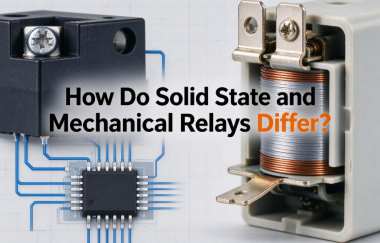
A solid state relay (SSR) is an electronic switching device that uses semiconductor components to control the connection and disconnection of electrical circuits. It is widely used in industrial automation, temperature control, and power electronics equipment. Compared with traditional electromechanical relays, solid state relays have no mechanical contacts and offer several advantages, including fast response times, low switching noise, and long service life. As automation systems and electronic equipment increasingly demand better switching performance and reliability, solid state relays have become important components in many electrical control systems. Understanding their definition, working principle, and applications helps ensure proper selection and use.
Catalog
I. What Is a Solid State Relay?
II. Working Principle of a Solid State Relay
III. Differences and Advantages of Solid State Relays and Electromechanical Relays
IV. Main Applications of Solid State Relays
I. What Is a Solid State Relay?
A solid state relay is a contactless switching device constructed from semiconductor electronic components. It primarily uses components such as optocouplers, silicon-controlled rectifiers (SCRs), triacs (TRIACs), and power transistors (such as MOSFETs) to switch electrical circuits on and off.
A solid state relay typically consists of an input control circuit, an isolation circuit, a driver circuit, and an output switching circuit. The input terminal receives an external control signal, which is processed by the internal driver and isolation circuits to control the conduction or cutoff of the output semiconductor device. This process enables the relay to control the connected load. Based on the type of output load, solid state relays can be classified into AC and DC types. When selecting an SSR, it is important to consider the input control voltage, output voltage, current rating, and load characteristics.
II. Working Principle of a Solid State Relay
A solid state relay operates by utilizing the conduction and cutoff characteristics of semiconductor devices to achieve switching control. Its working process generally involves three stages: signal input, electrical isolation, and output control.
When the input terminal receives a control signal, the internal control circuit activates the optocoupler, which transfers the control signal to the output side while providing electrical isolation between the input and output circuits. The output driver circuit then controls the power semiconductor device to conduct, creating a current path for the load. When the input control signal is removed, the output semiconductor device turns off according to its device type and circuit conditions, interrupting the load current.
Some AC solid state relays use zero-crossing switching, which means the relay turns on when the AC voltage approaches its zero-crossing point. This helps reduce electromagnetic interference and current surges during switching. DC solid state relays typically use MOSFETs or other power semiconductor devices to control the connection and disconnection of DC loads.
III. Differences and Advantages of Solid State Relays and Electromechanical Relays
The main difference between solid state relays and electromechanical relays lies in their switching structures. Electromechanical relays use an electromagnetic coil to drive mechanical contacts and switch circuits, whereas solid state relays use semiconductor devices for electronic switching control. The two types differ significantly in response speed, service life, noise, and power consumption.
1. Fast Response Speed: Solid state relays have no mechanical contact movement, allowing them to achieve faster switching response times. They are suitable for applications requiring frequent switching or rapid control. In contrast, electromechanical relays are limited by the operating time of their coils and mechanical contacts.
2. Longer Service Life: Solid state relays have no mechanical contacts, eliminating problems such as contact wear, contact bounce, and arc erosion. Under proper operating conditions, they generally provide a longer electrical service life.
3. Low Operating Noise: Solid state relays use semiconductor devices for switching and do not produce the mechanical impact noise associated with contact closure. This makes them suitable for equipment requiring quiet operation.
4. Better Vibration Resistance: Since solid state relays have no moving mechanical components, they generally offer better stability in vibrating environments, making them suitable for certain industrial equipment and automation applications.
5. Lower Maintenance Requirements: Solid state relays do not require regular maintenance or replacement of worn mechanical contacts. However, their internal semiconductor devices are sensitive to overcurrent, overvoltage, and high temperatures. Therefore, appropriate heat sinks and protection circuits are generally required based on the actual load conditions.
It is important to note that solid state relays are not superior to electromechanical relays in every application. For example, solid state relays have an on-state voltage drop and off-state leakage current, and they generate heat during operation. Some AC models also have limitations in their turn-off characteristics. Electromechanical relays, on the other hand, generally offer lower contact resistance and negligible off-state leakage current. Therefore, the appropriate relay should be selected according to the load type, switching frequency, and operating environment.
IV. Main Applications of Solid State Relays
1. Industrial Automation Control
Solid state relays are widely used in PLC control systems, industrial heating equipment, auxiliary motor control, and automated production lines. They can control heaters, solenoid valves, and other electrical loads, meeting the requirements of frequent switching and automated control.
2. Temperature Control Equipment
In industrial ovens, electric furnaces, injection molding machines, and temperature-controlled equipment, solid state relays can work with temperature controllers to regulate heating elements through switching operations. Their fast response and contactless switching characteristics make them suitable for applications requiring frequent heating power adjustments.
3. Household Appliances
Solid state relays are used in certain household appliances, including electric water heaters, electric ovens, and air conditioners. They provide electronic switching control for heating elements and other electrical loads.
4. Medical and Testing Equipment
Some medical instruments, laboratory equipment, and automated testing systems use solid state relays to control power supplies and heating loads. These devices help meet requirements for low noise, fast response, and stable control. However, specific selection must also comply with the electrical safety and isolation requirements of the equipment.
V. Conclusion
A solid state relay is a contactless electronic switching device based on semiconductor components. It primarily uses an input control signal to drive power semiconductor devices on the output side, thereby controlling the connection and disconnection of load circuits. Compared with electromechanical relays, solid state relays offer advantages such as fast response, low operating noise, better vibration resistance, and the absence of mechanical contact wear. They are widely used in industrial automation, temperature control, household appliances, and testing equipment.


