
What Signal Does a PIN Photodiode Output?


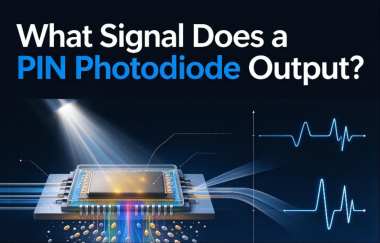
In the electronic components industry, a PIN photodiode is a common semiconductor optical detection device widely used in optical communication, optical sensors, automatic detection, and optical measurement systems. It converts received light signals into electrical signals, providing detectable and processable signals for subsequent circuits.
In practical applications, does a PIN photodiode output a DC signal or an AC signal when it receives light? What are the characteristics of its output signals, and how should they be processed? The answers mainly depend on the intensity and variation of the incident light, as well as the design of the peripheral circuit. Understanding these characteristics helps engineers select suitable PIN photodiodes and optimize optical detection systems.
Catalog
II. How Does a PIN Photodiode Work?
III. Types and Characteristics of PIN Photodiode Output Signals
IV. Signal Processing Methods for PIN Photodiodes
I. What Is a PIN Photodiode?
A PIN photodiode is an optoelectronic conversion device consisting of a P-type semiconductor layer, an intrinsic semiconductor layer (I-layer), and an N-type semiconductor layer. The intrinsic layer is located between the P-type and N-type regions and has a very low doping concentration, allowing it to form a relatively wide depletion region.
Compared with conventional PN-junction photodiodes, PIN photodiodes have a wider light-absorption region and better carrier collection capabilities. They can generally provide faster response speeds and lower junction capacitance, making them suitable for high-speed optical signal detection.
II. How Does a PIN Photodiode Work?
A PIN photodiode typically operates under reverse-bias conditions. When incident light reaches the photosensitive region, photons with sufficient energy can excite electrons from the valence band to the conduction band, generating electron-hole pairs within the intrinsic layer.
Under the influence of the internal electric field, electrons and holes move toward the N-type and P-type regions, respectively, generating a photocurrent. The magnitude of this photocurrent is generally proportional to the incident optical power, and its variations reflect changes in the intensity of the optical signal.
Therefore, a PIN photodiode converts optical signals into current signals, which can then be converted into voltage signals through peripheral circuits for easier measurement and processing.
III. Types and Characteristics of PIN Photodiode Output Signals
When a PIN photodiode receives an optical signal, its primary output is photocurrent. Depending on how the incident light changes, the photocurrent may contain a DC component, an AC component, or a combination of both.
1. Direct Current (DC) Signal
When a PIN photodiode receives stable, continuous illumination, such as continuous light from a stable LED or laser source, its output photocurrent generally contains a steady DC component.
The DC photocurrent depends on the incident optical power. Within the photodiode's linear operating range, higher incident optical power generally produces greater photocurrent. Therefore, DC output is commonly used in optical power detection, light intensity measurement, and photoelectric monitoring applications.
2. Alternating Current (AC) Signal
When the intensity of incident light changes periodically or non-periodically over time, such as with pulsed light, modulated light, or rapidly changing optical signals, the PIN photodiode generates corresponding variations in photocurrent.
For periodically modulated light, the output current contains an AC component corresponding to the light intensity modulation. For pulsed light, the output current appears as a time-varying pulse waveform.
These signals are commonly used in optical communication, optical encoding, infrared reception, and high-speed optical detection systems. Their detection quality depends partly on the frequency response and response speed of the photodiode.
3. Main Characteristics of Output Signals
PIN photodiode output signals have several important characteristics.
Signal Amplitude and Incident Optical Power: Within the device's linear response range, photocurrent is generally approximately proportional to incident optical power. Higher light intensity typically produces greater photocurrent.
Fast Response Speed: PIN photodiodes have a relatively wide depletion region and low junction capacitance, enabling fast photoelectric conversion and making them suitable for high-speed signal detection. However, their actual response speed also depends on device structure, reverse bias, load circuitry, and parasitic parameters.
Dark Current and Noise: Even without illumination, a reverse-biased PIN photodiode may generate a small amount of dark current. In addition, shot noise, circuit noise, and ambient light interference can affect output signal quality.
IV. Signal Processing Methods for PIN Photodiodes
PIN photodiodes produce current signals that typically require conversion and processing through peripheral circuits to meet the input requirements of subsequent electronic systems.
Current-to-Voltage Conversion: A transimpedance amplifier (TIA) is a commonly used signal processing circuit. It converts the weak photocurrent generated by a PIN photodiode into a voltage signal while providing the necessary amplification. This circuit is widely used in optical receivers and optical detection systems.
Filtering: Depending on the application, low-pass, high-pass, or band-pass filters can be used to suppress ambient light variations, power supply interference, and other unwanted frequency components, thereby improving signal quality.
Amplification and Demodulation: Weak AC optical signals can be amplified to increase their amplitude. When the received optical signal is modulated, an appropriate demodulation circuit can extract the original information, such as data in digital communication systems or measurement information from sensors.
Analog-to-Digital Conversion: In systems requiring digital signal processing, the conditioned voltage signal can be sent to an analog-to-digital converter (ADC). A microcontroller, digital signal processor, or other digital circuit can then analyze and process the converted data.
V. Conclusion
A PIN photodiode is an important optoelectronic conversion device whose primary output is photocurrent rather than a fixed DC or AC voltage signal. When receiving stable, continuous illumination, its output is generally dominated by a DC component. When receiving modulated or pulsed light, its output contains AC components or pulse components that vary with light intensity.


