
Which Is Faster: Photodiode or Transistor Response Time?


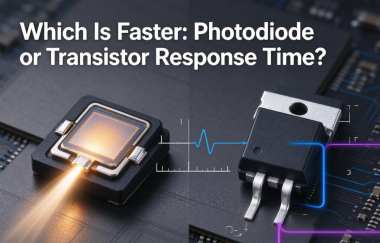
In the electronic components and optoelectronic detection industries, photodiodes and transistors are commonly used in signal detection and circuit control, but they differ in their operating principles and response characteristics. When a circuit needs to detect rapid changes in light signals, the component's response time directly affects detection speed and overall system performance. So, which responds faster: a photodiode or a transistor? In general, a photodiode has a faster optical response than a phototransistor, while a conventional transistor is not directly sensitive to light. However, the actual response speed also depends on the device structure, operating conditions, load circuit, and specific model.
Catalog
I. What Are Photodiodes and Transistors?
II. Which Responds Faster: A Photodiode or a Transistor?
I. What Are Photodiodes and Transistors?
1. Photodiode
A photodiode is a semiconductor device that converts light signals into electrical signals. It typically consists of a PN junction or PIN structure. When light strikes its photosensitive area, photons generate electron-hole pairs. These photogenerated charge carriers are then separated by the internal electric field, producing a photocurrent.
Photodiodes typically operate under reverse bias, although they can also work in photovoltaic mode without an external bias. They offer fast response speeds, good linearity, and favorable frequency response characteristics. Common applications include infrared receivers, optical communications, photoelectric detection, automatic control, and optical measurement systems.
2. Transistor
A transistor is a semiconductor device with three terminals. Common types include bipolar junction transistors (BJTs) and field-effect transistors (FETs). A conventional BJT consists of an emitter, base, and collector. It is primarily used for signal amplification, electronic switching, and current control.
A conventional transistor does not directly detect light. Instead, it requires an electrical signal applied to its base to control the current flowing between the collector and emitter. It is important to distinguish a conventional transistor from a phototransistor, which is a specialized optoelectronic device that directly converts light into an electrical signal and uses transistor amplification to increase the output signal.
II. Which Responds Faster: A Photodiode or a Transistor?
In terms of optical response speed, a photodiode is generally faster than a phototransistor. A conventional transistor, however, cannot be directly compared with a photodiode in terms of optical response because it is not inherently light-sensitive.
A photodiode primarily relies on the generation, separation, and collection of photogenerated charge carriers to convert light into electrical signals. Its relatively low junction capacitance and fast carrier collection process allow it to detect rapidly changing light signals. Some high-speed PIN photodiodes can achieve response times in the nanosecond range or even shorter, making them suitable for high-speed optical communications and precision optoelectronic detection.
A phototransistor, on the other hand, uses the base current generated by incident light to control the collector current. Its internal transistor amplification increases the output signal. Although this structure improves photosensitivity, carrier storage effects and internal device capacitance can introduce additional delays. The turn-off time can become significantly longer, especially when the phototransistor operates in deep saturation. As a result, phototransistors are generally slower than comparable high-speed photodiodes. However, their actual response speeds depend on device design and operating conditions.
It is important to note that not all photodiodes have response times of just a few nanoseconds, nor do all phototransistors operate in the microsecond or millisecond range. Actual performance should be evaluated using the manufacturer's datasheet. Other important factors include rise time, fall time, junction capacitance, load resistance, and test conditions.
III. Conclusion
Overall, photodiodes generally offer faster optical response speeds and are suitable for high-speed optical signal detection, optical communications, and precision measurement applications. Phototransistors provide greater signal amplification and are more suitable for photoelectric switches and detection circuits that prioritize sensitivity over response speed.
When selecting a component, a high-speed PIN photodiode is generally the preferred choice if fast response is the primary requirement. If the application places greater emphasis on optical signal amplification and detection sensitivity, a phototransistor may be more appropriate. The final selection should always be based on the response time, rise time, fall time, and operating conditions specified in the component's datasheet.


