
What Are the Functions and Applications of CBB Capacitors?


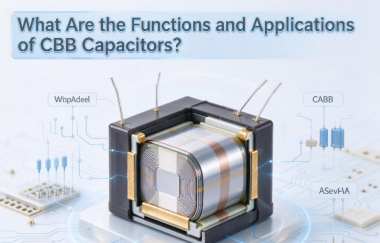
CBB capacitors are widely used film capacitors in electronic circuits. They are known for their non-polarized design, low dielectric loss, high insulation resistance, and good stability. They typically use polypropylene film as the dielectric material and can be classified into metallized polypropylene film capacitors and film-and-foil polypropylene capacitors according to their electrode structures and manufacturing processes. Thanks to their favorable electrical characteristics, CBB capacitors are commonly used in power supply circuits, signal processing, resonant circuits, and industrial control equipment. Understanding their features, functions, and selection criteria helps engineers choose the right capacitor for specific circuit requirements.
Catalog
II. Features of CBB Capacitors
III. Functions and Applications of CBB Capacitors
IV. How to Select CBB Capacitors
I. What Is a CBB Capacitor?
A CBB capacitor generally refers to a polypropylene film capacitor, also known as a polypropylene capacitor. It uses polypropylene film as its dielectric material and forms a capacitive structure through metallized electrodes or metal foil electrodes. It is a non-polarized capacitor.
Metallized polypropylene film capacitors also feature a self-healing capability. When localized dielectric breakdown occurs, the metalized electrode near the breakdown point may vaporize due to the instantaneous high temperature, isolating the damaged area from the electrode and restoring insulation. However, self-healing does not mean that a capacitor can withstand unlimited overvoltage or repeated breakdown events. Continuous overloading can still cause performance degradation or complete failure.
II. Features of CBB Capacitors
CBB capacitors are widely used in electronic devices because of the performance advantages offered by their dielectric materials and structural designs.
1. Non-Polarized Design: CBB capacitors have no positive or negative terminals, so they can be used in both AC and DC circuits. However, their rated voltage and application requirements must always be observed.
2. Low Dielectric Loss: Polypropylene film has a low dielectric loss, making these capacitors suitable for circuits that require low energy loss and reduced heat generation, particularly certain high-frequency and pulse applications.
3. High Insulation Resistance: CBB capacitors offer high insulation resistance and good insulating properties, helping reduce leakage current and improve circuit stability.
4. Good Capacitance Stability: The capacitance of polypropylene film capacitors changes relatively little with temperature, providing good long-term stability.
5. Self-Healing Capability: Metallized CBB capacitors can restore insulation by isolating localized breakdown areas. However, this process may result in a slight reduction in capacitance.
6. Good Pulse Handling Capability: Certain CBB capacitors can withstand relatively high pulse currents, making them suitable for switching power supplies, pulse circuits, and high-frequency applications. Their actual capabilities depend on the specific product design and specifications.
III. Functions and Applications of CBB Capacitors
CBB capacitors mainly perform filtering, coupling, resonance, bypassing, and pulse absorption functions in electronic circuits. Different circuit designs require different capacitance values, voltage ratings, and frequency characteristics.
1. Power Supply Filtering: CBB capacitors can be used in certain power supply circuits to filter high-frequency noise and voltage ripple, improving output quality. In switching power supplies, they are also commonly used for high-frequency filtering and DC bus applications.
2. Signal Coupling: In audio amplifiers and signal processing circuits, CBB capacitors block DC components while allowing AC signals to pass through. This prevents the DC operating points of different circuit stages from interfering with one another.
3. Resonance and Oscillation: CBB capacitors can work with inductors to form LC resonant circuits. They are used in oscillators, frequency-selective circuits, and filters to achieve specific frequency characteristics.
4. Pulse Absorption and Snubbing: In switching circuits and power electronic equipment, CBB capacitors with suitable pulse ratings can absorb transient energy, suppress voltage spikes, and reduce electrical stress during switching operations.
5. Bypassing and Decoupling: CBB capacitors provide a low-impedance path for AC interference signals, helping reduce the impact of power supply noise on sensitive electronic circuits.
In practical applications, CBB capacitors are commonly found in household appliances, power adapters, industrial control equipment, LED driver power supplies, audio equipment, communication devices, and certain automotive electronic systems.
It is important to note that capacitors connected directly to AC mains must meet the appropriate X-class or Y-class safety standards according to their circuit positions. Ordinary CBB capacitors cannot be used as direct replacements for safety-certified capacitors.
IV. How to Select CBB Capacitors
Selecting a CBB capacitor involves more than checking its capacitance and rated voltage. Engineers should also consider the circuit's operating conditions, frequency characteristics, and application environment.
1. Capacitance: Select the capacitance value and tolerance according to the circuit design requirements. Different capacitance values affect filtering performance, coupling characteristics, and resonant frequency, so arbitrary substitutions should be avoided.
2. Rated Voltage: Choose an appropriate voltage rating based on the actual operating voltage, peak voltage, and potential transient overvoltage in the circuit. AC and DC voltage ratings must also be distinguished, as they cannot be directly interchanged based on numerical values alone.
3. Frequency and Dielectric Loss: For high-frequency and pulse applications, pay close attention to the dissipation factor, equivalent series resistance (ESR), and allowable ripple current. These parameters help prevent excessive heating and premature capacitor failure.
4. Operating Temperature Range: Select a capacitor with a suitable operating temperature range based on the equipment's actual working environment. Check its capacitance variation and rated performance at the expected operating temperatures.
5. Pulse Performance: For switching power supplies, inverters, and high-frequency pulse circuits, check the maximum pulse current, peak voltage, and permissible \(dV/dt\) to ensure that the capacitor meets the circuit requirements.
6. Package Size and Reliability: Choose a suitable package according to PCB space, lead spacing, and mounting requirements. Also consider manufacturing quality, certifications, service life, and the technical specifications provided by the manufacturer.
V. Conclusion
CBB capacitors are non-polarized capacitors that use polypropylene film as their dielectric material. They offer low dielectric loss, high insulation resistance, good stability, and a certain degree of self-healing capability. These characteristics make them useful in power supply filtering, signal coupling, LC resonance, pulse absorption, and industrial control applications.
When selecting a CBB capacitor, engineers should consider capacitance, operating voltage, frequency, temperature, and pulse conditions rather than relying solely on the capacitor type. Choosing the right CBB capacitor helps improve the operating stability, reliability, and service life of electronic equipment.


