
What Is a CBB Capacitor?


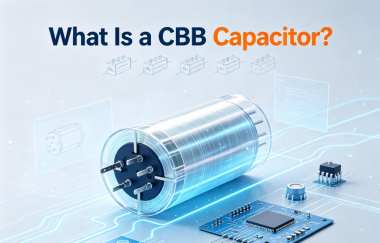
In the field of electronic components, capacitors are essential basic components in circuits and are widely used in energy storage, filtering, coupling, bypassing, and signal processing applications. Among them, CBB capacitors are widely used in power supplies, household appliances, industrial control systems, and various electronic circuits due to their low loss, high stability, and excellent high-frequency performance. So, what is a CBB capacitor? What are its characteristics? How does it differ from the commonly used electrolytic capacitor? This article will provide a detailed introduction to the definition, structure, working principle, performance characteristics, and applications of CBB capacitors.
Catalog
II. Structure and Working Principle of CBB Capacitors
III. Characteristics of CBB Capacitors
IV. Applications of CBB Capacitors
V. Comparison Between CBB Capacitors and Electrolytic Capacitors
I. What Is a CBB Capacitor?
A CBB capacitor is a metalized polypropylene film capacitor (MPF capacitor), which belongs to the category of film capacitors. In the electronics industry, “CBB” is a commonly used term for polypropylene film capacitors.
CBB capacitors mainly use polypropylene film as the dielectric material and form metal electrodes on the surface of the film through a metallization process. Since polypropylene materials feature excellent insulation properties, low dielectric loss, and high voltage resistance, CBB capacitors can maintain reliable electrical performance in circuits requiring high frequency and high stability.
Unlike electrolytic capacitors, CBB capacitors are non-polarized capacitors, meaning they do not have positive or negative terminals. They can be used in AC circuits without concerns about polarity connection and also provide longer service life and higher reliability.
II. Structure and Working Principle of CBB Capacitors
The internal structure of a CBB capacitor mainly consists of polypropylene film, metalized electrodes, lead terminals, and an outer protective package. Among these components, the polypropylene film acts as the insulating dielectric, separating the two electrodes and forming an electric field, while the metalized electrodes are responsible for storing charges and conducting current.
During manufacturing, an extremely thin layer of metal material is usually deposited onto the surface of polypropylene film to create a metalized film. Multiple layers of these films are then stacked or wound into a cylindrical structure, followed by encapsulation to form a complete CBB capacitor.
The working principle of a CBB capacitor is similar to that of a conventional capacitor. When the capacitor is connected to a power source, a potential difference is generated between the two electrodes, causing positive and negative charges to accumulate on each electrode. An electric field is then formed within the polypropylene dielectric, allowing the capacitor to store electrical energy. When needed, the stored energy can be released to provide current for the circuit.
In addition, CBB capacitors feature a self-healing function. When partial breakdown occurs in the film dielectric, the metal layer around the damaged area evaporates due to the instant high temperature, isolating the fault area from the electrodes and restoring insulation performance. This improves the long-term reliability of the capacitor.
III. Characteristics of CBB Capacitors
CBB capacitors are widely used in electronic devices mainly because of the following characteristics:
Excellent low-loss performance.
Polypropylene film has extremely low dielectric loss, meaning CBB capacitors generate less energy loss during operation. This makes them suitable for high-frequency circuits and power systems that require high efficiency.
Strong voltage resistance.
CBB capacitors usually support high rated voltage levels and can meet the requirements of different electronic devices. Common voltage ratings range from dozens of volts to thousands of volts, making them suitable for various power supply and industrial control applications.
High stability.
The capacitance of CBB capacitors is less affected by temperature and time changes. They provide excellent temperature stability and long-term reliability, ensuring stable circuit operation over extended periods.
Self-healing capability.
When minor breakdowns occur inside the capacitor, the metallized layer can automatically repair the damaged area, reducing the risk of failure and extending the service life of the capacitor.
Non-polarized design.
CBB capacitors have no positive or negative polarity restrictions and can be directly used in AC circuits. Their flexible installation method also reduces the risk of damage caused by incorrect polarity connections.
IV. Applications of CBB Capacitors
Due to their excellent electrical characteristics, CBB capacitors are widely used in various electronic fields.
In switching power supplies, CBB capacitors are commonly used for input filtering, output filtering, and voltage fluctuation suppression, helping improve power conversion efficiency and stability.
In household appliances, such as air conditioners, electric fans, washing machines, and lighting equipment, CBB capacitors can be used for motor starting, power factor correction, and circuit filtering.
In industrial control equipment, CBB capacitors are used in devices such as inverters, motor drives, and power control systems due to their high reliability and strong voltage resistance.
In addition, CBB capacitors are commonly used in high-frequency pulse circuits, audio equipment, signal coupling circuits, and timing control circuits to meet the requirements of electronic systems for low loss and stable performance.
V. Comparison Between CBB Capacitors and Electrolytic Capacitors
Both CBB capacitors and electrolytic capacitors are commonly used capacitor types in electronic devices, but they have significant differences in structure and performance.
First, in terms of polarity, CBB capacitors are non-polarized capacitors, while electrolytic capacitors usually have positive and negative terminals. They must be connected with the correct polarity; otherwise, incorrect connection may cause damage or circuit failure.
Second, in terms of capacitance, electrolytic capacitors generally provide larger capacitance values and are suitable for applications requiring large-capacity filtering and energy storage. In contrast, CBB capacitors usually have smaller capacitance values but are more suitable for high-frequency and high-stability applications.
Regarding service life, CBB capacitors use solid-state film dielectric materials and do not contain electrolytes, resulting in slower aging and typically longer operating life. Electrolytic capacitors, however, contain electrolyte materials that may dry out over time or under high temperatures, causing performance degradation.
Nevertheless, electrolytic capacitors have advantages such as lower cost and larger capacitance, so they remain important in power filtering applications that require high-capacity energy storage. In practical applications, the appropriate capacitor type should be selected based on specific circuit requirements.
VI. Conclusion
A CBB capacitor is a high-performance film capacitor that uses metalized polypropylene film as its core material. It features low loss, high voltage resistance, high stability, strong self-healing capability, and a non-polarized design. Due to its excellent reliability and frequency characteristics, CBB capacitors are widely used in switching power supplies, household appliances, industrial equipment, high-frequency circuits, and many other applications.
Compared with electrolytic capacitors, CBB capacitors have a smaller capacitance range but offer significant advantages in service life, stability, and high-frequency performance. As electronic devices continue to develop toward higher efficiency and reliability, CBB capacitors will continue to play an important role in modern electronic circuit design.


