
What Is the Difference Between Oil-Immersed and Dry-Type Transformers?


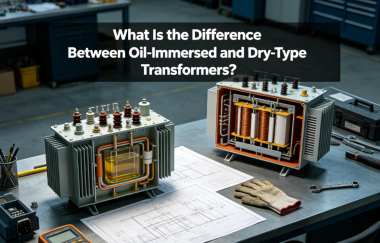
Oil-immersed transformers and dry-type transformers are both common power transformers used in electrical power systems. They are mainly used to change AC voltage levels to enable the safe transmission and distribution of electrical energy. Although they operate based on the same basic electromagnetic principle, they differ significantly in insulation media, cooling methods, structural design, operating environments, and application scenarios. Understanding the characteristics of oil-immersed and dry-type transformers can help users select the appropriate transformer based on voltage level, capacity, installation environment, and safety requirements.
Catalog
I. What Are Oil-Immersed and Dry-Type Transformers?
IV. How Should You Choose Between Oil-Immersed and Dry-Type Transformers?
I. What Are Oil-Immersed and Dry-Type Transformers?
Transformers primarily use the principle of electromagnetic induction to convert voltage through magnetic coupling between the primary and secondary windings. The main difference between oil-immersed and dry-type transformers is not their basic operating principle, but the insulation and cooling methods they use.
Oil-immersed transformers use insulating oil as the primary insulation and heat-transfer medium, with the windings, core, and other heat-generating components immersed in transformer oil. During operation, the heat generated inside the transformer is transferred through the insulating oil to the radiators and then dissipated through natural or forced cooling.
Dry-type transformers do not use liquid insulation media. They generally use air as the cooling medium and solid insulating materials to insulate the windings. Depending on the specific design, dry-type transformers can use natural air cooling or forced-air cooling.
II. Oil-Immersed Transformers
Oil-immersed transformers mainly consist of a core, windings, oil tank, insulating oil, cooling equipment, and corresponding protection and monitoring components. The insulating oil not only improves insulation between the windings and between the windings and core, but also removes heat generated during operation. It therefore serves both insulation and cooling functions.
Oil-immersed transformers offer good heat dissipation and are particularly suitable for large-capacity, high-voltage, and continuously operating power systems. Because insulating oil has high heat capacity and good heat-transfer properties, the transformer can effectively transfer heat generated by the windings and core to the cooling system through oil circulation.
In addition, oil-immersed transformers generally offer high power density and benefit from mature manufacturing technologies. They are widely used in power plants, substations, industrial power distribution systems, and large-scale power facilities. However, because the equipment contains insulating oil, its design must take into account fire protection, oil leakage prevention, and oil maintenance. Oil-immersed transformers also typically require an oil tank and radiators, resulting in certain requirements for the installation environment and maintenance conditions.
III. Dry-Type Transformers
Dry-type transformers use solid insulating materials instead of insulating oil. Their common structure includes a core, windings, insulation system, and cooling equipment. Some dry-type transformers use cast-resin or other solid insulation structures to improve the insulation, moisture resistance, and mechanical performance of the windings.
Because they do not contain insulating oil, dry-type transformers eliminate the risk of transformer oil leakage and do not require routine insulating-oil sampling or oil maintenance. They are therefore particularly suitable for indoor installations and locations with strict fire-safety and environmental requirements. Their structures are generally relatively compact, and maintenance is comparatively convenient.
Dry-type transformers primarily rely on natural air circulation or forced-air cooling for heat dissipation. Therefore, under the same capacity and operating conditions, their thermal performance needs to be ensured through appropriate structural design and adequate ventilation. Dry-type transformers are widely used in commercial buildings, residential buildings, hospitals, data centers, rail transit systems, industrial plants, and other locations with high fire-safety and environmental requirements.
It should be noted that dry-type transformers should not simply be considered to have lower insulation performance than oil-immersed transformers. The actual insulation level depends on factors such as the specific insulating materials, structural design, voltage level, and manufacturing processes. Dry-type transformers can also meet demanding insulation and safety requirements. However, for ultra-large-capacity and high-voltage applications, oil-immersed transformer solutions generally offer more mature technical advantages.
IV. How Should You Choose Between Oil-Immersed and Dry-Type Transformers?
Choosing between an oil-immersed transformer and a dry-type transformer requires comprehensive consideration of factors such as transformer capacity, voltage level, installation location, fire-safety requirements, environmental conditions, maintenance requirements, and project costs.
For applications such as large substations, power plants, or industrial power systems where large capacity, heat dissipation, and long-term operating performance are important, oil-immersed transformers generally offer greater advantages. If a transformer needs to be installed inside a building, in a densely occupied area, or in a location with high requirements for fire safety, environmental protection, and ease of maintenance, a dry-type transformer is generally more suitable.
V. Conclusion
Both oil-immersed and dry-type transformers use electromagnetic induction to convert voltage, but they differ significantly in insulation media, cooling methods, and application environments. Oil-immersed transformers use insulating oil for both insulation and heat dissipation, making them suitable for large-capacity, high-voltage, and large-scale power systems. Dry-type transformers use solid insulation and air cooling without insulating oil, making them more suitable for indoor installations and applications with strict fire-safety and environmental requirements.
Therefore, transformer selection should not be based solely on whether a transformer is oil-immersed or dry-type. Instead, the actual load, voltage level, installation environment, and safety requirements should all be considered to determine the most appropriate transformer solution.


